

There is a distinctive sound that a coconut palm makes when the wind passes 150 kilometers per hour. It stops to be a rustle and becomes a mechanical shriek, a high-pitched vibration that tells the atmosphere has ceased behaving properly and started warring against the earth. The Filipino people have been listening for this sound for generations. They know the beat of the Amihan breezes and the thick, humid embrace of the Habagat. They realize that living on the edge of the Pacific means accepting a certain agreement with nature: the water gives fish and cools the islands, and in exchange, it occasionally sends a storm to test the bamboo and the concrete. However, the deal is evolving. The ocean is no longer just a neighbor; it has become a battery, overcharged and leaking energy into the atmosphere with horrifying efficiency.
The topography of the Philippines has long made it a goalie for Southeast Asia. Comprising almost 7,000 islands lying directly in the Western Pacific Typhoon Belt, the nation acts as a barrier for storms rolling westward. In the past, this meant coping with roughly twenty tropical cyclones annually, a controllable, if challenging, cycle of devastation and reconstruction.
However, the timetable of late 2024 interrupted that rhythm. Six successive tropical cyclones pounded the archipelago during the course of about four weeks in October and November. It was a blitz that left meteorologists rushing to update their charts and villagers unable to dry their clothing before the next rainbands came. This wasn’t just bad luck; it was a statistical improbability made conceivable by a specific fuel source.
That fuel is heat.
| Key Context: Climate & Typhoon Activity | |
| Region | Western Pacific Typhoon Belt (Luzon, Bicol, Eastern Visayas) |
| Recent Anomaly | November 2024: Six consecutive tropical cyclones in one month. |
| Primary Driver | Elevated Sea Surface Temperatures (SST) providing higher energy yield. |
| Statistical Shift | 104% increase in super typhoons over the last two decades (PAGASA). |
| Critical Risk | Rapid Intensification (wind speeds increasing >56 km/h in 24 hours). |
| Compound Hazard | Accelerated sea-level rise enhancing storm surges. |
To understand why the storms are getting stronger, you have to look at the ocean. A typhoon is simply a gigantic heat engine. It absorbs warmth from the ocean surface, turns it into kinetic energy—wind—and releases it as rain. In the past, deep ocean water would churn up and chill the surface, functioning as a natural brake on a storm’s ferocity. But as global temperatures rise, the Western Pacific has warmed to new depths. The brakes are failing.
Data from the state meteorological bureau, PAGASA, reveals a 104% increase in super typhoons over the last two decades. It is a startling figure that transcends theoretical climate models and enters the domain of direct physical peril. The warmth is making the storms 25% more likely to reach Category 3 status or above. When Super Typhoon Man-yi blazed to life in late 2024, it fed on waters that were, by some projections, up to 40 times more likely to be that warm due to human-induced climate change. The ocean was waiting for it, ready like dry tinder.
The most horrifying part of this new period isn’t simply the final strength of the storms, but the speed at which they acquire it. Scientists term it “rapid intensification.”
In the past, a storm may take days to trudge from a tropical depression to a typhoon, giving coastal settlements in Bicol or Eastern Visayas time to harvest crops, tie down roofs, and escape. Now, we are seeing wind speeds spike by more than 56 kilometers per hour in a 24-hour span. A storm can go to sleep as a manageable threat and wake up as a monster.
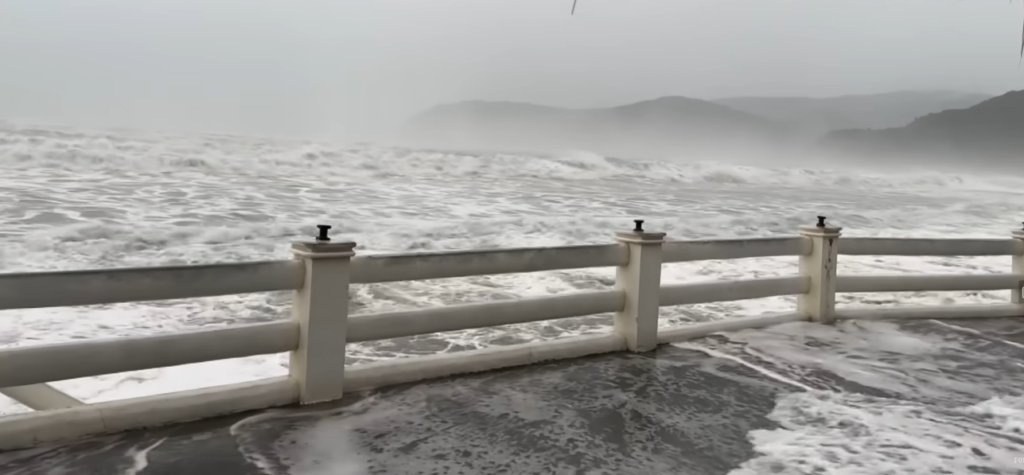
During a respite in the rain, I recall standing on a seawall and gazing at the grey horizon. It was then that I realized how unsettlingly calm the ocean appeared to be, even yet it was covertly feeding a vortex only a few hundred miles away.
The one thing that catastrophe management depends on the most is lead time, which is being stolen by this temporal compression. When a hurricane surges in intensity just before landfall, evacuation orders often arrive too late. The psychology of preparedness falls down. People who thought they could ride off a Category 1 find themselves tied down by a Category 4.
The events of 2024 were a devastating case study in this fatigue. Communities were hit, then hit again, then hit again. The recovery time—the vital breathing room needed to fix a roof or replant a rice paddy—has evaporated. In the provinces of Isabela and Aurora, the earth was so saturated by the first three storms that the rain from the fourth had nowhere to go but up, converting streets into rivers.
This phenomena of “compounding hazards” is the new reality. It is not simply the wind. Storm surges that travel farther inland are caused by the wind and sea levels increasing in the Philippines more quickly than the rest of the world. It is the combination of these storms with the monsoon seasons, causing unpredictable, destructive weather systems that endure.
We often talk about the resilience of the Filipino people. It is a well-worn narrative, almost a cliché, celebrated in news broadcasts showing youngsters laughing on top of damaged houses or neighbors sharing a pot of rice amidst the debris. But there is a silent rage rising behind that resiliency. Resilience is a survival mechanism, not a solution. To expect a population to simply “be resilient” in the face of storms that are mathematically twice as likely to occur and much more powerful is a strategy of abandonment.
The ghosts of Super Typhoon Haiyan (Yolanda) in 2013 and Super Typhoon Rai (Odette) in 2021 still haunt the public imagination. Haiyan was a shock, a storm that changed history. But what we are seeing now is the normalization of the extreme. The “extraordinary” season of 2024, with its conga line of typhoons, is what climate experts have been warning about for thirty years.
The mechanics are evident. As long as fossil fuel emissions continue to trap heat, the oceans will continue to absorb it. The Western Pacific will remain a hot tub. The storms will continue to find high-octane gasoline waiting for them as they approach the Eastern Visayas.
For the fisherman in Samar or the rice farmer in Nueva Ecija, the chemistry of the atmosphere is less relevant than the reality on the ground. The skies will become more unfriendly in the future. The typhoons are no longer merely meteorological events; they are the distinct, violent fingerprints of a warming world crushing down on the island. The wind is louder now, and the water is warmer, and the time to prepare is running out.
