

Heidi became pale beneath the dim light, then flashed to amber, then again to mottled green. It had nothing to do with fear. Nor was it camouflage. She was still. She was sleeping. But everything about her appearance transformed as if her body remembered what her mind was softly remembering.
In recent months, a wave of video evidence and lab research has altered our preconceptions about cephalopods and sleep. It turns out, octopuses don’t just sleep—they appear to attain a state startlingly akin to REM sleep in humans. This discovery occurred from labs in Okinawa and Washington, where researchers analyzed the octopuses’ brain function and came up with something astonishing.
Their sleep wasn’t uniform. It cycled. Quiet stages were typified by stillness, subdued skin, and closed pupils. But then came bursts of activity—short, intense episodes lasting less than a minute—where their skin would ripple with color, eyes quiver under shut lids, and arms briefly pulse. The octopus was clearly asleep during these moments, but its body sent a message.
Researchers believe these experiences might be the marine counterpart of dreaming. Although they don’t stretch into extensive tales as human dreams do, these bursts convey visual and motor clues that suggest a form of biological memory recall. Camouflage routines and predator responses emerge as flickers of skin pattern, perhaps recalling prior experienced moments.
| Key Detail | Description |
|---|---|
| Discovery | Octopuses alternate between quiet and active sleep stages |
| Researched by | Okinawa Institute of Science and Technology; University of Washington |
| Sleep Type | REM-like “active sleep” phase marked by color shifts and muscle twitches |
| Observed Behavior | Skin patterns mimicking awake camouflage while sleeping |
| Duration of Active Sleep | Fleeting—typically 40 seconds to 1 minute |
| Implication | Possible dreaming, memory replay, or behavioral rehearsal |
| Supporting Evidence | Viral videos (e.g., Heidi), neural scans, sleep-response tests |
| Reference | New England Journal of Medicine, Nature, The Conversation |
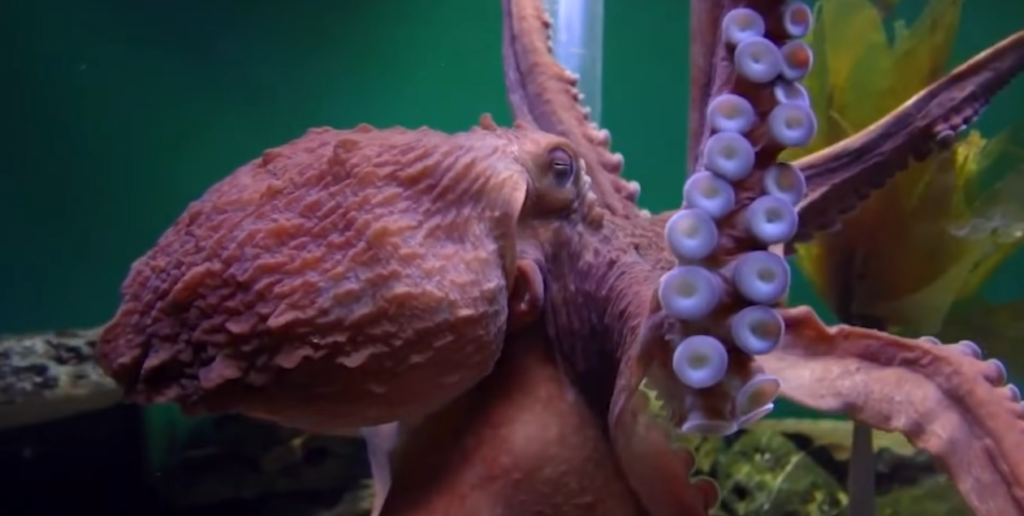
Costello, one of the study’s core examples, exhibited something even more unexpected. During an active sleep period, he abruptly ejected ink and bolted—behaviors highly associated with felt threat. Scientists couldn’t help but wonder: was that a nightmare?
To investigate whether these active periods were actually sleep and not micro-wakefulness, scientists conducted sensory experiments. To see if the octopuses responded, they tapped the tank and projected moving prey. During active sleep, there was no response—proving that the behavior stemmed from within, not from external stimuli.
The research teams used high-resolution neural scans to map octopuses’ brain activity during these phases. The brain fingerprints matched their awake states virtually identically. This is where dreams reside in people; during REM, our bodies remain still, our brains light up, memories replay, and our emotions stir.
These insights don’t mean octopuses are thinking about their childhood or engaging underwater conversations about philosophy. But they can be fantasizing about grabbing a crab or dodging a shadow. A flash of movement. A flood of color. A tactile playback. Like tiny clips on a loop rather than feature-length fantasies.
I found myself strangely affected watching Heidi’s video. Her presentation felt uncomfortably familiar—not in a technical sense, but in an emotional one. I’ve seen my dog’s paws quiver while sleeping. I’ve seen my child smile during naps. Something primordial is stirred by the possibility that an octopus is likewise remembering its day.
Importantly, the sleep cycles were constant. Typically, octopuses changed from silent to active sleep every 30 to 40 minutes. Each active episode was brief—typically approximately 40 seconds—but followed a remarkably predictable rhythm. This suggests more than coincidence. It indicates design.
These results cast doubt on the long-held theory that REM sleep originated exclusively in vertebrates from an evolutionary perspective. Octopuses diverged from our ancestry around half a billion years ago. Their neural systems are more autonomous and dispersed than others. Yet, they evolved something remarkably similar. This is the most beautiful example of convergent evolution.
Why would an octopus require dreams? The prevailing theory at the moment is survival. These species are famously intelligent. They solve riddles, escape aquariums, and mimic other animals. If dreaming is what we’re witnessing, it might be aiding in the refinement of learnt behavior. Practice while relaxing. memory loops for rehearsal. Below the surface, neural recalibration occurs.
In human research, REM sleep has been linked to memory consolidation and problem-solving. It’s especially helpful for creative association and emotional control. If octopuses are doing anything slightly analogous, it further puts them not just as sentient—but as cognitive beings capable of internal existence.
The implications extend far beyond curiosity. Octopuses have long been the invertebrate anomaly—intelligent, inquisitive, and emotional—and sleep research frequently contributes to our knowledge of consciousness. Now, they may also be dreamers.
Scientists are cautious. No one can definitively state that these animals have dreams in the same manner as humans without vocal confirmation or symbolic communication. However, the patterns, behaviors, and neurological markers indicate that whatever is going on within that remarkable brain is not silent.
Perhaps the most powerful argument is emotional, not scientific. To observe a creature recreate a moment in sleep—visibly, vividly—is to accept that something interior is happening. It’s more than instinct. It’s a mind in action.
And if an octopus can dream, even in ephemeral GIF-like bursts, then so much of what we presume about consciousness needs revising. The ocean, generally seen as mute and strange, may be home to more familiar minds than we’ve imagined.
For now, the dream remains just out of reach. But in seeing Heidi flicker through her underwater memories, something becomes incredibly clear—this isn’t just biology. It’s tale, memory, and maybe, in its own enigmatic cadence, a hint of something we thought belonged only to ourselves.
