

Chalkboards in theoretical physics departments, such as those in Cambridge, Princeton, or Berlin, frequently become covered in odd symbols that resemble decorations late at night. Curves that squirm. Greek characters. lengthy integral chains. It may appear to be a mysterious language to outsiders. However, some physicists who have been staring at those boards lately have started to suspect something strange and strangely beautiful: the violent chaos inside black holes might actually follow hidden mathematical patterns.
At first, that concept seems nearly ridiculous. After all, black holes are renowned for consuming all matter, light, and information. Even Einstein’s equations start to exhibit unsettling behaviors due to the extreme distortion of space and time caused by their gravity. However, while examining these objects’ mathematical properties, researchers discovered something intriguing. Beneath the seeming chaos, some equations continued to produce well-known structures from pure mathematics that mathematicians had previously thought had no physical significance at all.
| Category | Information |
|---|---|
| Topic | Hidden mathematical structures possibly governing black hole behavior |
| Theoretical Physicist | Sean Hartnoll |
| Key Mathematical Concept | Modular forms and higher-dimensional geometric structures |
| Observational Tool | LIGO Scientific Collaboration |
| Major Scientific Framework | General Relativity |
| Related Mathematical Geometry | Calabi–Yau manifolds used in string theory |
| Reference Sources | Space.com coverage of hidden black hole mathematics • ScienceDaily report on black hole vibrations |
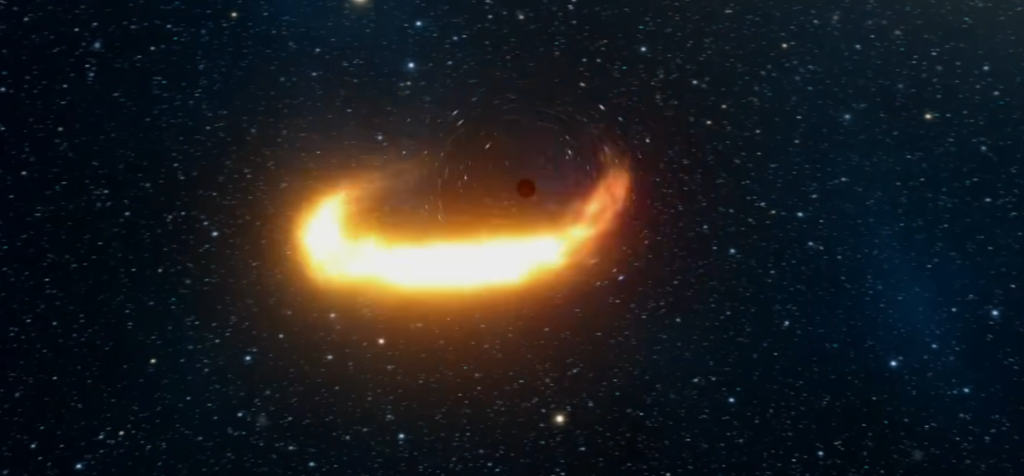
The study of how space-time behaves just inside a black hole is one of the fascinating threads in this research. Sean Hartnoll and other physicists have attempted to simulate what occurs when gravity becomes extremely unstable close to the event horizon. The calculations initially appear chaotic, with space bending, bouncing, and stretching in an unpredictable way. However, averaging those chaotic motions reveals patterns that resemble highly symmetrical mathematical functions called modular forms, which are typically found in abstract textbooks rather than astrophysical models.
It must have been an odd experience to watch the equations settle into those patterns. There’s a feeling that nature might be using mathematics to whisper something, but it’s still unclear exactly what.
For physics, black holes have always been strange objects. They are areas where space and time curve so sharply that standard rules start to break down, according to General Relativity. However, reality is described in a completely different language by quantum mechanics, the other major pillar of contemporary physics. For decades, physicists have struggled to reconcile those two theories. Black holes are thought to be located exactly where those worlds collide.
Often, the only tool that can cross that line is mathematics.
Researchers discovered something equally bizarre in recent studies looking at black hole collisions. Gravitational waves are ripples that are sent through space-time when two black holes swing past each other. These waves eventually reach detectors on Earth, such as those run by the LIGO Scientific Collaboration, after traveling across the cosmos. Though weak, the signals are extremely accurate. They contain minute traces of the physics that created them.
Scientists discovered geometric structures called Calabi-Yau shapes that appeared in the equations while simulating those waves. For many years, string theory—a theoretical framework that postulates that the universe is composed of tiny vibrating strings—was primarily linked to these multi-dimensional geometries. It was almost surreal to see them appear in calculations pertaining to actual astronomical events.
It is plausible that the universe has been utilizing these mathematical structures for a long time, subtly incorporating them into its harshest settings.
The atmosphere surrounding this concept appears to be cautiously excited within research institutes. Because of their training, physicists are often skeptical and wary of anything that appears overly sophisticated. Nature frequently defies human expectations. Nevertheless, the idea that black holes, which are frequently referred to as cosmic destroyers, might covertly adhere to intricately structured mathematical principles is intriguing.
When researchers examine the vibrations of black holes themselves, the concept becomes even more bizarre. When two black holes combine, the resultant object momentarily “rings,” akin to a hammer striking a bell. Researchers refer to the particular gravitational wave frequencies produced by these vibrations as quasinormal modes. Scientists have started mapping these vibrations in astounding detail using advanced mathematical techniques, exposing spiraling mathematical curves and structures that had been missed for decades.
That thought makes it difficult to avoid pausing. In a way, the universe’s darkest objects might be singing.
Much of this is still theoretical, of course. Although the mathematics is lovely, physicists have previously been duped by beauty alone. Observation will be the true test. Over the next ten years, scientists will be able to measure black hole collisions much more precisely as gravitational-wave detectors become more sensitive. These measurements could verify whether the anticipated patterns actually occur in the natural world.
The field is quietly anticipating that possibility.
If the patterns continue, they may provide a unique hint toward a unified theory that explains both quantum mechanics and gravity, something that physicists have been searching for for generations. It’s possible that black holes are more than just astronomical oddities. They might serve as testing grounds for the most fundamental laws of reality.
Disclaimer
Nothing published on Creative Learning Guild — including news articles, legal news, lawsuit summaries, settlement guides, legal analysis, financial commentary, expert opinion, educational content, or any other material — constitutes legal advice, financial advice, investment advice, or professional counsel of any kind. All content on this website is provided strictly for informational, educational, and news reporting purposes only. Consult your legal or financial advisor before taking any step.
