

The pavement in Iztapalapa is radiating heat like a stovetop by midafternoon. Women wait in line next to plastic barrels for a water tanker that might or might not show up on schedule. In the shade of a peeling stucco wall, kids sit on overturned buckets and kick at dust. A slight metallic odor permeates the air. One can’t help but notice how commonplace this scene has become.
The water crisis in Mexico City is getting worse due to the intense heat, and the once-theoretical term “day zero” is now being used in WhatsApp groups and grocery lines. The system that supports nearly 22 million people was never intended for this size, this climate, or this degree of stress. Located 7,300 feet above sea level on a drained lakebed, the city may have always been a silent warning due to its gradual annual sinking and reliance on water pumped uphill from far-off reservoirs.
| Category | Details |
|---|---|
| City | Mexico City |
| Metro Population | ~22 million |
| Main External Supply | Cutzamala Water System |
| National Water Authority | National Water Commission |
| Aquifer Dependency | ~60% of supply from groundwater |
| Current Drought Status | Nearly 90% of city in severe drought (2024–2026 trend) |
| Infrastructure Loss | ~40% of water lost to leaks/theft |
| Official Water Data | https://www.gob.mx/conagua |
| Climate Data Reference | https://www.climate.gov |
Its underground aquifer, which has been over-extracted for decades, provides about 60% of the capital’s water. Roads are cracking, colonial-era buildings are tilting, and the ground is sinking by almost 20 inches annually in some places. Seeing construction workers repair broken pipes has a symbolic quality. They pull up water. The city is submerged. Leaks get bigger.
The extensive network of dams and pumping stations known as the Cutzamala system provides the remaining supply. However, the reservoir levels have been at historically low levels, occasionally falling below 40% of their full capacity. Heat makes evaporation more intense. Storage is dangerously low after three years of poor rainfall and an unreliable El Niño season. Wave-by-wave delivery restrictions have been implemented by officials. It seems like every announcement buys time rather than assurance.
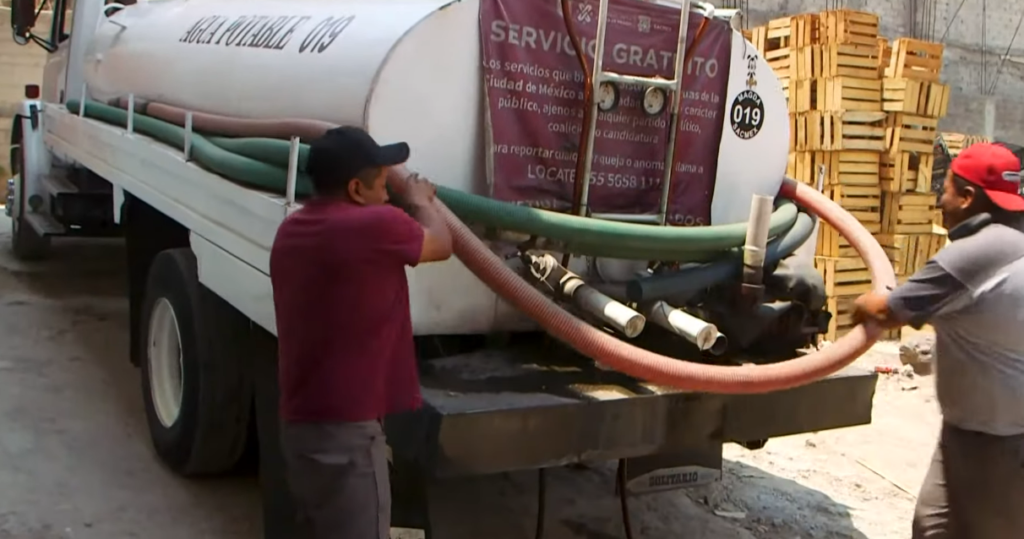
As if rationing fuel during a siege, Alejandro Gómez, a man in Tlalpan, recently described catching bathwater runoff to flush toilets, stretching every liter. With their engines running and their hoses snaking into rooftop tanks, water trucks thunder through tiny streets. Families without storage tanks just bide their time. And occasionally, they do without.
It’s still unclear if Mexico City will formally experience a “day zero,” in which no water is delivered at all from major reservoirs. Authorities have minimized the danger. On the other hand, experts are less optimistic. Some contend that the city already has a number of “day zeros” annually; they are just dispersed unevenly. Due to private wells and storage systems, wealthier neighborhoods are rarely affected by the protracted outages that are typical of working-class neighborhoods.
Another source of annoyance is infrastructure. Through leaks or unauthorized connections, about 40% of the water that enters the system is lost. When you see the mains bursting and spraying into the street after a pipe bursts, that statistic seems almost unreal. During the rainy season, water fills intersections, but months later, it drys out and vanishes. This city is thirsty and floods.
The heat is making things worse. Parts of the area saw temperatures surpass 40°C last summer, which accelerated evaporation and raised household demand. People depend more on cleaning, cooling, and washing as the temperature rises, despite dwindling supplies. According to climate scientists, the quiet hum of global warming is causing droughts in central Mexico to get longer and more severe.
Statistics cannot adequately describe what one sees when they walk past the exposed banks of Villa Victoria Dam, where cracked earth extends toward receding waterlines. Awkwardly, boats rest on dry mud. Catches are dropping, according to fishermen. Depleted reservoirs have a quietness about them that is almost accusing.
The growth of cities hasn’t helped. Over many years, rivers and wetlands were paved over and replaced with concrete, which stops rainwater from penetrating the ground. In the event of a storm, runoff does not replenish aquifers but instead rushes through drains. Instead of consistent replenishment, the city waits for rainfall during the dry months, which increasingly occurs in spurts.
Repairing leaks, increasing wastewater treatment, and collecting stormwater from rooftops are a few clear-cut solutions, at least on paper. Parts of the city already have rainwater harvesting systems, which could ease the strain on the centralized supply. But in order to scale them, coordination and investment are needed, and these processes frequently take longer than the crisis itself.
Resilience is something that investors and policymakers talk about, but it takes more than catchphrases. It necessitates facing inequality. In well-kept gardens in communities like Polanco, sprinklers continue to run. Residents of Iztapalapa estimate the lifespan of the water they store. It’s not a slight difference. It is structural.
It seems as though Mexico City is preparing for a scenario that other megacities might soon encounter. In 2018, Cape Town came very close to a complete system collapse. Los Angeles and São Paulo have faced comparable challenges. The issue of water scarcity is no longer limited to arid rural areas. It’s an urban setting. It has a political bent.
It’s difficult to avoid wondering if small steps will be sufficient when you see tankers navigating through traffic and delivering water like a band-aid solution to a chronic wound. This year, the rainy season might restock reservoirs. Maybe it won’t. The underlying imbalance—a megacity taking more than its geography can sustainably provide—remains even if it does.
