

The sound above Iceland’s glaciers has changed slightly in recent years. The distant rush of melting water and the crunch of moving ice are no longer the sole sounds. More and more, it is the constant buzz of drones making cautious arcs across white spaces, gathering data that is startlingly immediate and clear.
Drones used in Iceland to monitor glaciers are proving to be especially cutting-edge climate science instruments. Drones work closer to the ice, flying low across crevassed terrain and sending readings that are noticeably faster and more detailed than satellites, which nevertheless offer sweeping coverage.
It becomes clear why closeness is important when one is standing close to Vatnajökull’s edge.
| Category | Details |
|---|---|
| Initiative Focus | Drone-based monitoring of glacier melt and ice dynamics |
| Country | Iceland |
| Key Glacier | Vatnajökull Ice Cap |
| Core Technology | UAV-mounted radar, lidar, optical sensors, and IoT surface packages |
| Data Output | Near real-time ice thickness, velocity, elevation, and melt rate data |
| Annual Ice Loss | Approximately 40 km² of glacier area per year |
| Long-Term Projection | Icelandic glaciers could largely disappear by 2200 |
| Scientific Partners | University of Iceland; international polar research teams |
| Broader Impact | Sea-level rise forecasting; volcanic hazard assessment; climate adaptation planning |
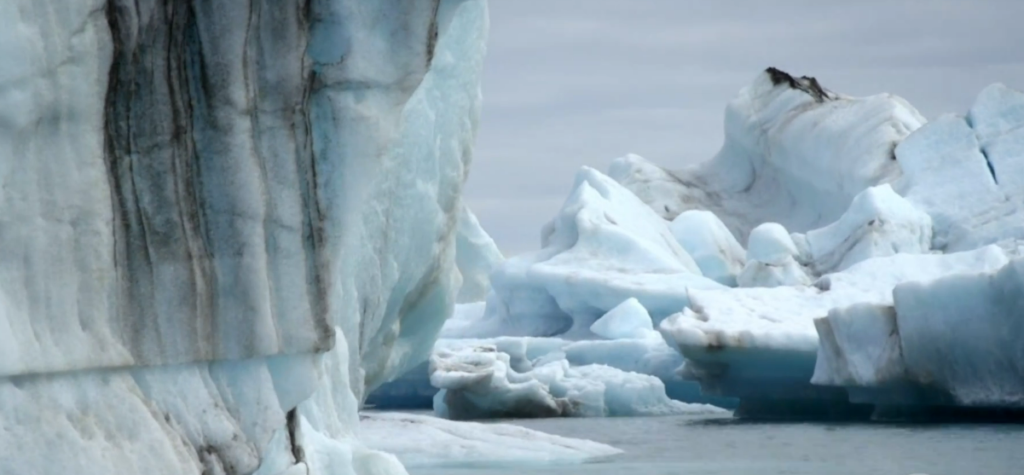
Elevation changes show up as statistical trends from orbit. Subtle ridges, narrowing edges, and cracked shelves become exact coordinates when viewed from a drone hovering 100 meters above the ground. Researchers are converting unprocessed footage into incredibly effective three-dimensional models by combining radar, lidar, and optical sensors, measuring surface movement and ice thickness with startling detail.
The transition to almost real-time observation from periodic snapshots has been incredibly successful.
Every year, Iceland loses over 40 square kilometers of glacial land. Scientists estimate that 11 billion tons of ice have been lost annually on average since the early 20th century. These numbers, which remarkably resemble data coming from other Arctic regions, have progressed from theoretical estimates to dashboards that are updated on a regular basis.
Drone technology has advanced over the last ten years far more quickly than most people anticipated. In order to uncover internal layers and bedrock outlines, lightweight radar equipment that weigh less than a kilogram are currently used to explore beneath the surface. Research teams use sophisticated techniques to turn reflected radio waves into maps that illustrate how water builds up at the glacier’s base, speeding up flow.
It seems like a very adaptable method.
Drones use lidar pulses to detect iceberg freeboard in proglacial lakes like Jökulsárlón, determining surface elevation and, if feasible, thickness. Radar imaging can detect whether meltwater is lubricating the glacier’s bed in colder regions since it can penetrate deeper. For predicting sea-level contributions and determining volcanic pressure beneath thinning ice, these insights are especially helpful.
On one field trip, I observed a technician protecting a battery pack from the wind as a drone rose into an apparently serene sky.
Although the sight seemed fairly normal, the data that was returning to the laptop was anything but. When compared to previous campaigns, the clarity of surface elevation changes that previously took months to validate now appeared in a matter of hours.
Reducing uncertainty in ice-loss estimates has emerged as a major concern for climate experts in light of global warming. In this sense, drones are incredibly dependable; they can communicate results every day and fly repeated survey grids with centimeter-level accuracy. With that frequency, scientists can confidently monitor rapid calving, abrupt draining episodes, and seasonal acceleration.
The benefits are incalculable.
Iceland’s volcanic systems are under less pressure when glaciers recede, which boosts the possibility of eruptions. Thus, subglacial melt monitoring is especially novel in hazard assessment, bridging the gap between geophysics and glaciology. Drones make research much safer and more accurate by simplifying processes and releasing human talent from risky field crossings.
Seeing technology change to meet needs has a subtly seductive quality.
Ice-penetrating radar studies were formerly carried out by crewed aircraft, but those trips were expensive and logistically challenging. Even though they are essential, satellites don’t always have the temporal resolution needed to record quick events. Comparatively speaking, a fleet of drones positioned close to research centers is surprisingly inexpensive and can be deployed just a few hours after an unexpected ice-shelf crack.
The largest obstacle to improving early-stage climate modeling is still obtaining regular data. Drones aid in bridging that divide.
Surface mapping coverage has grown dramatically since Iceland’s extended monitoring programs began, and data pipelines have greatly improved in terms of speed and integration. In order to validate both datasets and increase projection confidence, researchers are currently comparing models generated by drones with satellite altimetry.
It is an especially inventive collaborative architecture.
Icelandic scientists are working with foreign partners to coordinate drone surveys with international ice-monitoring programs. The strategy is consistent with the ten-year growth in the use of renewable energy, when distributed solutions outperformed centralized infrastructure in terms of adaptability.
It is anticipated that drone-based radar systems would become even more effective in the upcoming years, increasing flight ranges and enhancing bandwidth resolution. To make sure that systems continue to be incredibly robust in the face of extreme cold and strong winds, engineers are improving shielding electronics and antenna designs.
Although the equipment might seem small, its effects are significant.
Once thought to be stable, glaciers are receding across the Arctic at remarkably similar rates. Iceland’s advantage is its closeness and quickness. Policymakers can better grasp how ice loss affects sea-level rise and infrastructure development by incorporating real-time data streams into predictive models.
I briefly paused during one review session to marvel at how rapidly the glacier’s story was developing digitally as layers of colored elevation data flashed across the screen.
The promise of these machines was encapsulated in that instant. Not a show. Not hyperbole. Just a precise measurement that is given promptly.
Iceland is proving that responsive research may be shockingly inexpensive and incredibly dependable by incorporating drone monitoring into long-term climate management. Once a puzzle that seemed painfully unfinished, each flight adds a new piece.
