

The quiet following high tide is the first thing one notices in coastal Bangladesh. On what were once rice fields, a layer of white salt is left behind as the water recedes. That thin layer of white feels like a verdict in villages all over Khulna and Satkhira. Even though there may never be a formal declaration that these areas are uninhabitable, the evidence is already there, burning the roots of anything that tries to grow and fracturing the soil.
By 2050, scientists predict that up to 17% of Bangladesh’s coastal territory may be under water. That number is frequently mentioned at climate summits and policy forums, but statistics seem abstract when you’re standing next to a brackish pond. Women search for what they refer to as “sweet water” for hours on end while carrying aluminum pitchers. Particularly after cyclones push seawater deep inland, seeping into wells and remaining long after the winds subside, the ponds nearest to their homes have turned salty.
The 2009 Cyclone Aila is still cited as a point of division. Something changed, homes were flooded by saltwater, and embankments gave way. The land never fully recovered. Farmers who used to grow rice twice a year started experimenting with growing shrimp by purposefully soaking their plots in saltwater. A few adjusted. Others saw the choices made by their neighbors contaminate their own land. These villages are currently experiencing a persistent, albeit quiet, tension.
Rivers that transport Himalayan sediment into the Bay of Bengal have always shaped Bangladesh’s coastal region. There’s land. Land vanishes. However, the rhythm seems to have accelerated. The balance is being tipped by rising seas, land subsidence, and upstream river management that reduces sediment flow. The ability of engineering solutions to keep up is still unknown.
| Category | Details |
|---|---|
| Country | Bangladesh |
| Vulnerable Region | Khulna District; Satkhira District |
| Key Ecosystem | Sundarbans |
| Estimated Land Loss by 2050 | 12–17% of coastal land potentially submerged |
| People at Risk of Displacement | 15–20 million |
| Major Cyclone Turning Point | Cyclone Aila (2009) |
| Urban Migration Hub | Dhaka |
| Reference Sources | BBC Future – The country disappearing under rising tides |
| International Organization for Migration – Climate Change and Displacement in Bangladesh |
Tree roots are visible in some areas of the Sundarbans, the largest mangrove forest in the world, resembling arthritic fingers gripping mud. For many years, the forest has acted as a natural barrier to prevent storm surges, reducing the force of cyclones before they reach villages inland. However, estimates indicate that by the middle of the century, up to three-quarters of it may be under water. It’s difficult to ignore the fragility when you see fishing boats idling close to the edges of thinning mangroves.
No longer is migration a seasonal phenomenon. It’s structural. Men travel for months or even years in search of factory or construction jobs in Dhaka or abroad. Remittances have become simpler thanks to mobile banking, which has improved family survival while covertly depleting villages of working-age adults. When floodwaters rise, the schools attended by the children who are left behind sometimes literally float.
Newcomers sort plastic waste in slums like Korail in Dhaka, stacking recyclables in sacks that smell like river rot. Rice was once farmed by many. They now make barely enough money to get by by picking through the trash of the city. The texture of urban growth—crowded alleys, corrugated roofs rattling in monsoon winds—raises uneasy concerns, despite the fact that investors and policymakers portray it as progress.
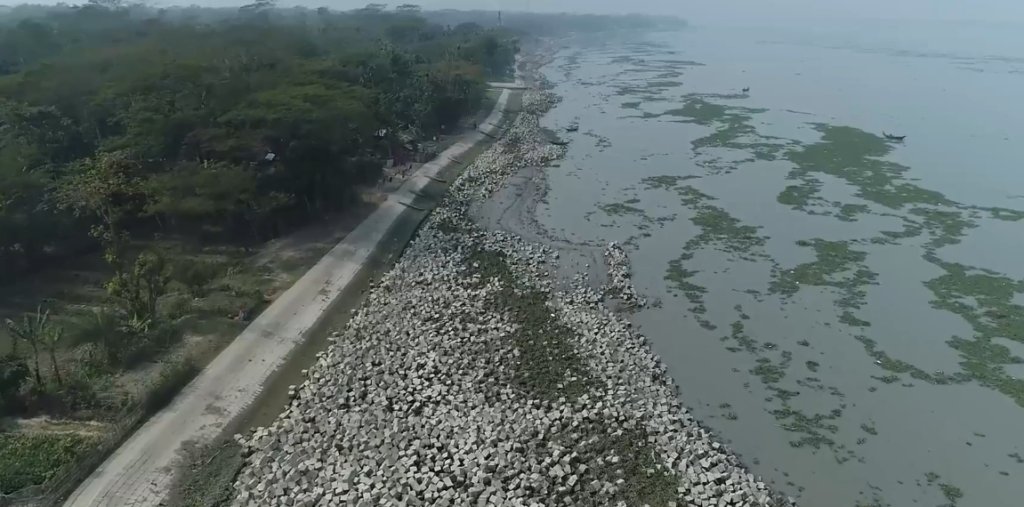
Bangladesh is actively involved in this narrative. In an effort to slow down the tides, the coastline is dotted with embankments and pallders, some of which are based on Dutch systems. Homes are raised on bamboo stilts by communities. Thousands of liters of rainwater are stored in rainwater harvesting tanks that are placed next to homes during the dry months. Adaptation is continuous, spontaneous, and frequently creative.
However, sustainability is questioned. Although yields are still unknown, salt-tolerant rice varieties are being tested. Although aquaculture generates revenue, it can also worsen salinity and disrupt local economies. What will happen to freshwater access if too many people turn to shrimp farming? The solution of today might end up being the limitation of tomorrow.
Migration is frequently framed as failure in policy discussions. However, migration is becoming more and more like a strategy. According to the International Organization for Migration, proactive movement management may lessen vulnerability. Theoretically, that makes sense. In actuality, it entails making sure migrants are not absorbed into unofficial settlements devoid of access to healthcare and education, which increases the likelihood of social unrest in cities already under stress from rapid urbanization.
Storms are getting stronger in the meantime. By the end of the century, catastrophic surges that previously occurred once every ten years might occur much more frequently. Early warning systems in Bangladesh have significantly improved, saving lives. However, stability is not the same as survival. Every cyclone erodes confidence, savings, and the belief that reconstruction is worthwhile.
The saying “climate change has a taste, and it tastes of salt” is frequently used in the southern states. It remains in the soil and on the tongue. It seems as though Bangladesh is turning into the frontline laboratory of sea level rise as we watch this happen, decades before more affluent countries experience the same pressure.
It is not just whether Bangladesh can keep the sea at bay that is at issue. It’s about whether the world is ready for what gradual, unrelenting displacement looks like. The possibility of 15–20 million climate migrants by 2050 is not far off. Already, a demographic shift is taking place covertly in urban slums and fishing villages.
Disclaimer
Nothing published on Creative Learning Guild — including news articles, legal news, lawsuit summaries, settlement guides, legal analysis, financial commentary, expert opinion, educational content, or any other material — constitutes legal advice, financial advice, investment advice, or professional counsel of any kind. All content on this website is provided strictly for informational, educational, and news reporting purposes only. Consult your legal or financial advisor before taking any step.
