

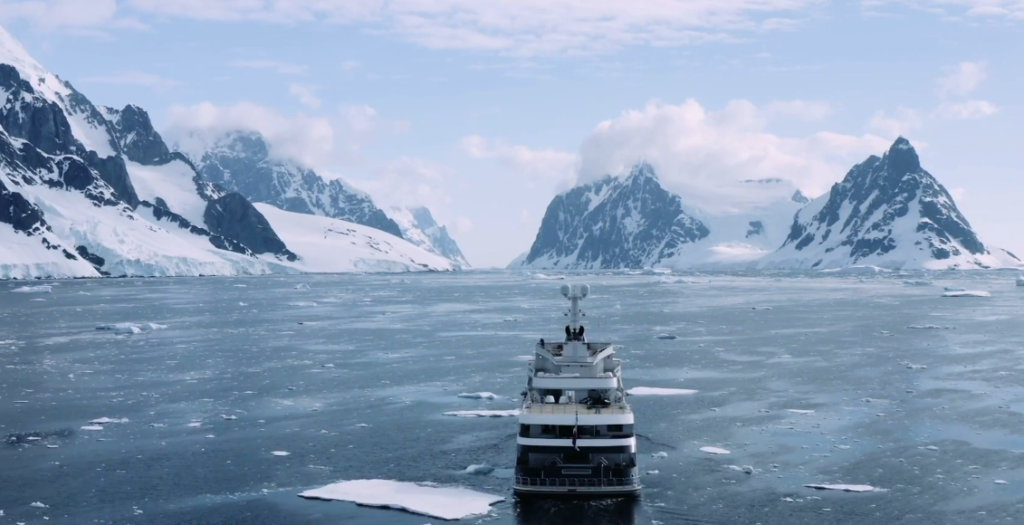
Cargo ships now pass through waters that used to crack loudly under thick ice in late September, when the Arctic sun hangs low but does not completely vanish. The sea appears surprisingly serene—open, dark, and almost hospitable. However, a closer look reveals pieces of ice floating like shattered glass, serving as a reminder to onlookers that this is still a place that isn’t quite sure what it wants to be. The presence of ships is not the only thing that is unexpected. It’s the early hour of their arrival.
Climate models had long predicted that dependable Arctic shipping routes wouldn’t actually open until the middle of the century. However, real-world travel and satellite data are revealing a different picture. These routes are already passable for months at a time, particularly along Russia’s northern coast. The models might have been overly cautious and underestimated the rate at which ice would thin and retreat.
It seems as though reality has surpassed forecasts.
Sea ice is being significantly impacted by the Arctic’s warming, which is occurring three to four times more quickly than the global average. Not only is it melting, but it’s also thinning, weakening, disintegrating earlier in the year, and reorganizing later in the winter. That small change is important to shipping companies. An additional round-trip ticket between Asia and Europe can result from a few more weeks of open water.
| Category | Details |
|---|---|
| Region | Arctic Ocean |
| Key Routes | Northern Sea Route, Northwest Passage |
| Main Driver | Rapid warming (3–4× global average) |
| Distance Savings | Up to 40% shorter (Asia–Europe routes) |
| Ice Trend | Significant thinning and decline since 1979 |
| Shipping Growth | ~40% increase in vessels (2013–2025) |
| Peak Season | Late summer (especially September) |
| Key Players | Russia, China, global shipping firms |
| Major Risks | Ice variability, oil spills, weak infrastructure |
| Reference 1 | Arctic Council Shipping Data |
| Reference 2 | Hakai Magazine Arctic Shipping Study |
Additionally, those journeys are shorter. Much shorter.
A ship passing through the Arctic can deviate from a conventional route via the Suez Canal by up to 9,000 kilometers. It’s difficult to ignore the allure when standing on the deck of a container ship and observing the endless horizon. Fuel prices decrease. Delivery times are getting shorter. Investors seem to think that this is becoming a part of the global logistics system rather than just a specialized route.
However, there are unsettling concerns about how quickly this expansion is happening.
In the Arctic, shipping does more than just follow the ice; it also shapes the future. Increased emissions, more black carbon settling on ice, and more disruptions to already delicate ecosystems are all consequences of having more vessels. This feedback loop, which some researchers refer to as “blue acceleration,” occurs when access causes activity, which in turn speeds up environmental change.
Whether this cycle can be stopped once it starts to pick up steam is still unknown.
Other, less obvious but no less significant forces are also at work. Parts of the Arctic have subtly become industrial corridors due to resource extraction. Liquified natural gas projects in northern Russia have led to an increase in specialized tankers that can break through ice all year round. Mining activities in Canada’s Arctic have drawn bulk carriers into waters that were previously only occasionally visited by exploration ships.
It is difficult to overlook the change when looking at traffic maps from the previous ten years. Since 2013, the number of ships entering Arctic waters has increased by about 40%. Persistent rather than dramatic in a single year. building up.
Despite all of this expansion, the Arctic is still unpredictable.
On these routes, captains discuss abrupt fog, shifting ice floes, and weather that can change in a matter of hours. The sea is open one moment and closing in the next. On a satellite image, what appears to be a dependable corridor might actually be a dangerous narrow window.
The maps seem more assured than the ocean itself.
Thanks to warmer Atlantic currents, the Northeast Passage, which runs along Russia’s coast, is now the busiest route. It opens more steadily and for longer. Another story is the Northwest Passage, which winds through the Canadian Arctic Archipelago. It is more complicated, colder, and still not fully utilized for commercial purposes.
The unevenness is important. It implies that growth isn’t consistent or unavoidable everywhere.
Businesses are still experimenting. routes for testing. Each season, ice-strengthened ships are sent farther north. Although the change isn’t quite complete yet, it also doesn’t feel tentative. It’s more akin to a silent exploration of limits, with each journey pushing a bit farther.
The speed at which this has transitioned from theory to practice is difficult to ignore.
Beneath the surface, there is also a larger context. Chokepoints, such as the Panama Canal, the Suez Canal, and narrow straits that are susceptible to disruption, have always shaped global shipping. The Arctic presents an alternative: a path that gets around a lot of these restrictions, creating a new trading region. That has geopolitical significance on its own.
However, the Arctic behaves differently from conventional shipping lanes. It defies predictability. Variability is still high even as the ice retreats, particularly near the end of the season. While some years have extended periods of peaceful navigation, others end abruptly, taking ships by surprise. Any assumption of steady growth may be complicated by the possibility that this uncertainty will last for decades.
There is an odd mixture of hope and anxiety as we stand on the brink of this change. The routes are opening more quickly than anticipated. The economics are convincing. Technology is catching up. However, there’s something unnerving about it.
Because the rapid warming and thinning ice that make these routes possible are also indicators of deeper instability. As this develops, there’s a subtle realization that the Arctic isn’t just getting closer.
