

Olympic Dream Seto made a silent entrance across the Seto Inland Sea on a chilly December morning, without any fanfare. The ship moved in a tranquil manner, as though automation were always the intention, with no captain at the helm and no shouted orders from the bridge. Commercial autonomy at sea began with that run, which was small in distance but enormous in significance.
By 2027, Japan will have launched the first autonomous cargo ships on commercial routes, marking a literal and statutory first. The nation is systematically altering coastal logistics through its MEGURI2040 plan, which combines exceptionally inventive maritime engineering with pressing demographic concerns.
A very real problem at the core of the change is the lack of crew in Japan’s maritime industry. Long-reliant on elderly labor, coastal freighters are increasingly finding themselves without replacements. For a nation that depends on ferry and cargo traffic to support more than 400 populated islands, this is a strategic weakness rather than just an operational snag.
Japan’s ships are now being trained to react like seasoned sailors—only faster, more reliably, and without fatigue—by utilizing cutting-edge machine learning and navigational data. In addition to staying on course, these ships also analyze maritime traffic, interpret sensor feedback from radar and cameras, and make decisions that lower the chance of accident. Tokyo’s shore-based command centers serve as a human backup when necessary, much as air traffic control towers.
| Element | Description |
|---|---|
| Project Name | MEGURI2040, backed by the Nippon Foundation |
| First Ships Operational | Olympia Dream Seto ferry (Dec 2025); cargo ships by April 2026 |
| Commercial Cargo Routes Launch | Targeted by 2027 |
| Technology Used | AI navigation, computer vision, radar, remote monitoring from shore |
| Objective | Address crew shortages, enhance maritime safety, and reduce human error |
| Future Vision | Fully unmanned coastal and cargo shipping by 2040 |
| International Role | Japan aims to set global standards in autonomous maritime transport |
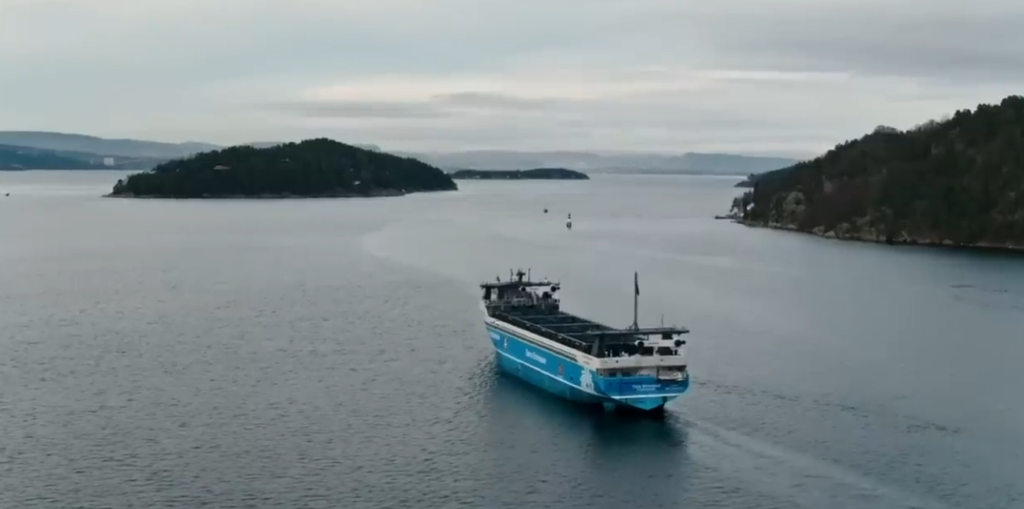
Although the technology seems futuristic, its implementation has been extremely controlled. The first semi-autonomous passenger ferry, the Olympia Dream Seto, has already undergone thousands of kilometers of testing in various scenarios. The fleet is currently being prepared for the arrival of cargo ships like Mikage and Genbu, which will function autonomously on domestic routes that link cities like Kobe, Osaka, and Yokohama. Full-scale commercial deployment is anticipated by 2027.
The risks go well beyond practicality. Japan isn’t just interested in operating a few unmanned ships. It is consciously setting itself up to establish the international standard for autonomous maritime transportation. The data collected from these experimental routes is expected to assist establish international safety standards and regulatory benchmarks, according to officials.
The concept is especially appealing since it combines state-of-the-art engineering with a pressing societal need. In contrast to other countries that seek autonomy for efficiency or originality, Japan is acting out of necessity. Technology must address the limitations caused by the country’s aging population and workforce shortages immediately.
As I watched the Olympia ferry arrive, completely controlled by algorithms and only aided by remote operators when needed, I couldn’t help but feel a sense of silent wonder. It was more than simply the technology; it was the feeling that the ancient and profoundly human craft of sailing had recently acquired a new tongue.
Importantly, speed hasn’t come at the expense of security. Before reaching each milestone, these vessels undergo extensive testing. Onboard software is trained to evaluate, respond, and adjust, and obstacle detection systems are updated on a regular basis. High-trust automation—vessels that operate decisively under duress while always allowing for human override—is the aim, not just automation.
The Japanese government is already collaborating with insurers, data scientists, and shipbuilders to address the difficult issues raised by autonomy. Who has the blame if a ship makes a mistake? Without a human workforce, how should remuneration be handled? The shipping industry is now forced to face these kinds of issues head-on.
But the vision is still apparent. By 2040, Japan wants half of its coastal shipping to be automated. In addition to modernizing the maritime supply chain, this action would enable more energy-efficient, precisely-routed transportation, which would drastically cut emissions if it were effective. This approach tackles worldwide environmental issues in addition to the logistical difficulties faced by a single country.
With container ships like GENBU and RoRo ferries like HOKUREN MARU NO. 2 preparing for real-time deployment, phase 2 of the MEGURI2040 project is already in progress. In a setup that feels a lot like the way drones are controlled in intricate airspace, these ships will operate fixed coastal loops under the supervision of remote controllers who will only intervene when necessary.
Through the integration of AI and ICT frameworks, Japan is effectively transforming maritime routes into smart corridors that are responsive, adaptive, and mapped. Instead of replacing people with a fleet of robots, the final result is a low-risk, highly effective technology that enhances logistics networks and augments dwindling human personnel.
Japan has created models for autonomous maritime hardware and software that other countries may potentially embrace, all the while keeping costs under control through strategic collaborations. The more general inference? The International Maritime Organization may use Japan’s ocean-tested procedures as a model when it starts creating new international standards.
Seeing a nation with centuries of maritime heritage comfortably embrace machine-guided possibilities has a certain romance to it. Autonomy is about evolution, not erasure, whether the young computer engineer in Tokyo or the elderly fisherman in Hokkaido. It’s about maintaining the things that are most important: continuity, safety, and dependability.
Disclaimer
Nothing published on Creative Learning Guild — including news articles, legal news, lawsuit summaries, settlement guides, legal analysis, financial commentary, expert opinion, educational content, or any other material — constitutes legal advice, financial advice, investment advice, or professional counsel of any kind. All content on this website is provided strictly for informational, educational, and news reporting purposes only. Consult your legal or financial advisor before taking any step.
