

Students are choosing sides in addition to classes. While some computer science tracks are growing more slowly, enrollment in cybersecurity degrees is continuously rising at both large universities and community colleges. Why are students becoming drawn to digital defense rather than advancement? It is closely related to how today’s students wish to feel about their work and is both practical and emotional.
Finding relevance is more important to many people than avoiding difficulty. From the outset, cybersecurity provides experiential learning. Students are discovering actual threats, stopping breaches, and solving puzzles that have immediate consequences rather than laboriously going through theoretical proofs or abstract algorithms. That’s inspiring as well as fulfilling.
“In my CS classes, I was writing code that might be used someday,” said a junior at a Texas institution. I’m thwarting potential attacks in my cybersecurity lab tonight. His voice was resolute rather than contemptuous.
The labor market has also changed in recent years. Employers are desperately seeking defenders in addition to developers. To keep their systems operating safely, hospitals, banks, public infrastructure teams, and even small-town school districts are depending more and more on cyber experts. Competitive earnings, which are especially appealing to students juggling loan debt and growing living expenses, are a result of this high demand.
Cybersecurity institutions are accelerating career pipelines by providing degrees combined with certifications like CompTIA Security+ or Certified Ethical Hacker. Before completing their degree, students frequently find employment as analysts. In the current tight economy, the quickened trajectory feels especially advantageous.
| Key Comparison Factors | Cybersecurity | Computer Science |
|---|---|---|
| Job Growth (2025-2030 est.) | 33% (faster than average) | 15–17% |
| Entry-Level Pay | Higher or equivalent | Varies widely |
| Curriculum Focus | Hands-on, threat response, network security | Theory-heavy, programming, algorithms |
| Industry Demand | High across sectors (finance, health, defense) | Broad but increasingly saturated |
| Math & Coding Intensity | Moderate, practical problem-solving | Advanced algorithms and math-heavy |
| Sense of Impact | Immediate, tangible (e.g. threat defense) | Long-term, often indirect |
| Student Mindset Fit | Action-oriented, protector, puzzle-solver | Builder, developer, theoretical thinker |
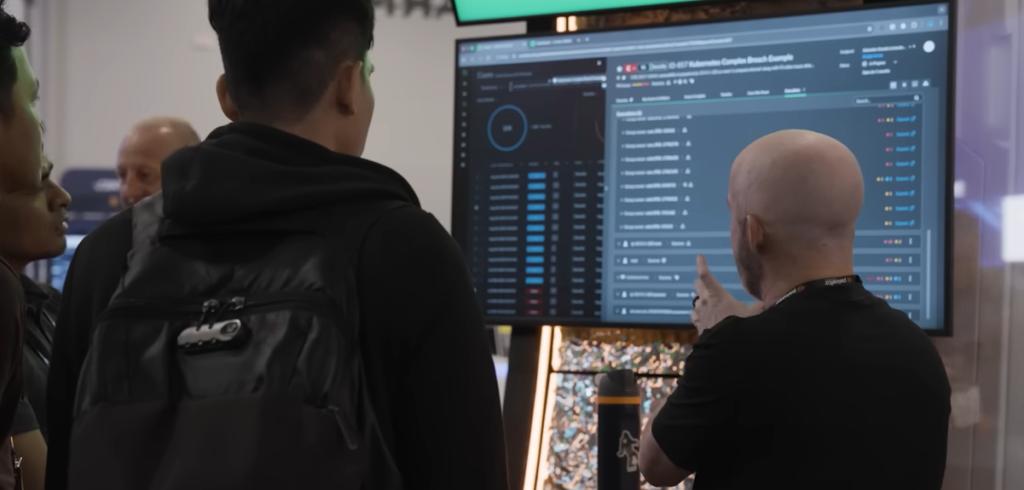
However, despite its tremendous complexity, computer science continues to demand widespread respect and opportunities. Many students feel cut off from the practical applications of their study due to lengthy project deadlines and complex math requirements. Students who study cybersecurity, on the other hand, feel more like defenders than builders.
The significance of such divergence has increased. Careers that are emotionally aligned are valued by this generation. Today’s students expect their education to represent their ideals, whether they are related to data privacy, AI safety, or climate technology. That call is answered by cybersecurity. It puts them in the midst of something dynamic, significant, and rapidly changing.
As a result, some faculty members have modified their expectations. When given a digital lockpick and instructed to break into a simulated network, students who previously struggled in core computer science classes are excelling, according to a professor I spoke with about his cybersecurity curriculum. This change aims to increase involvement rather than lower the bar.
Another factor is that access to this education is surprisingly inexpensive. Many cybersecurity programs are integrated into community colleges or are available online with lower tuition than standard computer science degrees, which can cost six figures. Additionally, they frequently collaborate with government funding or workforce initiatives, supporting both career-switchers and first-generation students.
The field also has an intrinsically exciting quality. Intrusion detection, ethical hacking, zero-day exploits—it feels like a digital frontier, and students discuss it like a real-time chess match. The feedback loop is efficient and fulfilling. You may immediately observe the results of identifying and fixing a vulnerability. That clarity and speed work incredibly well to maintain students’ interest and attentiveness.
Additionally, the cybersecurity ecosystem is quite adaptable. It promotes innovative thinking, across industries, and quickly adjusts to technological advancements. The skills are easily transferable to securing a cloud-based business or safeguarding a water facility. Because of its versatility, the area has become especially appealing to students who wish for their degree to be recognized in more than one specific field.
Nevertheless, the change isn’t about one discipline taking the place of another. Many of the tools used by cybersecurity professionals still have their roots in computer science. However, cybersecurity is starting to seem like a wise choice for students who are attempting to choose a specialty. It is tangible, fulfilling, and—above all—necessary.
There will probably be more hybrid programs that combine the two approaches in the upcoming years. Schools are already offering dual-degree alternatives or starting cybersecurity tracks in their computer science departments. Students benefit from this unique overlap, which combines the breadth of applied defense with the depth of classical computer science.
In the end, this pattern illustrates how education is evolving. Students seek usefulness as much as knowledge. They are drawn to positions that allow them to be employed, flexible, and influential. Notably, cybersecurity provides all three.
