

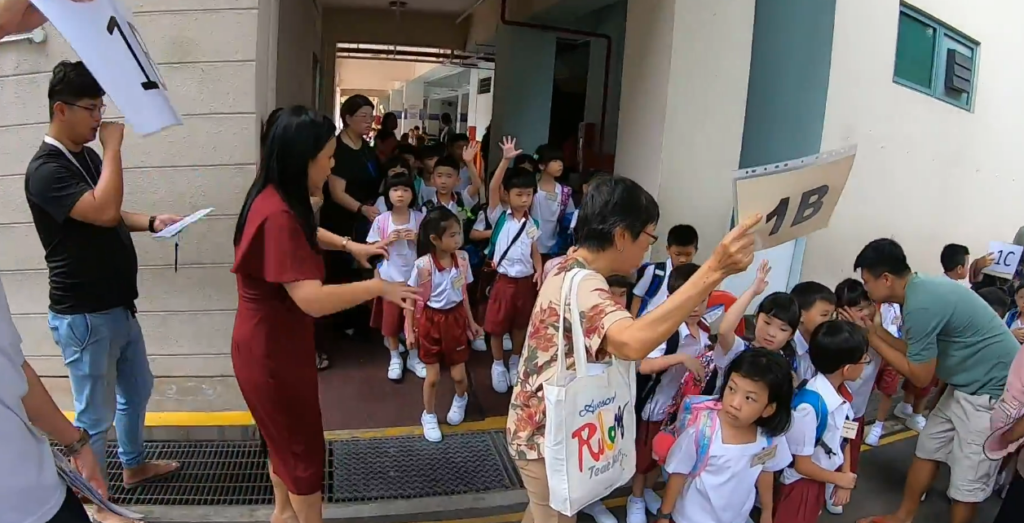
The courtyard is already pulsing with the excitement of little routines by the time the first bell fades, such as tightening shoelaces, lining up water bottles, and politely exchanging greetings. The day at Rosyth Primary School doesn’t start out quickly. It begins with presence.
The school has maintained a consistent position in Singapore’s educational story since 1956. It is more than just a speech or a ballot category; it is a worldview that has been developed gradually over decades of deliberate leadership and is based on principles that go beyond simple banners. They permeate everyday choices and are frequently apparent in the tiniest exchanges.
Rosyth was chosen in 1983 to host the Ministry of Education’s Gifted Education Programme. This change brought responsibility and attention to the school. While other universities leaned into prestige, Rosyth leaned into equilibrium. The gifted track was not a pedestal—it became a laboratory for more inclusive academic research. Every student, whether in GEP or mainstream, was considered as capable of achieving astounding heights.
| Category | Details |
|---|---|
| Location | 21 Serangoon North Avenue 4, Singapore 555855 |
| Founded | 1956 |
| School Type | Co-educational Government Primary School |
| Known For | Gifted Education Programme (since 1983) |
| Signature Strengths | Academic rigour, bilingual excellence, student research & innovation |
| Recent Achievement | Awards in Individual Research Study (IRS) and Innovation Programme (IVP) |
| Motto | “Nurturing Lives Through the Development of Character” |
| Website | www.rosyth.moe.edu.sg |
In recent years, the institution has noticeably extended its focus on student-led inquiry. The Individual Research Study (IRS) has become a relevant forum for expression. One study studied eco-anxiety among youngsters, integrating field interviews, data visualisation, and original narrative. The girl behind it said during a school presentation that she “wanted adults to know how we feel when the news talks about melting glaciers.” Her honesty landed harder than any graph.
By merging initiatives like the IRS and the Innovation Programme (IVP), Rosyth has fostered a particularly innovative culture where curiosity isn’t separate from discipline. Students are trained to approach their questions with both creativity and structure. It’s an exceptionally effective skill set that frequently reflects scientific studies in preparing people for future complexity.
On a mid-year visit to a Primary 5 school, I observed how the students used personal artifacts to investigate the idea of cultural inheritance. A child stood up to describe the significance of a wooden fish passed down from his grandfather, its edges worn from decades of usage. The teacher asked the class how stories affect memory rather than moving on to the next student. They hesitated. Then, almost naturally, the chat became more in-depth.
That moment resonated with me, especially considering it wasn’t a performance for visitors. It was just the way they teach—layered, introspective, and incredibly effective in making sense of the ordinary.
Rosyth’s concept of multilingual excellence is also worth highlighting. Writing folktales, giving oral recitations, and creating graphic interpretations of proverbs are all encouraged activities for students in the Chinese Language department. This method has boosted pupils’ expressive confidence and drastically decreased rote dependency. By providing a variety of routes to language proficiency, the school makes sure that proficiency isn’t solely assessed through grammar exercises.
Importantly, Rosyth has chosen not to allow its academic accolades become the full story. Teachers spend a lot of money on social-emotional learning. One program invited kids to compose a letter to themselves from the future. A Primary 4 kid wrote, “I hope you’re kind and don’t care too much about being top in class.” It wasn’t prompted. It was just the way she felt.
The idea that success is not transactional is reinforced by the school’s deliberate creation of these emotional awareness pockets. Through organized reflection, conflict resolution programmes, and character-based classroom routines, kids develop the language to express disappointment, doubt, pride, and empathy.
I recall seeing a bulletin board where students had listed their recent “failures” in the middle of my reporting. “I didn’t make the Science team, but now I know I want to try again next year,” one of the notes said. Such resilience is not innate; rather, it is developed gradually and frequently through mentoring that promotes shame-free self-honesty.
Another strategic step was Rosyth’s 2025 decision to discontinue accepting parent volunteer applications as a method to prioritize admission. This difficult action was characterized not as a refusal of involvement, but as a commitment to equity. The school strengthened its commitment to justice by eliminating backdoor benefits. The decision was daring and made a strong statement: opportunity should be determined by merit rather than strategy.
The leadership in Rosyth consistently signals that they are looking ahead. All programs undergo evaluations for relevance as well as results. The school didn’t just approve posters when students suggested a recycling campaign. They linked it to systems thinking and charged teams with auditing classroom behaviors. It was especially helpful in demonstrating that behavioral change requires more than simply catchphrases—it requires execution.
As the year progresses, one can see how the school environment actively shapes its community. I observed a Primary 6 student assisting a younger child in finding their misplaced water bottle during an afternoon dismissal. It wasn’t prompted by an instructor. No prize was offered. It was just the way things are done here, discreetly but reliably.
There is often chatter regarding rankings. Indeed, Rosyth does incredibly well on paper. However, culture is more difficult to rank. The internal scripts, habits, and soft skills that influence children’s self-perception in a communal setting. Rosyth seems to realize that test scores are snapshots, while values are tales that emerge over time.
By establishing a climate of trust, introspection, and drive, the school has developed something exceptionally sustainable. It produces thoughtful students in addition to intelligent ones. The difference is slight, yet vitally significant.
I came upon the saying, “You don’t need to be loud to lead,” written in marker across a whiteboard during my last tour of the Innovation Lab. I think that’s the best way to describe Rosyth. Quietly outstanding. Relentlessly thoughtful. And extraordinarily ahead of the curve.
