

In a bright classroom set amid rice paddies and forested hills in South Jeolla Province, pupils sit shoulder to shoulder—silent, eyes wide—as a life-sized projection of King Sejong begins to speak in clear, poetic Korean. His robes shimmer slightly as he turns toward the class. This is not a dramatization, not a field trip, and especially not a YouTube clip. Projected, interactive, and remarkably present, it is history.
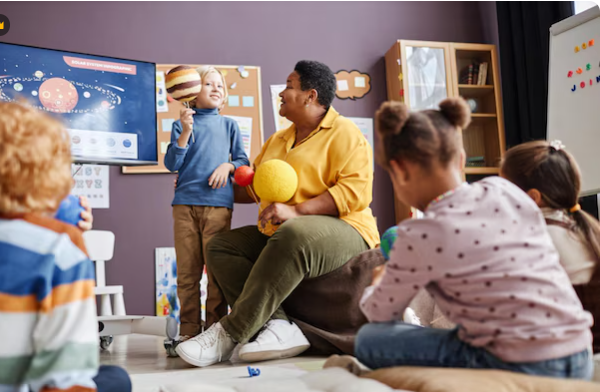
South Korea’s hologram effort, especially impactful in underprivileged rural schools, represents more than just technological glitter. It is a quietly ambitious attempt to level the educational field. Where city kids may benefit from expert instruction and field-based experiences, their rural counterparts increasingly engage with dynamic content that can be both intellectually and emotionally resonant.
Key Educational Use of Holograms in South Korea
| Feature | Details |
|---|---|
| Location | South Korea, with a focus on rural and remote school districts |
| Technology Used | 3D holographic projection with AI-powered voice interaction |
| Subjects Covered | History, Science, Literature, Foreign Languages, 3D Animation |
| Launch Period | Introduced in 2023; spotlighted at the 2024 Korea Glocal Education Fair |
| Key Benefits | Immersive storytelling, equitable access, better engagement, future-focused skills training |
| External Reference |
The technology is amazingly seamless. A flat panel at the front of the room doubles as a stage. Above, holographic projectors stack visual data in real time, generating dimensional characters that walk, talk, and reply. By merging motion design with voice-sensitive AI, these figurines can carry on full interactions. Students ask queries. The AI listens, processes, and offers responses tailored to each query. It is incredibly efficient in grabbing curiosity.
During a session on Korean independence history, one teacher noticed that students who rarely volunteered were suddenly initiating debates. They asked about colonial censorship. They challenged strategic judgments. They discussed motives. The 3D reproduction of the March 1st protest managed to bring them into the action, almost as if they were navigating it themselves.
Incredibly adaptable, the system goes far beyond historical vignettes. Science classes use holographic molecules that rotate and respond to hand motions. Dramatized poetry recitals are a part of literature classes. Students studying animation also gain from this: they may create digital 3D models and display their designs into the classroom, modifying motion, lighting, and proportions in real time. A flying tiger that flew over the desks was animated by one student. Another built a kinetic sculpture that adjusted with each uttered syllable.
By integrating holograms into the conventional curriculum, South Korean educators aren’t seeking to replace traditional teaching—they’re enhancing it. The technology delivers a style of storytelling that is immediate and multi-sensory, making challenging concepts feel grounded. In the backdrop of continually evolving pedagogy, this technique stands out as exceptionally unique.
In a little school just outside Daegu, a literature class studying modernist poetry brought in a holographic replica of poet Yun Dong-ju. Wind animation mimicked the tone of his art as he delivered poetry under a canopy of projected starlight. Students watched in silent reflection. The mood was “strikingly similar” to a live performance, according to the teacher’s later description. It was education—stylized, immersive, and immensely human.
By integrating AI and voice recognition, the system also adapts to individual demands. Students struggling with pronunciation receive real-time coaching. A middle schooler practicing Japanese was reprimanded gently by the hologram, which rephrased a statement in slower tempo and simpler syntax. The guidance was incredibly clear.
At one point, a ninth student stood and asked a holographic Admiral Yi Sun-sin whether he had ever doubted his country’s destiny. The avatar responded with a brief lecture on resilience after pausing, obviously preprogrammed for depth. I found myself unexpectedly moved by how organically the scene unfolded. It felt less like watching tech, more like participating in a well-directed drama with very high stakes.
Skeptics do raise reasonable issues. Overexposure to visual tech may desensitize learners or detract from analytical rigor. Yet initial research has showed that understanding levels have considerably improved, particularly in historical analysis and science comprehension. Even behavioral engagement—long a concern for digital-native students—has considerably boosted in schools employing the technology consistently.
The Korean Ministry of Education has made sure that the rollout includes technical assistance and teacher training through strategic partnerships with edtech companies. Many teachers, first cautious, now report enhanced collaboration in class planning. It seems strangely apt that one teacher likened it to “team teaching with a time traveler.”
Importantly, this program also serves a cultural function. Many of the holograms are built from archive data, museum partnerships, and verifiable oral accounts. For example, the projection of an astronomer from the Goryeo period was created utilizing linguistic modeling, modern interpretations, and ancient documents. These characters don’t just give facts—they transmit heritage. That alone is remarkably successful in establishing a connection between identity and knowledge.
This holographic push is not about glamor. It is a finely calibrated pedagogical shift that connects science and narrative. For early-stage learners, this develops inventiveness. For senior pupils, it gives new viewpoints on abstract philosophy and civic history.
As education increasingly overlaps with immersive technology, South Korea’s approach may be a blueprint—not just for how we educate, but for how we value experience as part of learning. In these classrooms, students are doing more than just taking in information; they are also communicating, trying new things, and most importantly, remembering.
Disclaimer
Nothing published on Creative Learning Guild — including news articles, legal news, lawsuit summaries, settlement guides, legal analysis, financial commentary, expert opinion, educational content, or any other material — constitutes legal advice, financial advice, investment advice, or professional counsel of any kind. All content on this website is provided strictly for informational, educational, and news reporting purposes only. Consult your legal or financial advisor before taking any step.
