

Beneath the modest skyline of Dutch cities like Utrecht and Eindhoven, a subtle change is occurring. Once seen of mostly as centers for theory and study, universities are now being rethought as hubs for innovation that benefits both people and the environment. A new blueprint is being established by the Netherlands, one that links ethics to artificial intelligence, weaves sustainability through education, and leverages teamwork as a key force for change.
Because it begins from the ground up in research labs and lecture halls, the method is especially novel. Students are not only studying energy systems at TU Eindhoven, for example, but they are also involved in their design. Researchers, businesses, and national policymakers are all brought together in a highly effective loop by the Brainport ecosystem that envelops the university. What is developing is a dynamic, collaborative creative environment driven by shared responsibility as opposed to compartmentalized expertise.
Meanwhile, Utrecht University is investigating the possibility of intercontinental education. Through the “Acclimatise” project from CHARM-EU, Dutch students collaborate with their counterparts at 10 African universities to create climate solutions that are influenced by both scientific approaches and local knowledge. It’s a particularly useful framework for training students to approach global issues from multiple perspectives rather than just one.
| Key Area | Details |
|---|---|
| Country | The Netherlands |
| Focus | University-led innovation blueprint |
| Leading Universities | TU Delft, TU Eindhoven, Utrecht University, University College Roosevelt |
| Innovation Pillars | Ethical AI, sustainability, university-industry collaboration |
| Challenges | Talent retention, scale-up ecosystem, funding gaps |
| Investment Highlights | $2.5B in tech (2024), $700M in green tech |
| Government Support | R&D tax incentives, smart city funding, generative AI frameworks |
| Example Projects | CHARM-EU education initiatives, TNO smart city digital twins |
| Forecast (2030) | €250B–€400B contribution in startup market cap |
| External Reference | The Next Web article |
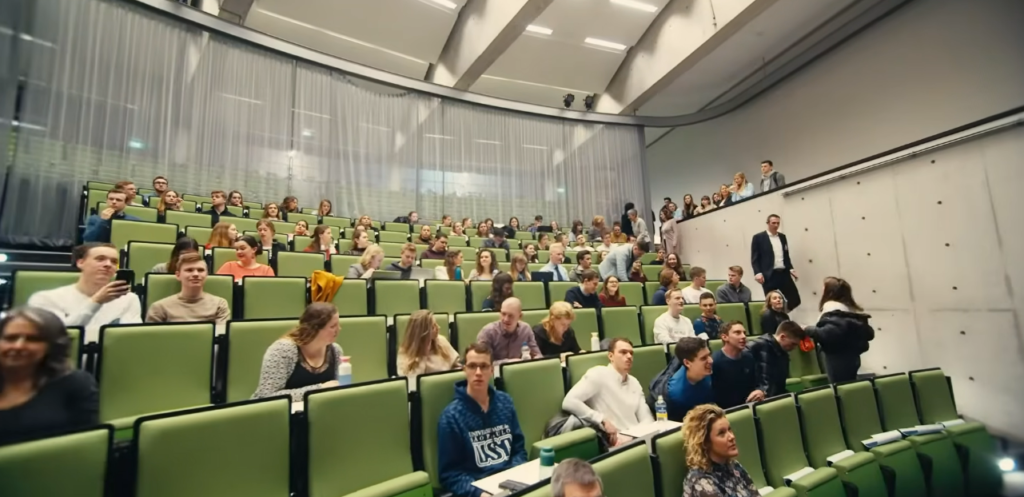
The gap between Indigenous and Western sources of knowledge is being addressed at University College Roosevelt as well. Their educational module actively reconstructs how information is created, shared, and valued rather than merely acknowledging historical academic inadequacies. By engaging in transnational storytelling and land-based learning, students provide a markedly enhanced paradigm for inclusive education.
These are not stand-alone experiments. Unexpectedly, the Dutch government has thrown itself into this moment. It has increased its support for advanced R&D, smart cities, and ethical AI during the past year. With regulatory sandboxes and industry-specific trial zones, generative AI—now a key component of the nation’s digital aspirations—is being incorporated into public policy. Developing public trust in tandem with technology advancement is more important than simply creating smarter tools.
By making investments in smart infrastructure, especially in The Hague and Amsterdam, the Netherlands is also setting up its cities to serve as innovation testbeds. Developing digital twins—virtual representations of entire communities that enable planners to replicate traffic, energy use, and even emergency responses—is one TNO-led initiative. The Netherlands’ smart city approach is incredibly resilient and data-driven because of that kind of strategic vision.
The nation is equally progressive in its dedication to green technology. Businesses like Vind (wind optimization) and Voltfang (energy storage) are getting not only funding but also research and regulatory support, with $700 million invested in green businesses last year alone. To make sure their ideas are scalable and sustainable, these businesses collaborate closely with academic academics and public sector consultants rather than working independently.
I recall seeing a banner for a public AI ethics lecture at TU last autumn while strolling through Delft. Locals, students, and engineers were all squeezed into one town hall for the event, so it wasn’t some specialized academic discussion. More than anything else, I sensed that something genuinely collaborative was happening here at that precise time.
Despite all of the momentum, there are still difficulties. The most urgent issue is probably keeping top-tier IT talent. Even though the Netherlands has tax breaks and a good standard of living, many AI and fintech professionals eventually leave the country for cities like San Francisco or Singapore because of the higher salaries and quicker capital transfers there. Despite its remarkable structure, the Dutch model is still up against the overwhelming attraction of international IT hubs.
Investors like Anders Indset believe that benefits alone won’t be enough to solve this. He makes the case for streamlining the stock listing procedure and providing superior long-term incentives in order to retain the founders’ Dutch roots. Amsterdam-based fintechs like Adyen, which developed gradually before reaching global scale, share this opinion. The next phase of this strategy will be defined by businesses that master local growth and then go global.
The talent problem is related to venture funding as well. Although the country’s early-stage ecosystem is thriving, later-stage growth is still mostly dependent on US funding. In order to overcome this, the Netherlands must expand its patient capital pool and maybe create scale-up-specific sovereign innovation funds.
The trend is obvious despite these developing pains. Dutch-founded businesses may increase their market value by more than €400 billion by 2030. What’s more, they could do it while establishing new international norms for responsible innovation. The Dutch do not pursue magnitude for its own sake. They are attempting something much more ambitious: demonstrating that economic growth, ethics, and education can all be combined into a single, well-thought-out plan.
This blueprint is unique not only in what it creates but also in the way it does it. Through treating students as collaborators rather than merely learners and incorporating civic goals into all aspects of tech development, the Netherlands is providing a way forward that seems both profoundly entrenched and remarkably adaptable. It is a strategy that other nations would benefit from studying, not only as a template to follow but also as a way of thinking to embrace.
