

Before, it was easy. The promise was stability if you choose a major like computer science, business, or nursing. Not immediate wealth, but stability in employment, a good wage, and a foothold. However, it became clear to me while attending a recent college advising session that this formula is quickly falling apart.
Enrollment trends have changed significantly during the last several years. Students at mid-sized public universities and even elite universities are quietly abandoning majors that were once thought to be surefire ways to succeed in the workplace. A degree that was previously thought to be “future-proof” now has an invisible asterisk: it could be disrupted.
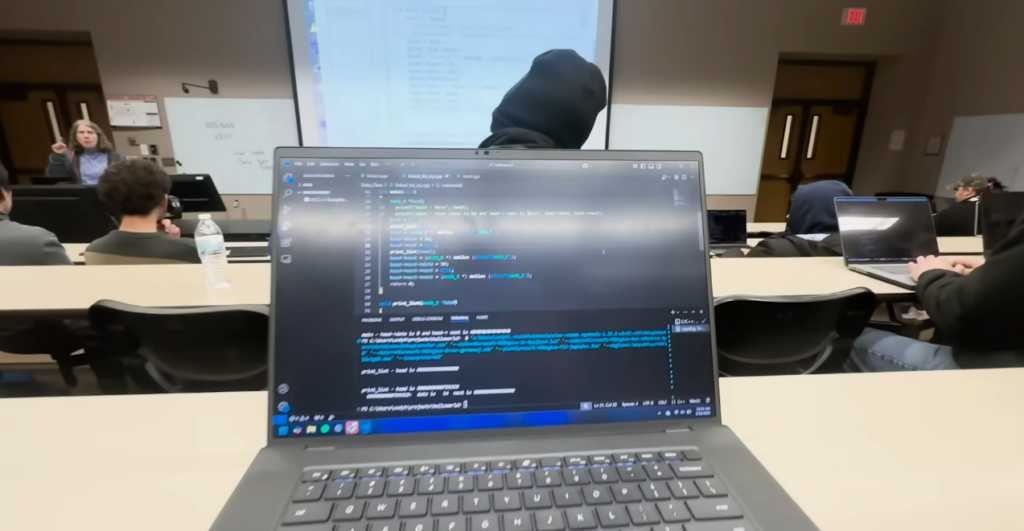
Artificial intelligence is definitely responsible for some of this development. In addition to listening to lectures, students today are also reading headlines. AI has a significant impact on traditional fields when it is able to create reports, analyze data, or even write code. Due to concerns about long-term viability, it is now common for second-year computer science students to drop out. The blended routes of sustainable engineering and cybersecurity with policy are more their style.
Students are thinking very clearly by using publicly accessible data like university registries and career sites. In addition to asking, “What job will this get me?” they are also inquiring, “Will this job still need me?” That particular change indicates the more profound change that is taking place. We are redefining relevance.
| Trend/Insight | Description |
|---|---|
| Decline in Traditional “Future-Proof” Majors | Computer Science, Business, and even Engineering see falling enrollment |
| Rise of Skills-Based Education | Students prefer certifications, bootcamps, and direct-to-career pathways |
| Shift in Career Perceptions | AI disruption reshapes student assumptions about job stability |
| Economic Factors | Rising tuition and student debt prompt ROI-conscious decision-making |
| Institutional Lag | Many universities still cling to outdated curricula and rigid structures |
Consider Jenna, who is a sophomore at a New York state college. Although she began her internship in marketing, she soon discovered that ChatGPT was primarily used for campaign brainstorming. She informed me, “The software was doing most of what I thought I’d be learning.” She moved to environmental compliance, which she thinks will continue to be primarily human-led because it is regulated.
I thought about the conversation a lot. It was not motivated by fear. It was surprisingly practical.
Shorter certifications, virtual apprenticeships, and gig-based upskilling are among the incredibly flexible career paths that are dislodging traditional four-year degrees. These days, platforms like Salesforce Pathways, Google Career Certificates, and Coursera are viewed as accelerants rather than substitutes. Notably, employers are also reacting. More job postings now state “certification accepted” or “equivalent experience.”
Calculus has changed for students who are burdened with tuition. Why spend tens of thousands of dollars and four years on a degree that may be outdated by the time you graduate? Value is being redefined as a result of economic pressure. These days, a degree must be able to show a connection to both adaptability and the demands of the market.
Conversely, universities are not all adjusting at the same rate. Many universities stick to strict forms, even if some are integrating real-world capstones or combining liberal arts with data literacy. That inflexibility is turning into a drawback.
A few colleges are creating models that are worth observing through strategic alliances with business. ASU’s employer connections, Purdue’s competency-based credentials, and Georgia Tech’s affordable online master’s program in computer science are noteworthy. These programs support students’ aspirations for their lives, education, and careers in addition to providing content.
There are, however, 10 instances of academic inertia for every audacious invention. Departments run the risk of becoming academic fossils if they don’t change their curricula or reconsider learning objectives. Flexibility is essential in a world that is changing quickly; it is not an option.
This shift’s leading students are not disengaged. Quite the opposite—they are quite strategic. They are researching related skills, assembling multidisciplinary toolkits, and monitoring labor trends. AI ethics may be taken by a public health major. Data visualization could be taught to a student of journalism. These are pivots toward a more robust career base, not diversion.
Learning choices that are surprisingly economical are propelling this trend. Instead of enrolling in another elective, it is difficult to resist the allure of spending $49 a month for specialized training. Particularly if the option doesn’t directly translate into a useful skill.
Additionally, a growing number of students are drawn to human-centered jobs that resist automation, such as those in applied psychology, crisis management, ethics, or field research. These domains—judgment, empathy, and context—offer things that technology finds difficult to imitate.
The subject of “what matters” has been resonating on campuses ever since the pandemic began. Pupils are not giving up on their studies. They’re making changes to it. Furthermore, the future they envision is closely reflected in their revisions.
Both recruiters and rankings no longer use the term “future-proof.” Students themselves are rewriting it, decision by decision, degree by degree.
Disclaimer
Nothing published on Creative Learning Guild — including news articles, legal news, lawsuit summaries, settlement guides, legal analysis, financial commentary, expert opinion, educational content, or any other material — constitutes legal advice, financial advice, investment advice, or professional counsel of any kind. All content on this website is provided strictly for informational, educational, and news reporting purposes only. Consult your legal or financial advisor before taking any step.
