

The room used by the Radical Constructivists after the last bell on a Tuesday afternoon at Bret Harte Middle School in East Oakland appears to be a constructive disaster. Scraps of balsa wood are on one table, a partially built device with elastic bands and a little motor is on another, and two students are carefully debating the geometry of something they are measuring with a ruler in the far corner. Neither of them appears to be entirely persuaded. Nearby, an adult volunteer is observing. not getting involved.
merely observing. The initial measurement is deemed incorrect by the student who came up with it. The student who constructed the frame advises them to give it a shot. They give it a shot. It falls apart. The pupil who stated that it was incorrect appears to be quietly content. They begin anew. Since The Radical Constructivists is an after-school program administered entirely by volunteers, it relies on the unique energy of adults who participate voluntarily rather than for financial compensation.
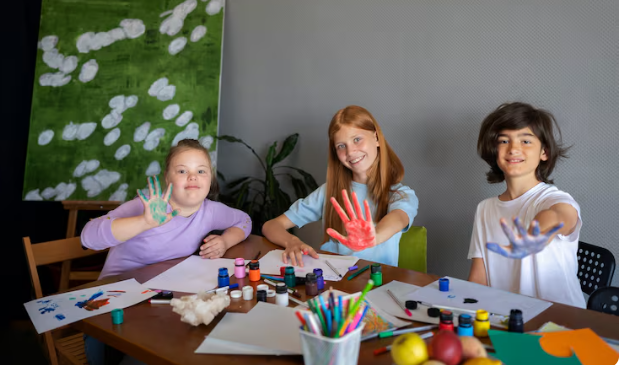
The program’s organizational concept, which is based at Bret Harte Middle School, is straightforward enough to sum up in one sentence but far more difficult to implement: children learn by creating things, breaking them, comprehending why they broke, and then constructing them better again. Tests don’t exist. Grades don’t exist. Every student that participates must first construct a rocket that can soar higher than the school building. After that, the pupils choose what they want to create.
The rocket launch is more significant than it first appears. It’s a threshold experience that accomplishes multiple goals at once: it makes students think about physics without referring to it as physics class; it gives them an early success that builds self-confidence in their ability to make things; and it results in a visible, dramatic outcome—the rocket either clears the roofline or it doesn’t—that is measurable in a way that leaves no room for doubt.
Depending on the student, the openness of what comes next after that initial struggle can either feel freeing or confusing. Some people know what they want to build right away. Some take longer, moving around the room, picking up and putting down objects, and observing what other children are working on. Recognizing that process as a kind of reconnaissance rather than idleness, the mentors have learnt to be patient with it.
The build-break-rebuild cycle is the program’s central pedagogical tenet, not an accident or a result of scarce resources. Pupils are urged to push the boundaries of their inventions. Determine where the structure fails, comprehend the mechanics of the failure, and redesign using that information—not carelessly, but purposefully. This method is completely at odds with how most educational environments handle errors, when failure is something to reduce and conceal rather than look into.
A project that fails the first test is regarded as progress in the Radical Constructivists classroom. There is data in the accident. The following version is improved by the data. This may seem obvious, but it necessitates a room culture that takes time to develop and cannot endure without constant adult modeling.
Similar initiatives can be found throughout Oakland and the larger East Bay. For example, the Junior Center of Art and Science offers after-school programs that integrate science, art, and visual storytelling, and groups like the Awesome Foundation support community-based creative initiatives. Compared to other cities of its size, Oakland appears to have amassed a richer collection of unconventional kids programs through a combination of circumstance and intentional community effort.
It is still really uncertain if such focus results in quantifiable long-term benefits for the children who go through them. What’s obvious in that room on a Tuesday afternoon appears more difficult to dispute: children debating mathematics with a sincere interest in who is correct since the solution affects whether the structure they constructed is sturdy.
Disclaimer
Nothing published on Creative Learning Guild — including news articles, legal news, lawsuit summaries, settlement guides, legal analysis, financial commentary, expert opinion, educational content, or any other material — constitutes legal advice, financial advice, investment advice, or professional counsel of any kind. All content on this website is provided strictly for informational, educational, and news reporting purposes only. Consult your legal or financial advisor before taking any step.
