

Beijing’s decision to shut down its extensive private tutoring business was not merely an administrative one; it was a cultural one. The “Double Reduction” policy sought to change the way families, educators, and investors view education while easing the unrelenting academic burden on students. The reform was not presented as a form of discipline. Instead, it was a deliberate reorientation aimed at fostering equity, balance, and a new definition of success.
What academics have called “education fever” has engulfed Chinese parents for years. Private tutoring depleted funds and increased anxiety by turning into an unofficial second school system. The government essentially put an end to an education arms race that had become unsustainable by outlawing for-profit tutoring. What happens when education slows down? was the new question that families who had previously fought to get their kids enrolled in evening classes had to deal with.
The effects on the economy were especially bad. Within months, tech-driven educational behemoths like TAL Education and New Oriental saw a billion-dollar decline in market value. Even though entire startup ecosystems collapsed and thousands of instructors were laid off, Beijing persisted. In order to create a more inclusive foundation for the future generation, officials maintained that the sacrifice was essential. In one way, their argument was extremely successful because it made society face the extent to which the pursuit of test scores had strayed from the pursuit of knowledge.
| Key Area | Details |
|---|---|
| Official Policy Name | “Double Reduction” Policy (双减) |
| Core Goals | Reduce homework pressure, control after-school tutoring, elevate public-school quality |
| Who It Affects | K–9 students, private tutoring companies, teachers, parents, EdTech firms |
| Major Restrictions | Weekends/holiday tutoring banned; compulsory-education tutoring must register as non-profit; foreign curricula prohibited |
| Government Priorities | Student well-being, AI literacy, vocational pathways, equal opportunities |
| Economic Impact | Massive losses for private tutoring giants; tens of thousands of layoffs |
| Societal Impact | Cultural shift in parenting expectations; increased role of public schools |
| Strategic Objective | Strengthen innovation capacity and nurture talent for national advancement |
| Future Direction | Gradual easing of restrictions in non-core areas to support job creation |
| Reference Link | https://www.moe.gov.cn |
The core of this reform is an ideal that seems remarkably contemporary: education as a shared civic responsibility rather than a market. Under Xi Jinping’s direction, education is now reframed as a moral endeavor. He reminded parents that while scores are temporary, education must last a lifetime. In a society where academic pressure has long been associated with virtue, the message struck a deep chord. The policy’s hope is based on the idea that a country can become more competitive by first improving its humaneness.
The government sent a particularly creative signal by making artificial intelligence education mandatory in all K–12 schools. It connected moral formation with machine learning and empathy with efficiency. As early as primary school, students are now taught programming, data logic, and ethical AI applications. Raising a generation that comprehends accountability and algorithms is the obvious objective. This change is not just academic; it is strategic, establishing state-guided values while equipping a populace to prosper in a data-driven economy.
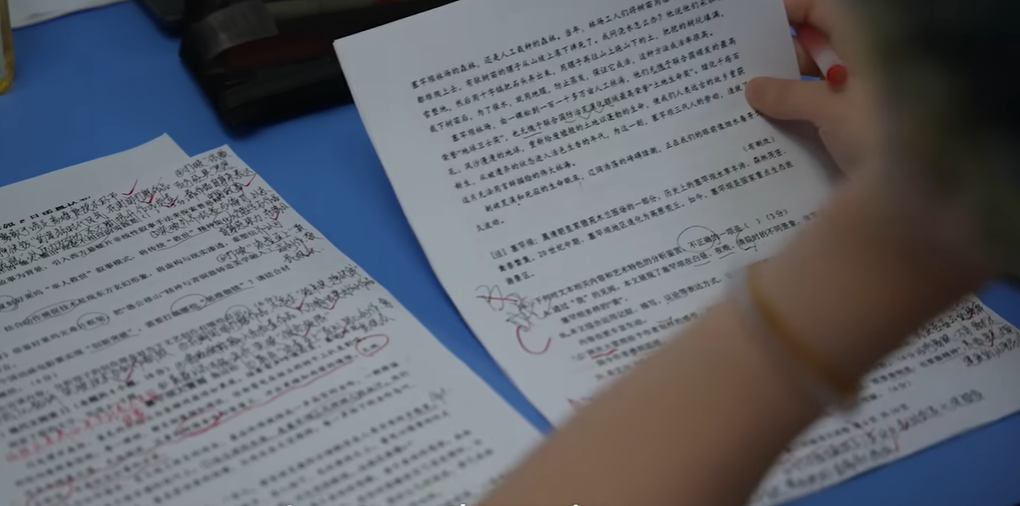
Previously seen as a means of achieving upward mobility, private tutoring is now presented as a barrier to equity. For a lot of middle-class families, this is a source of both comfort and anxiety. Children have more free time when there aren’t as many lessons, but parents are concerned that their children may lose their academic edge. Parents in Beijing and Shanghai talk about grudgingly embracing evenings that used to be devoted to practice exams. According to one mother, her daughter now “has time to be bored,” which was unimaginable just a few years ago.
The tone of the government has been very clear. It asserts that education is a collective marathon rather than an individual race. Beijing hopes to improve public education, lessen disparity between wealthy and impoverished districts, and standardize learning quality by consolidating oversight. The tactic is not wholly novel. It is reminiscent of past reforms implemented by Hu Jintao, who prioritized “education for quality.” However, Xi’s strategy has a decidedly nationalistic bent; he contends that education must support the state’s long-term innovation objectives and that talent is the cornerstone of revitalization.
Economic policy and this focus on human capital are closely related. Instead of test-taking machines, China needs innovative, flexible thinkers as it transitions from manufacturing to technology-led growth. The new system promotes project-based learning, group collaboration, and problem-solving. Instructors are urged to use more flexible teaching strategies and less rote memorization. Compared to the mechanical discipline that formerly characterized Chinese classrooms, this represents a significant change.
Contradictions still abound. The same system that promotes freedom of thought also imposes rigorous ideological conformity, and creativity cannot be regulated. The state continues to have complete authority over parental participation, teacher conduct, and school content. Ironically, though, because boundaries compel adaptation, innovation may actually arise within that framework. This reform is frequently referred to by Chinese educators as “controlled creativity,” a term that encapsulates the paradox and the promise of this time period.
Long stigmatized as a backup plan, vocational education has seen a notable uptick. According to a new law, it is just as significant as academic education, providing equal access to higher education and employment opportunities. For young people in rural areas, who previously had no other options besides testing, the concept is especially advantageous. One Ministry of Education statement reads, “There is no higher or lower education, only different types.” This is a rare acknowledgement that skill and dignity can coexist without hierarchy.
Cultural perceptions are gradually changing. Enrollment in sports programs and art schools is increasing in urban areas. Parents are looking into new enrichment activities after becoming fixated on standardized tests. Family expectations have gradually loosened as a result of the government’s message that health and happiness are more important than grades. Although some fear it might make a generation less competitive, the change feels remarkably effective in reducing stress.
Public figures and celebrities have subtly endorsed this change. Entrepreneurs such as Jack Ma, who made their fortunes through educational technology, came to represent the excess that the government aimed to control. The emergence of new voices advocating for emotional intelligence and curiosity over rote perfection, including educators, psychologists, and even influencers, coincided with his public retreat. The conversation seems almost Western, but it is rooted in Chinese pragmatism, which aims to produce self-assured, competent citizens who benefit society as a whole.
Teachers are also changing. A lot of people have started experimenting with group and research-based learning. Though sometimes chaotic, they characterize it as liberating. Previously discouraged as boastful, some schools now permit kids to give brief presentations. The goal is to simplify motivation and engagement by turning students from listeners into participants. Early feedback indicates that students are noticeably more cooperative and expressive, even though implementation differs by province.
Demographic goals are also part of the reform. The government wants to encourage families to have more children by lowering the cost of education and relieving parental stress. The high cost of raising competitive students has contributed to a recent sharp decline in birth rates. The “Double Reduction” policy seeks to buck that trend by making childhood less taxing and more affordable. It is pedagogy wrapped around social policy, serving as a subliminal reminder that education in China is never limited to schools.
Disclaimer
Nothing published on Creative Learning Guild — including news articles, legal news, lawsuit summaries, settlement guides, legal analysis, financial commentary, expert opinion, educational content, or any other material — constitutes legal advice, financial advice, investment advice, or professional counsel of any kind. All content on this website is provided strictly for informational, educational, and news reporting purposes only. Consult your legal or financial advisor before taking any step.
