

Drivers in Washington have started receiving odd messages in recent weeks referring to Washington State Administrative Code 16C-16.003, which appears to be an official legislation. The SMS messages seem incredibly realistic at first glance. They mimic the format and tone of official notifications and threaten a series of repercussions, including license suspension, registration block, further fines, and even legal action, if the recipient does not take immediate action. However, if you go deeper than one layer, the entire structure falls apart. There is no such code. There are no agencies. Furthermore, the danger is a hoax, skillfully crafted to take advantage of people’s bewilderment and panic.
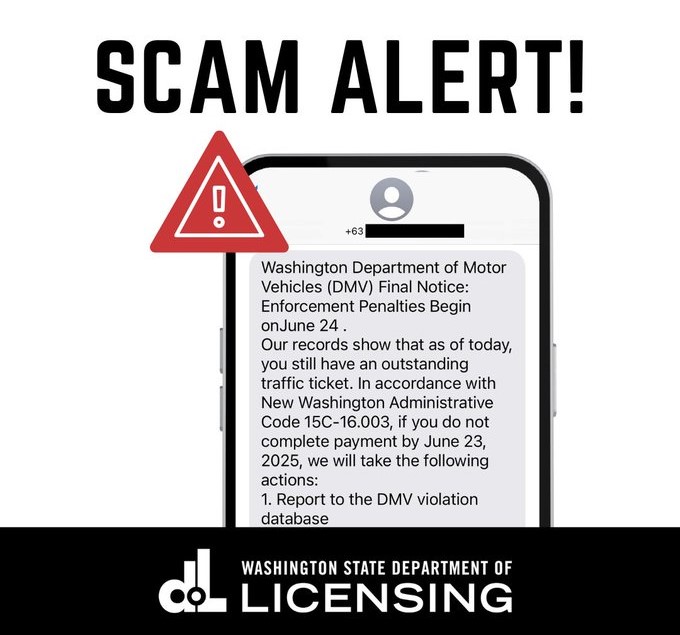
These messages create an urgent and deceptive tone by mimicking the gravity of an official legal reference. The digital equivalent of a stern knock on the door is this notification, which is smartly phrased and comes from a person in uniform. Many drivers are taken off guard because they are understandably unaccustomed to the complexities of state codes. Ultimately, how many locals are aware of the authenticity of a Code 16C-16.003?
| Key Detail | Information |
|---|---|
| Name of Referenced Code | Washington State Administrative Code 16C-16.003 |
| Legitimacy of Code | Completely fabricated—no such law exists in official Washington law databases |
| Method of Scam | Text messages impersonating state and local traffic agencies |
| Threats Included in Message | License suspension, fines, lawsuits, credit score damage |
| Fake Agencies Mentioned | “Seattle Vehicle Administration,” “Seattle WsDOT,” “Washington DMV” |
| Response from State Officials | Washington DOL and WSDOT confirmed the messages are fake |
| Guidance from Authorities | Do not click any links; delete the message immediately |
| Time Period of Scam Activity | Ongoing throughout 2024–2025 |
| Target Audience | Drivers in Washington with registered vehicles |
| Official State Agency Website | Washington Department of Licensing |
Scammers are using a wide variety of strategies and are no longer just using robocalls or emails. These texts are disguised as familiar. They impersonate local officials by posing as the “Seattle Vehicle Administration” or the fake “Washington DMV,” fusing actual locales with made-up agencies. Before the purported enforcement date, which is frequently June 24 or June 25, the receiver is urged to click a link to address their apparent infraction. The trap starts when that link is opened.
Victims are directed to fraudulent websites intended to gather personal data and financial information by clicking on the link. The damage starts as soon as the information is turned in. It could lead to unapproved transactions, money theft, or even worse, identity theft. The scam’s design is incredibly successful at playing on common fears, particularly those who are already overburdened by digital overload and inflation and have busy schedules.
On a recent weekday, staffers at a Shoreline Department of Licensing office were frequently approached by perplexed customers who were holding their phones. These were worried citizens who had waited more than an hour to confirm that the SMS they got was authentic, not those looking to renew their licenses on a regular basis. Reiterating what the agency had previously stated on social media, the clerks suggested that they “ignore or delete.”
In response, the Department of Transportation (WSDOT) and the Washington Department of Licensing (DOL) have released several public warnings. No official notification regarding tolls, penalties, or license suspensions would ever be sent via unsolicited text message, the organizations have stressed. Tolls are not collected by SMS in Washington state, so any reference to code 16C-16.003 should be taken seriously. They have a very obvious message: never click on a link from an unreliable source.
The remarkable aspect of the hoax is how precisely it works. Messages vary by region, often highlighting toll programs like Good To Go! or local roads like SR 520. The senders provide a false sense of legitimacy by using foreign numbers or impersonating local ones. It’s simple to become engrossed in the contrived urgency for the typical individual who glances at their phone during lunch or while stuck in traffic.
Phishing scams have evolved over the last ten years, and this version is especially creative in the way it blends geographical specifics with fictitious legal terminology. This scam feels customized, which significantly boosts its efficacy in contrast to generic ones that say your bank account has been frozen or your Netflix account has been compromised. It also draws attention to hyper-targeted deception, a larger trend in cybersecurity.
Scammers are turning classic crime into a distant, scalable business by utilizing internet technologies. When they can just take advantage of people’s trust and anxiety, they don’t need to compromise systems or spread malware. These schemes invade attention spans, take advantage of instincts, and become viral like a silent swarm of bees. They aren’t slowing down either.
This scam strikes drivers emotionally, particularly elderly locals, foreigners who are not familiar with local rules, and young individuals who are just starting to handle car registrations. The fear of being sued, losing one’s driving privileges, or having one’s credit score harmed is very strong. That anxiousness turns into action when combined with a deadline or countdown. Furthermore, the harm has frequently already been done by the time the victim recognizes they have been duped.
Fortunately, state representatives in Washington are attempting to communicate in multiple ways in response. Awareness is being raised by the Attorney General’s office’s alerts, in-office guidance, and social media posts. However, this scheme also highlights a crucial weakness: the sophistication of scams has increased, and the typical person’s digital literacy hasn’t kept up. Few individuals actually come across actual administrative codes in their daily lives, thus even though a code like 16C-16.003 is completely fake, it is plausible.
This is a critical opportunity for policymakers. Early resistance could be provided by creating more transparent communication procedures and incorporating digital fraud alerts into DMV procedures or even vehicle registration documents. Tech businesses also have a part to play; by identifying and banning questionable texts and links, as well as by investing in AI-based scam detection, these attacks’ reach might be greatly diminished.
Vigilance is also the best defense for the rest of us. Generally speaking, no respectable organization will ever send a text demanding immediate payment together with threats of legal action or suspension. If in doubt, get in touch with the agency immediately by phone at a reliable number, online, or in person. For instance, copying and pasting the dubious statute into Google immediately shows that there is no Washington State Code 16C-16.003.
Disclaimer
Nothing published on Creative Learning Guild — including news articles, legal news, lawsuit summaries, settlement guides, legal analysis, financial commentary, expert opinion, educational content, or any other material — constitutes legal advice, financial advice, investment advice, or professional counsel of any kind. All content on this website is provided strictly for informational, educational, and news reporting purposes only. Consult your legal or financial advisor before taking any step.
