

There is a specific type of subdued radicalism that doesn’t use manifestos or slogans to make its presence known. Instead, it manifests itself in the way a school arranges its curriculum, selects its pupils, and determines its core beliefs about humanity following protracted institutional discussion. You can quickly get a sense of it by strolling around the Rhode Island School of Design’s urban campus in Providence on any given afternoon. Students make sketches of fire escapes. A sculpture installation is being pulled through a small hallway by someone. In the middle of a sentence, a professor pauses to examine a doorknob, taking in its design logic as if for the first time. It’s not a performance. The culture is the reason.
Founded in 1877 by Helen Adelia Rowe Metcalf using $1,675 in leftover funds from a women’s centennial commission, RISD was always based on an unusual idea. The school for geniuses was not founded by Metcalf. She founded it to provide access to design education, especially for women who had been routinely excluded from it. All of RISD’s current endeavors are subtly supported by this founding instinct, which holds that creative capacity is widely distributed and only needs a door opened for it.
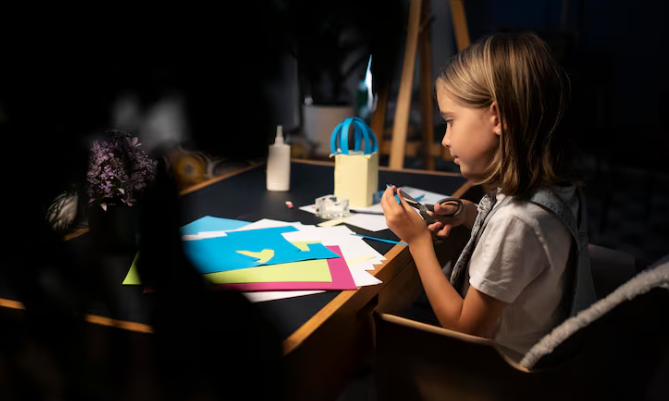
The fundamental tenet of the school is that creative thinking isn’t a unique talent that some kids are born with and others aren’t; this is rarely expressed directly but is evident throughout its educational framework. It resembles a native tongue more. Before formal education starts to insist that they stop, every child speaks it fluently. A five-year-old’s natural grasp of space, weight, color, and narrative can be seen when you watch them construct with blocks or describe a drawing they’ve created. What transpires next will almost certainly determine whether that capacity is developed or quietly discouraged.
Instead of substituting technical instruction for that initial instinct, RISD’s curriculum appears to be built around maintaining it. Instead of lecture halls, studios host two-thirds of the courses. Drawing, spatial dynamics, and design principles foundational classes are not remedial; rather, they are regarded as serious intellectual work that requires students to relearn how to see before learning how to make. In a time when professional pipelines and quantifiable results are becoming more and more important in higher education, there is an almost confrontational quality to that approach.
It’s possible that RISD is actually resisting an educational system that has spent 150 years classifying kids as “creative” or “not creative” with little to no explanation. This is what its founding philosophy has always subtly demanded. An intriguing conflict arises from the school’s affiliation with Brown University, which is located directly across College Hill. There are two institutions next to each other, one based on the conventional academic hierarchy and the other on the idea that creating things is just as important as studying them. In their own ways, both are correct. However, only one begins with the presumption that you are already knowledgeable when you get there.
It’s difficult to ignore the fact that RISD’s alumni record, which includes 11 MacArthur Fellowships, Emmy Awards, Guggenheim Fellowships, and Academy Awards, seems to confirm that it is not a factory for prodigies but rather an organization that discovered creative thinkers in places that others might have missed. I think that’s the whole point. not finding talent. denying that it was ever concealed in the first place.
Disclaimer
Nothing published on Creative Learning Guild — including news articles, legal news, lawsuit summaries, settlement guides, legal analysis, financial commentary, expert opinion, educational content, or any other material — constitutes legal advice, financial advice, investment advice, or professional counsel of any kind. All content on this website is provided strictly for informational, educational, and news reporting purposes only. Consult your legal or financial advisor before taking any step.
