

Strangely enough, it starts with a dog walker who believed she had spotted a deer. At first, the sight didn’t quite register along the River Itchen, where the water flows silently between low branches and reeds. A big, light-brown animal, motionless and unaffected, lying in the sun. The dog then let out a bark. The animal raised its head, alert, almost inquisitive, then abruptly and fluidly slid into the water and vanished. Not a deer. Strange.
That moment, brief and almost accidental, has become one of the defining images of what people now call simply the “capybara escape.”
The nine-month-old capybara Samba wasn’t supposed to be here. She had only been at Marwell Zoo for a day, still getting used to her makeshift enclosure and remaining in a pair with her sister Tango. Both had slipped out by the following morning. Tango remained close, hiding in the bushes nearby, as though he wasn’t sure if freedom was worth it. Samba had a different choice.
The decision might not have been a human choice at all. Capybaras are gregarious, naturally cautious, and incredibly adaptive animals. She must have been drawn forward by something once she was outside the enclosure—possibly the quiet openness of the surrounding countryside or the smell of water. Whatever it was, she continued.
She had already left by the time zoo employees realized what had happened.
The subsequent search has been somewhat bizarre and oddly methodical. At dusk, thermal drones hover over fields. Along the banks of rivers were nets. Experts are examining grainy video in an attempt to differentiate between a capybara and a deer of comparable size. It sounds like something from a low-budget wildlife documentary, but it takes place in suburban England, where people are now checking their garden sheds and ponds with surprisingly serious attention. And yet Samba is still elusive in spite of the effort.
In discussions with people who have seen her, a detail keeps coming up. speed. Capybaras, who are frequently characterized as gentle or even lazy, can swim with surprising ease and run faster than most people realize—up to 20 miles per hour. There’s a certain efficiency to the way she moves when you watch a video of her slipping into the river. Without hesitation. Simply vanished. It’s difficult to ignore how rapidly the narrative has taken on a life of its own.
| Category | Details |
|---|---|
| Animal | Capybara (largest rodent in the world) |
| Name | Samba |
| Age | ~9 months |
| Location | Marwell Zoo, Hampshire, England |
| Escape Date | March 2026 |
| Companion | Tango (recovered shortly after escape) |
| Last Sightings | River Itchen near Twyford |
| Behavior | Fast runner, strong swimmer, hides near water |
| Capture Efforts | Drones, sniffer dogs, nets |
| Reference | BBC News Coverage |
| Reference | Marwell Zoo Statement |
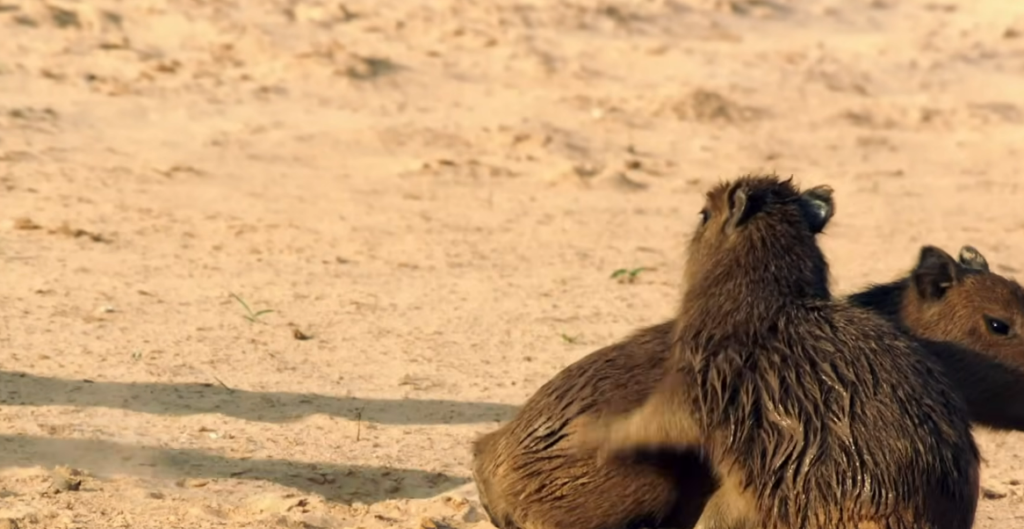
Samba is discussed as though she were a local figure in the neighboring villages. Someone says they saw her close to a hedgerow. Another claims that at dusk, she crossed a small walkway. After hearing bits and pieces of the story, kids picture her strolling through backyards at night. A fascination with animals that don’t quite belong and appear out of nowhere in familiar places seems to have been sparked by the escape.
Beneath the curiosity, though, is a more subdued worry. This is not a natural habitat for capybaras. They depend on certain conditions that Hampshire might not be able to fully supply, such as water and group dynamics. Given how intensely social these animals are, zoo officials have stressed the importance of reunifying her with Tango. Even though she appears capable, she becomes vulnerable when she is by herself in ways that are not immediately apparent.
Samba appears to be handling things, though.
That’s the peculiar aspect. She has been moving through fields and along riverbanks for days, sometimes coming to the surface long enough to be seen before disappearing once more. She might be adjusting minute by minute as she learns the terrain in real time. Or perhaps she’s just acting on instinct, as capybaras have always done—moving when needed, avoiding danger, and staying near water.
As you watch this play out, you get the impression that the narrative is more about perception than escape.
Animals in captivity are characterized by their boundaries. routine routines, feeding schedules, and enclosures. Even for a moment, they transform into something different when they step outside those lines. more difficult to follow. less certain. In this way, Samba has practically instantly changed from being an exhibit to an enigma.
It subtly calls into question how well-controlled environments actually are. Zoos are not the only systems that rely on predictability. The story abruptly shifts when there is a tiny gap or an overlooked detail. The animal is not in its proper location. The strategy doesn’t quite work.
The search is ongoing for the time being.
Teams move cautiously along the river, listening for minute disturbances in the brush and keeping an eye out for movement. With a mixture of curiosity and caution, locals keep their dogs closer than usual, keeping an eye on the edges of fields. And Samba is still just out of reach somewhere in that landscape, half-hidden, moving when it feels safe.
Disclaimer
Nothing published on Creative Learning Guild — including news articles, legal news, lawsuit summaries, settlement guides, legal analysis, financial commentary, expert opinion, educational content, or any other material — constitutes legal advice, financial advice, investment advice, or professional counsel of any kind. All content on this website is provided strictly for informational, educational, and news reporting purposes only. Consult your legal or financial advisor before taking any step.
