

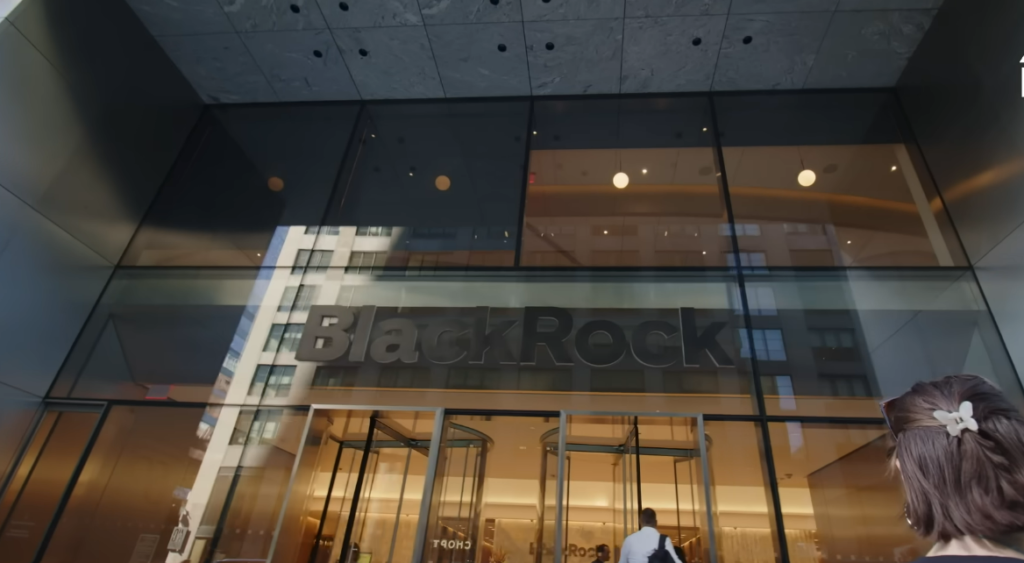
The BlackRock headquarters on Park Avenue appears almost unassuming from the outside. Large financial institutions are known for their quiet efficiency, glass walls, and constant staff turnover. However, something extraordinary is housed within that building: the ability to influence trillions of dollars that are traded daily on international markets.
BlackRock stock, which is traded under the symbol BLK, is an odd kind of barometer just based on that scale. Investors often believe that something more profound is going on beneath the surface when it moves quickly. Everyone was recently reminded of that fact by the stock.
Following the company’s decision to restrict withdrawals from one of its private credit funds, BlackRock shares dropped more than 7% on a tumultuous trading day in early March. Wall Street isn’t usually shaken by headlines like that. However, the response indicated that investors were keeping a close eye on things, possibly sensing tension within a sector of finance that has quietly grown enormous.
Over the last ten years, the private credit market has grown rapidly, reaching a current value of about $1.8 trillion.
| Company | BlackRock, Inc. |
|---|---|
| Stock Ticker | BLK |
| Stock Exchange | New York Stock Exchange |
| Headquarters | New York City, United States |
| Founded | 1988 |
| CEO | Larry Fink |
| Assets Under Management | About $12.5 trillion |
| Market Capitalization | Around $148 billion |
| Employees | Approximately 24,900 |
| Dividend Yield | About 2.4% |
| Industry | Asset Management / Investment Management |
| Reference | BlackRock stock data on Yahoo Finance: https://finance.yahoo.com/quote/BLK |
| Additional Reference | BlackRock investor relations and stock information: https://ir.blackrock.com |
Following the 2008 financial crisis, banks reduced their risky lending, leaving asset managers to step in. Companies like BlackRock started providing direct financing to businesses, frequently using funds that guarantee consistent returns. Investors eagerly participated, including insurance companies, pension funds, and wealthy families.
Increased yields typically draw notice.
However, some weak points may now be exposed by that same growth. Recently, redemption requests reportedly reached over $1 billion in one of BlackRock’s lending vehicles. Only a percentage of those withdrawals were permitted by the company, with redemptions being restricted to about 5%.
In theory, that action complies with common liquidity guidelines for funds that own illiquid loans. However, technical explanations are rarely the focus of markets. They emphasize mood. Additionally, the mood changed.
It seemed as though investors were suddenly reconsidering a long-held belief that private credit always operates in the background as they watched the stock chart flicker on trading screens that afternoon. This unease was exacerbated by the abrupt write-down of a $25 million loan, indicating that some borrowers may be having more difficulties than anticipated. However, BlackRock is by no means a weak organization.
The business was first established in 1988 as a bond manager with an emphasis on risk management by Larry Fink and a small group of partners. It gradually grew over the years, acquiring rivals, introducing exchange-traded funds, and ultimately emerging as the world’s biggest asset manager.
The business has occasionally seemed to be everywhere.
Through its index funds, BlackRock has investments in thousands of businesses. Banks and other organizations worldwide use its Aladdin risk-management platform. Governments have even consulted the firm during financial crises.
Investors become intrigued by such influence.
On the one hand, a lot of people consider BlackRock stock to be a reliable, nearly constant aspect of contemporary finance. Just by virtue of its size, a company that manages more than $12 trillion tends to inspire confidence. That impression is supported by the dividend yield, which is modest but steady.
However, size can also draw attention.
There is a perception that BlackRock’s profile has somewhat changed as a result of its growth into alternative assets and private credit. Traditional asset management used to be a major focus of the company. It now faces more and more competition from private equity behemoths like Blackstone, Apollo, and KKR, which are companies that work in riskier areas of the financial industry.
That change could account for some of the anxiety.
It’s difficult to ignore how frequently the same topics come up in discussions about interest rates, corporate debt, and the uncertain future of lending markets when strolling through Midtown Manhattan on a late winter afternoon. Buses rumble down Madison Avenue as traders peruse market updates while seated in coffee shops. The world of finance is on guard.
Investors appear to think that private credit will continue to be a significant growth driver for companies such as BlackRock. However, it remains uncertain if the industry can sustain its serene image in the event that economic circumstances worsen. Loans issued during more prosperous times may be put to the test by rising interest rates and corporate stress. At times like these, history tends to reappear.
Many types of credit appeared to be completely safe prior to the financial crisis. Then all of a sudden they didn’t. As of yet, no one is advocating for a recurrence of 2008. However, whenever markets start to doubt opaque financial products, there’s a faint echo of that old lesson. And BlackRock is frequently at the center of those discussions due to its vast reach.
BLK stock is still close to the top end of its historical range despite the recent decline. The business is still regarded by investors as a cornerstone of international finance, a kind of institutional anchor in erratic markets. That self-assurance is still there.
However, the episode had a minor impact.
Disclaimer
Nothing published on Creative Learning Guild — including news articles, legal news, lawsuit summaries, settlement guides, legal analysis, financial commentary, expert opinion, educational content, or any other material — constitutes legal advice, financial advice, investment advice, or professional counsel of any kind. All content on this website is provided strictly for informational, educational, and news reporting purposes only. Consult your legal or financial advisor before taking any step.
