

In Ohio, a sixth-grader inquired about the experience of sleeping in space. In order to illustrate how weightlessness alters rest, the astronaut on television grinned before drifting into a leisurely midair roll. With equal parts amazement and incredulity, the students burst out laughing. That response—the unadulterated wonder—exactly summed up what NASA hopes to accomplish with its massive educational effort.
NASA has effectively elevated science class to orbit by converting the International Space Station into a working classroom. Additionally, it involves doing rather than just observing. Today, students all throughout the United States are constructing real experiments, putting them in tiny modules, and launching them into space to test them in authentic microgravity environments. Textbooks may only allude to this type of practical science.
Students are given a genuine place at the scientific table through incredibly successful collaborations with groups like Higher Orbits, Space Tango, and the American Institute of Aeronautics and Astronautics. These partnerships, which include technical mentoring, organized contests, and actual launch possibilities, are especially creative. Students are contributing in addition to learning.
Recently, a group of rural Kentucky high school students came up with a project to investigate the behavior of plant roots in orbit. An experiment to track the growth of mold under low gravity was sent by another. These are not gimmicks; rather, they are significant studies that were approved by NASA engineers and sent to the ISS on resupply trips. Ten years ago, that alone would have sounded like fiction.
| Initiative | Description |
|---|---|
| NASA’s Space Classroom | A STEM learning initiative using the ISS as an active educational platform |
| Higher Orbits Program | A nonprofit sending student-designed experiments to space |
| CubeSat Missions | Student-built small satellites launched with NASA support |
| Educator Astronauts | Teachers trained to teach live lessons from space |
| Partners Involved | NASA, Space Tango, Higher Orbits, AIAA, U.S. schools |
| Key Activities | Microgravity experiments, astronaut Q&A, live video sessions |
| Goal | Inspire and prepare students for future careers in STEM and aerospace |
The accessibility of these services is what makes them so effective. Even pupils from underfunded areas are having the opportunity to participate because to public-private partnerships and smart planning. A teacher from East Tennessee spearheaded the nation’s first student-built satellite launch from her middle school. Even though it was only briefly publicized, the children who witnessed that milestone soar into the skies were profoundly affected.
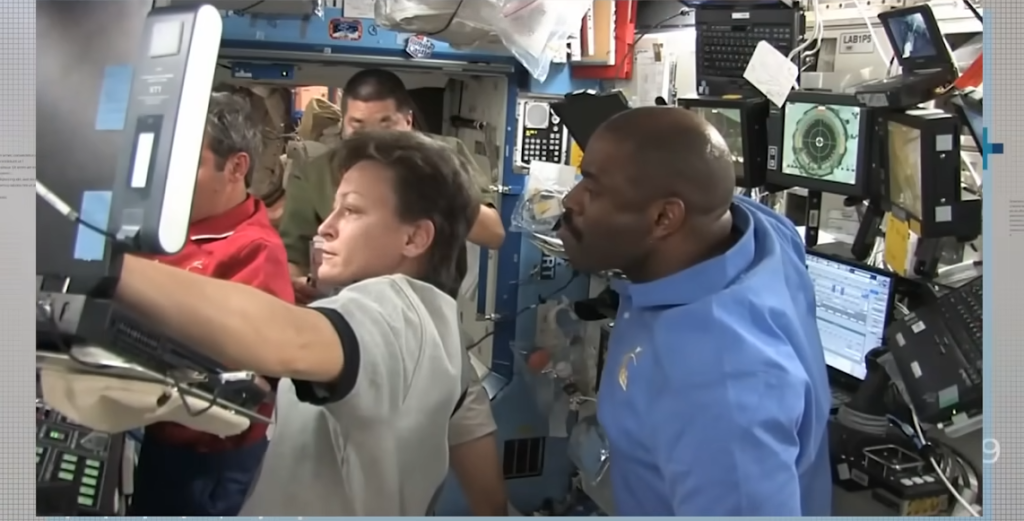
Teachers are become important roles as well. Dorothy Metcalf-Lindenburger, a former high school teacher who is now an astronaut, used to provide live scientific demonstrations from space, demonstrating how liquids behave in microgravity or how motion feels when inertia isn’t tethered to the ground. Her speech was so clear that it seemed to be floating in orbit like a TED Talk. These in-person interactions, sent to Earth in real time, provide students with an uncommon level of scientific intimacy.
The change is conceptual as well as technological. Students used to read about or, at most, imitate space. These days, they are creating payloads, giving presentations at aerospace conferences, and even coaching younger students who want to be the next to launch. Confidence is developed through launchpads rather than lectures.
The founder of Higher Orbits, Michelle Lucas, who worked at NASA, stresses that the objective is not to turn every student into an engineer. It’s to demonstrate that they could be—if they so choose. Thousands of people have benefited from her program, many of whom have gone on to pursue careers in robotics, biotechnology, or aerospace. Others utilized their knowledge to health, climate science, or cinema. The experience’s adaptability is quite beneficial.
However, it’s not always simple. It can be difficult to arrange launch windows, find sponsors, and fulfill the exacting technical requirements for spaceflight. Students, however, rise to the occasion. They solve problems resolutely. They are graceful while presenting data. They proudly defend their beliefs. It is similar to witnessing pros in action because they are aware that they are a part of something genuine, not because they are experts.
That first video call with an astronaut is a pivotal moment for many. Admiring someone on a screen is one thing. Asking them a question and receiving a well-considered response while in orbit is quite another. It is a life-changing experience. It sends a strong and intimate message that science is not far off. You are able to participate in it.
These initiatives have significantly increased STEM student engagement indicators during the previous five years. Schools say more people attend science fairs. In the classroom, teachers observe increased curiosity. New levels of ambition are observed by parents. The change is emotional as well as intellectual. Students who once found science uninteresting now talk casually and fluently about orbital mechanics.
NASA is taking advantage of this trend. It is creating a more competent and diverse workforce of the future by incorporating these programs into its larger purpose framework. Once enclosed by four walls, the classroom now has a laboratory that is 17,000 miles per hour above the ground. Furthermore, that redefinition is both important and exhilarating.
Disclaimer
Nothing published on Creative Learning Guild — including news articles, legal news, lawsuit summaries, settlement guides, legal analysis, financial commentary, expert opinion, educational content, or any other material — constitutes legal advice, financial advice, investment advice, or professional counsel of any kind. All content on this website is provided strictly for informational, educational, and news reporting purposes only. Consult your legal or financial advisor before taking any step.
