

A quiet, somewhat awkward physicist named Bob Lazar was interviewed by a Las Vegas television journalist named George Knapp in 1989. Over the next thirty years, this interview would become one of the most contentious videos in the history of UFO research. Lazar stated that he was employed in 1988 to work at S4, a classified facility in the Nevada desert close to Area 51, where the US government was storing and trying to reverse-engineer several extraterrestrial spacecraft. He explained the system of propulsion. In 2015, the International Union of Pure and Applied Chemistry confirmed and named Moscovium the element that powered it, which he named Element 115. At the time, this substance was not officially listed on the periodic table. He gave an account of the interior of a craft he named the Sport Model. He claimed to be collaborating with 22 scientists.
| Film Title | S4: The Bob Lazar Story |
|---|---|
| Release Date | April 2, 2026 (UK) / April 3, 2026 (US) |
| Runtime | 1 hour 54 minutes |
| Directors | Luigi Vendittelli, Christopher Matteau |
| Producer | Luigi Vendittelli |
| Production Company | Motivo / Project Gravitaur |
| Distribution | Amazon Prime Video (rent $9.99 / buy $19.99 USD); also at wearenotalone.com |
| Subject | Robert Scott “Bob” Lazar — physicist and UFO whistleblower |
| Lazar’s Claim | Hired at S4 facility near Area 51 in 1988 to reverse-engineer extraterrestrial technology |
| Propulsion Element Referenced | Element 115 (Moscovium — confirmed by IUPAC in 2015, four years after Lazar named it) |
| Key Interview Subjects | George Knapp (journalist), Gene Huff, Mario Santa Cruz, Joy Lazar |
| Narrated By | Bob Lazar himself |
| IMDb Rating | 7.7/10 |
| Rotten Tomatoes Audience Score | 95% |
| Joe Rogan Appearance | Episode #2479, April 3, 2026 — Lazar and Vendittelli appeared on release day |
| Reference Links | IMDb — S4: The Bob Lazar Story / Rotten Tomatoes — S4: The Bob Lazar Story |
The majority of those who heard that interview believed he was mentally ill, confused, or lying. Some continue to do so. However, the narrative remained unchanged. Lazar has told the same story with the same technical specificity over the course of more than 35 years of media appearances, podcast interviews, and public scrutiny. He hasn’t changed, retracted, or added anything implausible to fill the void.
Consistency might be a sign of a man who made an early commitment to a fabrication and never broke. It might also show a man being honest. That question remains unanswered in the Luigi Vendittelli and Christopher Matteau-directed documentary S4: The Bob Lazar Story, which debuted on Amazon Prime Video on April 3, 2026. It does something different: it depicts precisely what Lazar said, rendered with a degree of visual accuracy never seen in any other account.
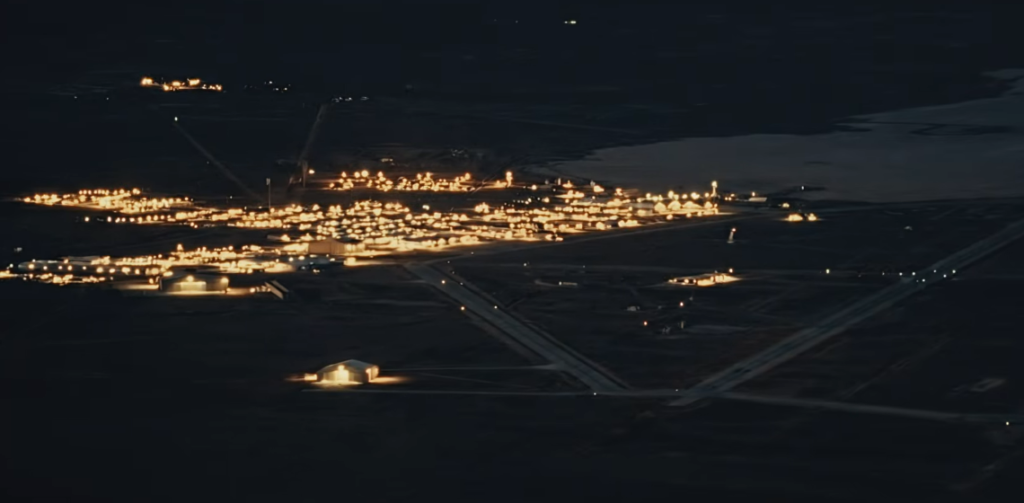
The film, which was directed by Vendittelli, started out as an attempt by a Canadian production company to create the most realistic visual reconstruction of the S4 facility and the craft Lazar worked on. The documentary’s most immediate contribution is the 3D recreations, which were created over years of design, research, and production. The hangar doors were built into a mountainside in the desert. Sitting on an elevated platform was the circular metallic craft. The reactor, which is the size of a basketball, uses a fuel that shouldn’t exist in theory to produce gravitational waves. All of this has been explained verbally and with crude diagrams in earlier documentaries. The visual fidelity with which S4 renders it eliminates the need for abstraction. You can see the instrumentation, the hatch, and the hallway. As usual, the documentary won’t address whether what you’re witnessing is accurate.
The film is narrated by Lazar, who appears on screen as a man who has lived with this story since before the majority of his current audience was born, carrying it in the same way that people carry something both heavy and irreplaceable. Here, too, is George Knapp, who broke the original story in Las Vegas in 1989 and has followed it throughout his career. One of Lazar’s closest friends, Gene Huff, has consistently corroborated over the years and was present at some of the events described. Bob’s wife, Joy Lazar, offers the kind of humanizing context that previous accounts mostly omitted. It serves as a reminder that behind the element-115 talks and the claims about the classified facility, there is someone who has also lived this, endured the threats, intimidation, and professional destruction, and persisted.
Lazar’s second appearance on the Joe Rogan Experience, episode #2479, coincided with the release of the documentary. According to reports, Lazar and Rogan watched the movie together prior to the start of the podcast. With over 100 million views on YouTube, Lazar’s debut on the show is still the most watched episode ever, according to Rogan. Regardless of one’s opinion of its verifiability, that is an important piece of information regarding the public’s desire for this content. Within days of its release, the movie received a 7.7 on IMDb and a 95% audience rating on Rotten Tomatoes, indicating that it is doing well with those who attended.
It is not unreasonable for skeptics to claim that Lazar’s story is presented in the documentary without any significant opposition, that it is advocacy disguised as journalism and reconstruction disguised as proof. The willingness to accept Lazar at face value reveals more about the audience than the subject, according to a Rotten Tomatoes reviewer who bluntly pointed out that everything in the movie has been accessible on YouTube for years. There is some truth to that criticism. It’s obvious that the film was created by people who support Lazar and want others to do the same. Counterarguments are not given the same amount of time.
However, it’s difficult to ignore the documentary’s arrival at a specific cultural moment. Area 51, also known as Dreamland, was officially recognized by the US government in 2023. The nearby facility Lazar mentioned, S4, has never received recognition. Whistleblowers have testified, Congress has held hearings on UAPs, and the general denial that characterized official responses to this topic for fifty years has changed into something more ambiguous and awkward. The vocabulary and framework introduced by Bob Lazar in that 1989 interview in Las Vegas are directly responsible for much of what is being discussed in those congressional hearings. He gave the place a name. He gave the element a name. He explained the technology. Without him, the current discussion would not take place as it does, regardless of whether he is a reliable source or an incredibly tenacious liar.
