

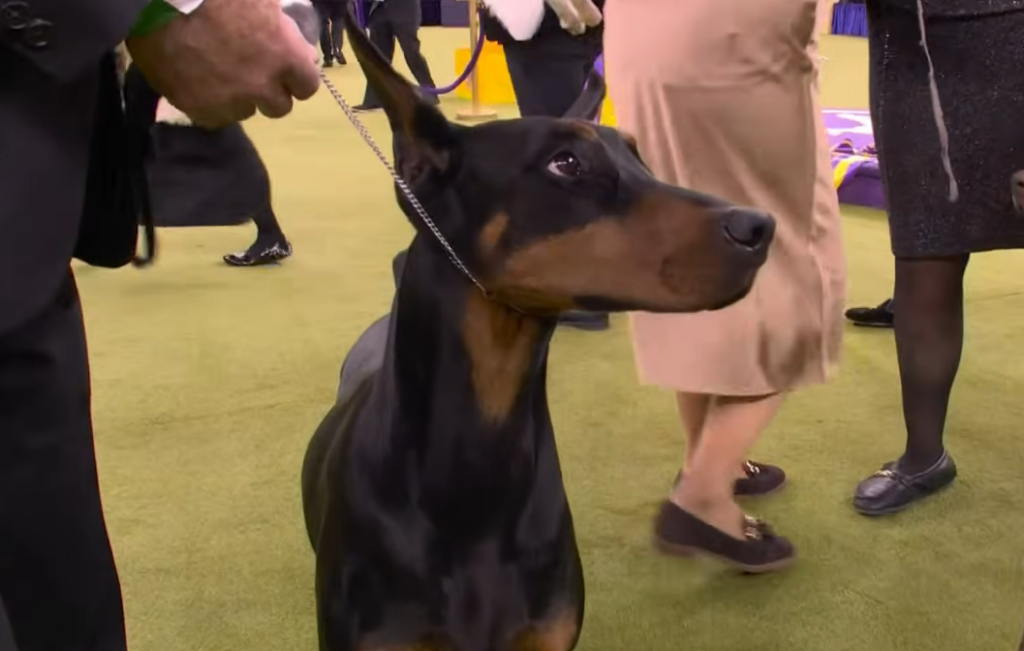
The air in Madison Square Garden crackled with a real sense of occasion for the 150th Westminster show, a historic evening demanding a historic champion. When judge David Fitzpatrick’s palm swung strongly toward the sleek, calm form of Penny the Doberman Pinscher, the accompanying scream hailed more than a single dog. It celebrated an incredibly successful collaboration and a thirty-seven-year story of patience. Penny, embodying the breed’s perfect architecture with every taut muscle, stood absolutely still amidst the turmoil. Her handler, Andy Linton, simply nodded, the quiet culmination of a lifetime’s artistry written in the thin creases around his eyes.
In 1989, Linton won his first Westminster gold with a Doberman named Indy. To witness him direct Penny is to observe a master class in subtle communication, a discourse of faint leash pressures and shared focus resulting in a gait of pure, floating force. His victory now, as his career undoubtedly winds down, feels extraordinarily poetic. It indicates that heritage is not a static trophy but a living thread, weaved over decades and connected by the enduring attributes of a breed. I watched his worn hands, solid on the lead, and recognized this win was a gift of time.
In the aftermath, surrounded by klieg lights and demanding reporters, Penny exposed her unexpectedly straightforward character. She turned and gave a spectator’s leg a strong nudge with her nose after striking a regal pose. The champion immediately demanded a thorough petting session rather than applause. The lovely contradiction at the core of dog shows was brought to light by this disarmingly ordinary incident. We spend years honing their posture and features, yet their greatest joy remains terribly basic. Greg Chan, the co-owner, describes her as “very demanding,” but at that moment, she was just a dog looking for companionship, a reminder that beyond the polished façade lives a relatable heart.
| Field | Details |
|---|---|
| Name | Penny |
| Breed | Doberman Pinscher |
| Age | 4 years old |
| Title | Best in Show – 150th Westminster Kennel Club Dog Show (2026) |
| Event Date | February 3, 2026 |
| Event Location | Madison Square Garden, New York City |
| Handler | Andy Linton |
| Owners | Francis Sparagna, Diana Sparagna, Theresa Connors-Chan, Gregory Chan |
| Competition Scale | Over 2,500 dogs representing 200+ breeds |
| Historical Significance | Fifth Doberman to win Westminster; first Doberman winner since 1989 |
| Runner-Up | Cota (Chesapeake Bay Retriever) |
| Official Reference | Westminster Kennel Club – https://www.westminsterkennelclub.org |
Her famed victory dinner—plain boiled chicken and carrots—further highlighted this contrast. One hour, the apex of competitive breeding; the next, a supper familiar to any family kitchen. The dogs live fully in the present, navigating these changes with a grace that frequently eludes us. For Penny, the championship chicken certainly tasted substantially better than normal, but the experience was founded in basic joy. This forward-thinking shift to life after the ring is already scheduled. Her owners indicate she will retire to become a therapy dog, a vocation for which her friendly temperament appears particularly appropriate.
The other finalists each painted a distinctive depiction of canine brilliance. Cota, the charming Chesapeake Bay Retriever who placed second, wagged his entire body with such unabashed excitement upon getting his medal that his handler allowed him play with it. The crowd’s thundering backing for him emphasized a recurrent optimism for an underdog breed. In the meantime, the Old English Sheepdog Graham was a wonderful, bouncing cloud, and the Afghan Hound Zaida walked with unearthly elegance, a vision of flowing silk. Each signified a pinnacle, a dream made flesh and fur.
Yet the true, optimistic spirit of Westminster frequently shines brightest far from the Best in Show ring. It survives in the accounts of newcomers like Joseph Carrero, a Nevada heavy equipment operator who shepherds his pet Neapolitan Mastiff between grueling shifts.
It echoes in the story of Natalee Ridenhour, who found a new life path due of the Boerboel breed she brought to the Garden. Their canines did not proceed far in the competition, but their appearance itself was a triumph. It confirms that this spectacular spectacle is ultimately fuelled by a common, intense affection for these animals, a link that remains remarkably versatile, connecting amateurs and legends alike.
Penny’s achievement, therefore, stands as a powerful tribute to both eternal norms and simple joys. She represents the top of a craft refined over generations, a living sculpture judged and found perfect. Simultaneously, she reminds us that perfection, in the end, is not sterile. It asks for attention by nudging a leg. It enjoys a basic food. Soon, it will provide solace as a therapy dog, trading the judge’s scrutiny for a stranger’s appreciative touch. Her story effectively suggests that the finest successes are those that leave place for heart, integrating the spectacular with the gloriously, reassuringly ordinary.
