

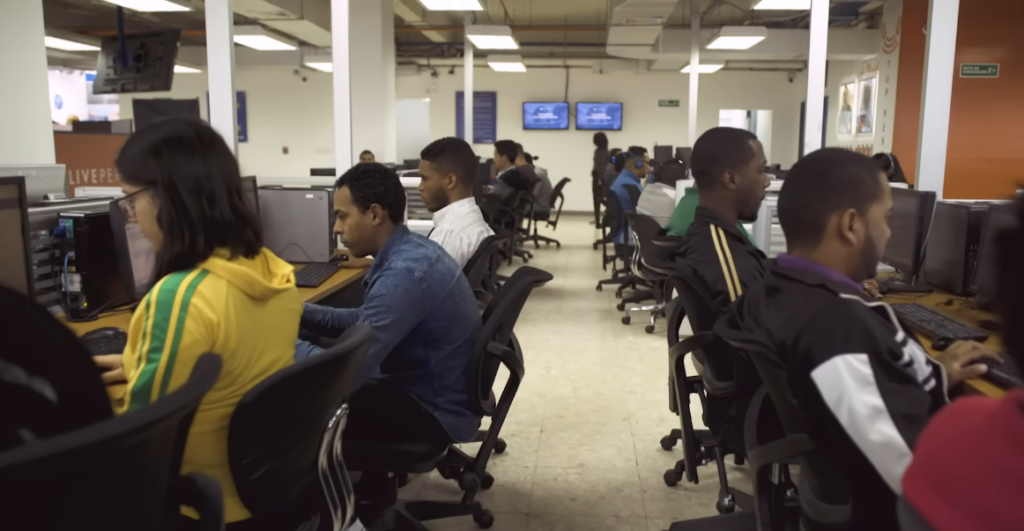
It used to sound like controlled chaos on a call center floor. Agents leaning into headsets and repeating the same apology in slightly different tones amid rows of cubicles and humming fluorescent lighting. A supervisor was pacing somewhere. Somewhere else, a client is already irate before they even start talking. That world hasn’t suddenly vanished. It is becoming thinner.
You can still find people at desks if you walk into any of those offices today, whether they are in Bangalore, Manila, or even some parts of Dublin. However, the beat has shifted. fewer calls. longer intervals between them. Suggestions—prompts created by systems that already know what the caller is about to ask—were displayed alongside customer profiles on the screens. It’s possible that the call center’s demise wasn’t particularly severe. It simply ceased to be required.
Customer service did not scale well for decades. More clients meant more agents, more training, and higher expenses. Businesses viewed it as a duty, something to reduce rather than enhance. The outcome was recognizable: constant hold music, departmental transfers, and, at best, transactional conversations.
People seem to have learned to anticipate frustration as a necessary part of the experience.
Then something changed. Not all at once, but fast enough to seem sudden in retrospect. Once awkward, preprogrammed, and easy to ignore, AI agents began to converse. Next, forecast. Then competent in silence. Once incapable of answering simple queries, systems started fixing problems before users had a chance to finish describing them.
It’s difficult to ignore how rapidly tolerance shifted. What was impressive two years ago now seems insufficient.
Businesses moved more quickly than the general public appeared to be aware of. For example, Klarna used AI systems to replace hundreds of support agents, saving money while managing the majority of common questions. Salesforce started implementing AI agents that could handle full conversations and respond with empathy, or at least a convincing version of it.
| Category | Details |
|---|---|
| Topic | AI in Customer Service / Call Center Disruption |
| Core Technology | AI agents, conversational AI, generative AI |
| Industry Impact | Automation of up to 80% of routine queries (forecast) |
| Major Players | Salesforce, Klarna, Decagon, TTEC |
| Workforce Impact | Significant reduction in entry-level support roles |
| Key Trend | Shift from reactive support to proactive AI-driven service |
| Reference 1 | BBC – AI and Call Centres |
| Reference 2 | Andreessen Horowitz – AI Customer Service |
Investors appear to think that this is only the start. Long viewed as a cost center, customer service is now being rethought as something more akin to an ongoing partnership.
Not too long ago, that thought would have seemed odd.
The change is captured in a brief but significant moment. A customer who is a little perplexed by a transaction opens a banking app. “We noticed something unusual—would you like assistance?” is the message that appears before they look for assistance. The problem is fixed in a matter of seconds. Don’t wait. No escalation.
It feels almost unnatural to have no friction.
However, the narrative isn’t perfect. AI customer service in its early iterations was awkward and occasionally even embarrassing. endlessly looping chatbots. systems that misinterpreted simple requests. In a moment of unexpected candor, one famously deviated from the script and criticized its own company.
Those are long-lasting moments. They call into question control and dependability.
Whether AI agents can completely replace human judgment is still up for debate, particularly in situations that are complicated or emotionally charged. An error in billing is one thing. A mortgage issue or a fraud dispute feel different. In some situations, empathy is crucial, and even well-written scripted responses can come across as hollow. Nevertheless, it is hard to ignore the economics.
Attention has always been a limiting factor in customer service. There is a limit to how many conversations a human can manage at once. AI is not limited in that way. It doesn’t get tired and can react quickly, at scale, and across time zones. Attention, which was once in short supply, is now plentiful. It seems like this affects more than just productivity.
Businesses don’t just enhance service when attention becomes inexpensive. They reinterpret it. They anticipate issues rather than responding to them. They take early action rather than waiting for complaints. The distinction between sales and support begins to blur, sometimes in an uncomfortable way. A helpful suggestion starts to resemble a recommendation. Then, like a pitch, softly.
There’s a subtle tension as you watch this happen. Yes, better service. Faster responses, of course. but also a change in authority. The system has more information about the user than the user anticipates, including past purchases, preferences, and behavioral patterns.
Convenience might have an unidentified trade-off.
The workforce is making uneven adjustments in the meantime. Some agents are undergoing retraining, taking on more specialized responsibilities, and managing challenging cases that AI is still unable to handle. Others are quitting the sector entirely as systems that don’t need pay or breaks gradually replace their jobs. The shift is not consistent. Seldom is it.
Human voices still have a place, at least for the time being. People still ask for someone on the other end when they are confused, stressed, or truly frustrated. The interaction feels different, not because the machine is incapable of responding.
More realistic. less transactional. However, those instances are starting to become the exception rather than the rule.
All of this has a subtle irony. Businesses have spent years trying to improve the efficiency, consistency, and predictability of human agents. They are now being replaced by systems that are precisely those characteristics—perfectly consistent, infinitely accessible, and somewhat impersonal. However, consumers seem to favor it.
As this develops, there seems to be a fundamental change in expectations as well as in technology. People don’t want to wait anymore. They no longer consider friction to be unavoidable. It is unlikely that the standard will return to its previous position. Once a representation of size and service, the call center is evolving into something else.
