

A rain gauge at St. Louis Lambert International Airport recorded 8.64 inches of rain in a single day on the evening of July 26, 2022. In every neighborhood of the city, basements were flooded with water. Brown rushing water covered the roads. There were two fatalities. By the time the accounting was completed, the damage had reached a billion dollars. The term “1,000-year flood”—the statistical abbreviation for an occurrence so uncommon that it should, on average, only occur once in a millennium—appeared frequently in the news coverage that followed. The phrase was used by meteorologists. It was utilized by emergency managers. It was intended to illustrate the scope of what had transpired. Unintentionally, it actually made clear how badly our language for characterizing extreme weather has lagged behind the actual weather.
After examining that storm, researchers at Washington University in St. Louis concluded that it was most likely a 1-in-530-year occurrence rather than a 1-in-1,000-year one. What follows in their analysis is more significant than that distinction: storms of that size are now two to four times more likely to occur in the future than they were over the previous millennium. It’s not just that the label has become vague. It has started describing the completely incorrect distribution.
In less than a week in July 2025, the United States saw four distinct events that were categorized as 1-in-1,000-year rainfall incidents. Four. Seven days from now. A century of rain gauge data from an extinct climate served as the foundation for the statistical framework that drives flood mapping, stormwater design, infrastructure planning, and insurance pricing nationwide. The Clausius-Clapeyron equation, which does not negotiate or hedge, describes a physical relationship whereby the atmosphere can hold about 7% more water vapor for every degree Celsius of warming. In shorter windows and over smaller areas, there is more water available to fall more intensely when there is more water vapor in the air. For years, the math has outpaced the policy.
IMPORTANT INFORMATION TABLE — EXTREME RAINFALL & THE 1,000-YEAR FLOOD
| Category | Details |
|---|---|
| Original Definition | A “1,000-year flood” = statistical event with 0.1% probability of occurring in any given year; used to design infrastructure nationwide |
| New Reality | US experienced four separate 1-in-1,000-year rainfall events in less than one week in July 2025 |
| Scientific Finding | Washington University in St. Louis study: July 2022 St. Louis event was likely a 1-in-530-year event, not 1,000 years; will be 2–4 times more likely in the future |
| St. Louis July 2022 | 8.64 inches of rain in 24 hours at Lambert International Airport; 2 deaths; over $1 billion in damage |
| Uncertainty Range | NOAA’s error bars for 1,000-year events in St. Louis: ~7.5 to 15 inches of daily rainfall — an “incredibly wide range” |
| Data Limitation | Modern rain gauge records cover only ~100 years; insufficient to precisely define 1,000-year probabilities |
| Atmospheric Physics | Clausius-Clapeyron relation: every 1°C of warming allows air to hold ~7% more water vapor, intensifying rainfall |
| Heavy Rainfall Trend | Frequency of heavy rainfall in the US has increased by 10% over the past 50 years |
| US Annual Precipitation Trend | Annual precipitation has increased ~0.2 inches per decade since 1901; extreme events outpacing average trend |
| Zhengzhou Flood (China, July 2021) | Extreme rainstorm killed 302 people, including 14 drowned in a subway |
| Future Projection | 1-in-100-year floods could become annual events in some coastal areas by 2040 |
| Infrastructure Problem | FEMA flood maps and stormwater systems designed for a climate that no longer exists |
| Key Research | Thompson & Konecky (Washington University), using blended paleoclimate data + climate models to reframe extreme storm probabilities |
| Atmospheric Rivers | “Rivers in the sky” capable of carrying as much moisture as the mouth of the Mississippi River; increasingly intense |
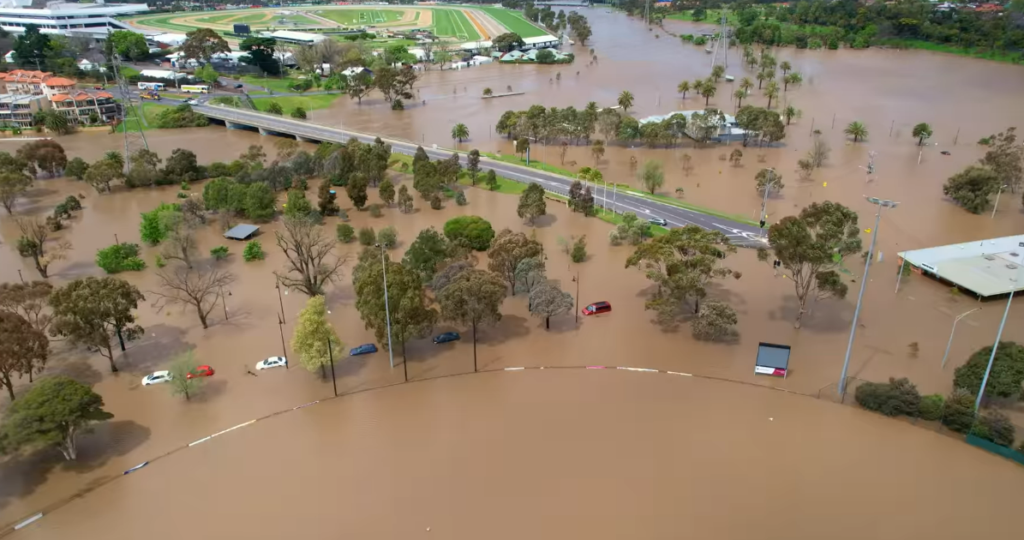
Part of the issue is the uncertainty inherent in these statistical labels, which merits more candid discussion than it usually receives. The error range for what counts as a 1,000-year event in that area is between 7.5 and 15 inches of rainfall in a 24-hour period, according to researchers at Washington University who examined NOAA’s precipitation frequency estimates for the St. Louis storm. This range is so broad that it includes a factor of two. “Anything from about 7.5 inches to 15 inches,” according to one researcher.
Based on statistical extrapolation from about a century of observations, the label describes probabilities over a millennium through mathematical stretching. Even in a stable climate, that would be difficult. The historical baseline is deliberately deceptive in one that is changing quickly. In hydrology, the past comprises nearly all of the available data, and the past is no longer a trustworthy predictor of the future.
Zhengzhou, in the Henan Province of China, experienced a rainstorm in July 2021 that dumped a year’s worth of rain in just three days. Fourteen people drowned in the subway system after becoming trapped in underground trains as floodwater poured through station entrances more quickly than anyone could react, accounting for 312 deaths. The subway is underground by design. It was not designed to withstand the sky crashing into it. However, extreme rainfall events are increasingly overwhelming the presumptions built into the infrastructure that manages them. Flood gates, storm drains, culverts, and retention basins are all calibrated to past rainfall frequencies that are no longer relevant. Over the previous fifty years, there has already been a ten percent increase in the frequency of heavy rainfall in the United States. The average precipitation trend is being greatly outpaced by extreme precipitation events. It is necessary to acknowledge that the infrastructure was built for conditions that have already passed in order to catch up.
Reading about how flood frequency is estimated and how those estimates are applied in policy gives the impression that the system as a whole is functioning with an institutional inertia that made sense twenty years ago but is now actually dangerous. Millions of Americans’ land use decisions, building codes, and flood insurance requirements are determined by FEMA’s flood maps, which are frequently decades old, based on outdated hydrological data, and did not take into consideration the systematic upward trend in extreme precipitation that climate models have been predicting and observed data has been confirming. The rate at which precipitation extremes scale with temperature has generally been found to be underestimated by climate models. The difference between what we’re ready for and what’s actually coming may be greater than the official projections indicate if the models are conservative and the trend is accelerating.
Even in the best of situations, practical infrastructure planning is a slow-moving endeavor, so it’s still unclear how quickly the concept of return periods can be updated. Building codes are updated every ten years. Political procedures and in-depth surveys are necessary for flood maps. Stormwater systems have lifespans measured in generations, are buried underground, and are costly to upgrade. However, the storms aren’t holding out for the permit procedure. According to climate projections, by 2040, what is currently considered a 1-in-100-year flood may become an annual occurrence in some coastal areas. That is fourteen years away, which is well within the planning horizon of infrastructure that is currently being planned and constructed to specifications that might be consistently insufficient before the concrete cures.
The Washington University study’s principal investigator, Alexander Thompson, stated unequivocally that “extreme storms and flooding are not going away.” He was referring to St. Louis, but the same statement holds true for Zhengzhou, Houston, central Kentucky, and the four American interior towns that all had the purportedly rarest rainfall events during the same seven-day period in the summer of 2025. The terms “1-in-100-year,” “1-in-500-year,” and “1-in-1,000-year,” which aided engineers and planners in communicating risk, were never intended to foster complacency. However, the words have outlived the world they depicted. We can no longer wait for the next flood to remind us that we need to find new ones and new standards to go along with them.
