

A freight locomotive rolled silently along a section of track between Aulnoye and Busigny on a gloomy morning in northern France. There was no cheering crowd, no dramatic unveiling. Radar feeds and lidar readings flickered across monitors as engineers inside the cab watched screens rather than the horizon. The moment felt both routine and subtly historic as France tested fully autonomous cargo trains on high-speed routes.
The project has been underway for a number of years, spearheaded by SNCF in partnership with Alstom, Thales, Bosch, and the Railenium Institute. Around 2020, early prototypes started operating with some autonomy before progressively increasing the degree of automation. The goal is now more obvious: go toward GoA4, or complete autonomy, with remote supervision taking the place of the traditional driver’s constant control. If this change is successful, it might have a greater impact on freight rail in Europe than any timetable change ever could.
The actual test train appears to be nearly unremarkable. body made of steel. typical freight wagons. Lines overhead hum softly. However, cameras, radar units, and lidar sensors mounted on its sides and nose scan the tracks ahead, identifying obstacles, deciphering signals, and computing braking curves in real time. There is a slight sense of incredulity as you watch it leave a siding yard, accelerating smoothly without any obvious intervention. Trains have always seemed to be operated by humans, using judgment, experience, and instinct.
The reasoning of SNCF is practical. Paris-Lyon and other busy corridors are getting close to capacity. Capacity could be increased by up to 25% by automating braking and acceleration and decreasing headways between trains. Investors appear to think that automation is more about optimizing flows—smoothing out the inconsistencies that human reactions invariably introduce—than it is about eliminating drivers. However, one can’t help but wonder how unions and seasoned engineers feel about algorithms taking over.
| Category | Details |
|---|---|
| Country | France |
| National Rail Operator | SNCF Group |
| Key Industrial Partner | Alstom |
| Technology Focus | Fully Autonomous (GoA4) Freight & High-Speed Trains |
| Test Locations | Northern France (Aulnoye–Busigny, Calais), National Network |
| Oversight Authority | EPSF (French National Railway Safety Authority) |
| Cybersecurity Partner | ANSSI |
| Target Benefits | Up to 25% capacity increase, improved efficiency, energy savings |
| SNCF Official Website | https://www.sncf.com |
| Alstom Press Information | https://www.alstom.com |
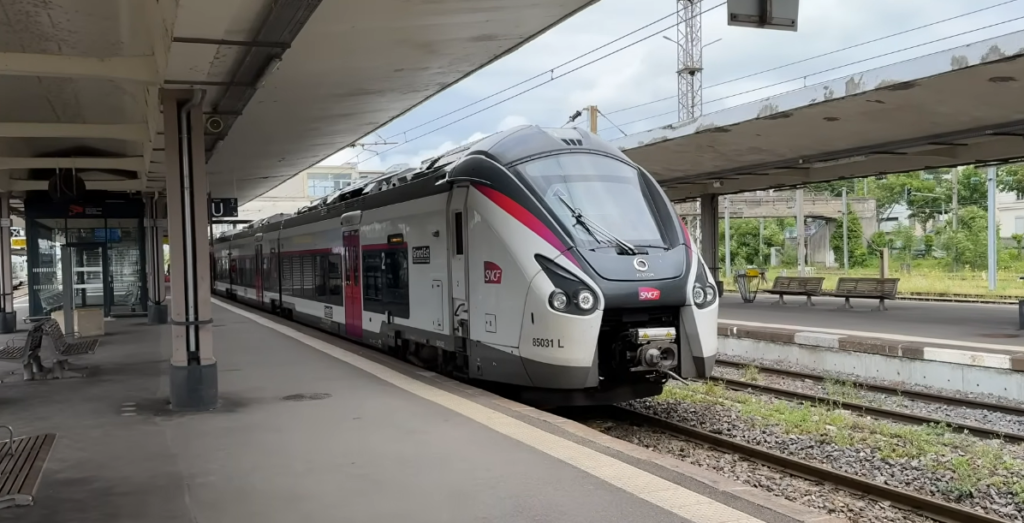
At Alstom’s Crespin location, a Regio 2N regional train was equipped and modified for the initial trials before being sent onto commercial tracks with engineers aboard. The sensors learned how signals appear in different light and weather conditions by gathering data without regulating movement. It’s a methodical procedure. The system needs to be able to identify not only a red signal but also one that is partially hidden by glare, fog, or rain. There is no room for doubt in rail safety.
The flexibility provided by cargo operations makes the freight trials especially important. Because trains can operate without passengers, engineers can test automated responses and braking profiles in a controlled environment. Technicians were reportedly huddled around laptops in a yard close to Calais while the locomotive performed automated acceleration tests, its movements measured and exact. It was a technical, almost muted atmosphere. No bottles of champagne. only streams of data.
Safety is still the main priority, of course. The trials have been approved by the French National Railway Safety Authority, or EPSF, which is closely monitoring progress. Because they understand that a connected, automated train needs to be protected from digital intrusion just as strictly as from trackside hazards, ANSSI cybersecurity teams are involved from the beginning. Whether public opinion will catch up to technological capabilities is still up in the air. For decades, automation in aviation has been accepted, but rail feels different because it is more visible and closer to everyday life.
A larger European context is also present. Germany’s DB Cargo is experimenting with Automatic Train Operation, while the Netherlands has started testing autonomous freight operations on the Betuweroute. France is determined not to fall behind. As these initiatives take shape, a silent race is being waged—not for show, but for cost and operational efficiency.
One can feel the rush of passing trains, the shifting air pressure, and the vibrating gravel beneath their feet when standing next to a high-speed line close to Valenciennes. It almost seems unreal that a freight convoy or TGV might travel 300 km/h in the future without a driver operating the controls. However, parts of Paris and Lille’s metros are already automated. Instead of feeling revolutionary, the progression feels evolutionary.
Before full deployment, SNCF maintains that driver-supervised automation, or semi-autonomy, should be the immediate objective. That detail is important. At least for the time being, humans are still present to supervise the system and take action when necessary. However, history indicates that complete autonomy becomes less radical and more commonplace as dependability increases and public trust levels level out.
Additionally, there are financial incentives. Energy savings of up to 15% are promised by automated driving patterns. Schedules that are more predictable, less downtime, and fewer delays brought on by human error. Those margins are important to freight customers who have limited delivery windows. Trucking and rail compete, and automation may shift the scales back in favor of rail, reducing emissions and alleviating traffic on the highways.
However, there is a faint uneasiness when you watch a freight locomotive move forward, reacting to invisible code instead of instinct. Railways have long been associated with human coordination and industrial strength. That symbolism changes when the driver is removed. Instead of using hand signals and whistles, it turns into a network controlled by algorithms and remote supervision centers.
The speed at which automation is becoming commonplace across industries is difficult to ignore. Trucks, automobiles, warehouses, and now high-speed railroads. It’s possible that France’s experiment will be a quiet success, blending in with everyday logistics. Adoption may also be slowed by technical, cultural, or regulatory obstacles.
