

Not all endeavors end spectacularly, but rather with a subtle shift in direction. This week’s closure of Amazon Fresh and Go outlets was announced in a controlled news release rather than with pyrotechnics or ceremonial farewells. The wording was cautious, even operative. It said, “We haven’t yet developed a truly unique customer experience with the appropriate economic model.” Just a redirection, no apology or spin.
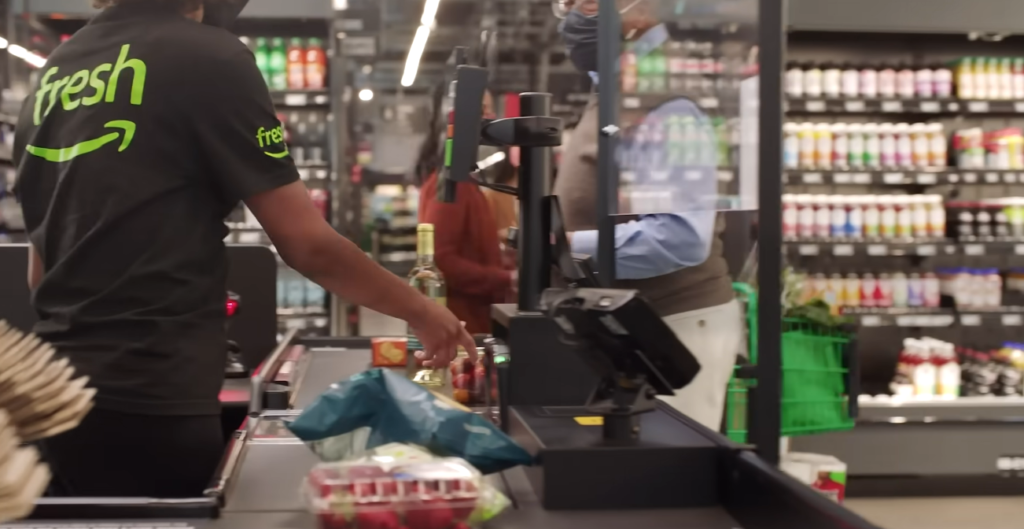
These stores were introduced as physical expansions of Amazon’s Fresh delivery network, promising a smooth, technologically advanced future. Dash carts with smart features allowed customers to bypass the checkout line. Cameras followed objects. Employees were replaced by sensors. However, in spite of these advancements, the stores frequently had an oddly silent vibe—futuristic but emotionally vacuous.
15 Amazon Go convenience stores and 57 Amazon Fresh supermarkets will be closed, the company announced in recent days. Major cities like Naperville, Schaumburg, Rancho Mirage, and Cerritos are also affected by these closures. Certain ones will be transformed into Whole Foods stores, while others will stay in limbo. Amazon is currently rewriting its grocery playbook around what it refers to as “deeply familiar convenience,” which was previously highly weighted toward technology-first experiences.
The closures had long been anticipated in several localities. The green sign in Rancho Mirage that promised a new Amazon Fresh had subtly vanished months before the public was informed of the official decision. The store never opened. Unexpectedly, local authorities acknowledged that Amazon had kept up rent payments, giving them hope that the project may still proceed. It wasn’t, though.
| Detail | Information |
|---|---|
| Topic | Closure of all Amazon Fresh and Amazon Go physical stores |
| Announced By | Amazon, January 27, 2026 |
| Total Stores Affected | 57 Amazon Fresh, 15 Amazon Go |
| Reason for Closure | Lack of a “distinctive customer experience” and weak economic scalability |
| Future Plans | Some locations converted to Whole Foods; expanded focus on Same-Day Delivery |
| Reference | aboutamazon.com |
Amazon has experimented with many retail formats over the last ten years. While some were discreetly phased out, others failed quickly. This motion is significantly different because it’s a conscious move toward what’s working rather than merely a retreat. Amazon’s 2017 acquisition of Whole Foods continues to be a pillar. Both the number of stores and its cultural significance have greatly increased. Over 100 new Whole Foods stores, including smaller-format Daily Shops that specialize in grab-and-go necessities, will be opened by Amazon in the coming years.
Amazon discovered trends in consumers’ actual shopping habits by utilizing sophisticated analytics, particularly with regard to food. Since January 2025, Same-Day Delivery requests for perishable items have reportedly multiplied forty times. The majority of consumer orders now consist of fresh commodities in areas where they are available. It’s a very obvious indication that convenience is about time, not just proximity.
In 2024, I had the experience of strolling through one of the Chicago Go stores. It was sleek and strangely immaculate. It was striking that there were no checkout lineups. Nevertheless, the encounter seemed fragmented. Nobody said hello to you. No scents of baked bread or fresh veggies. The warmth was lacking, despite the remarkable efficiency.
A noticeably better emphasis on Amazon’s advantages—logistics, data, and flexibility—is evident in this selection. Many Silicon Valley-inspired businesses find it difficult to balance the human touch and technology needed for physical stores. Retail is a social ritual as much as a supply chain.
Amazon is embracing familiarity while upgrading accessibility by growing Whole Foods and Same-Day Delivery. The approach is especially creative in that it recognizes mistakes without portraying them as failures. It is a remix rather than a rejection of grocery retail.
Naperville, Morton Grove, Oak Lawn, and North Riverside are just a few of the several Illinois communities that are impacted. Chicago’s downtown Go shops will also close. The brand’s online presence is expected to increase while its physical presence declines. Amazon stressed that even if its physical stores close, Fresh as a service will still be available.
In light of changing customer behavior, the closures are more of a recalibration than a setback. More and more Americans want their groceries delivered to their door rather than waiting in bright aisles. More and more consumers favor efficiency over spectacle and stability over novelty.
Amazon’s next venture is the smaller, convenience-focused Whole Foods Market Daily Shop. These shops seek to combine simplicity, rapidity, and intimacy at the community level. Pre-packaged meals, coffee, and necessities—all within a few hundred feet. This rotation, if done correctly, could be incredibly successful in recovering territory that has been lost to chains with greater agility.
Baskets may never be filled or shelves stocked at the Rancho Mirage store, which is still vacant and officially still under contract. However, it represents a more general change in perspective. Amazon closes its doors on one vision while opening others based on user feedback, lessons learned, and economic clarity.
With the help of strategic alliances and extensive system integration, Amazon’s retail division is getting closer to its core competency—scaling what works. Whole Foods and its delivery networks are being positioned as the new standard-bearers of its grocery ambitions by optimizing operations and releasing resources from low-traction assets.
The grocery industry will probably become more fragmented in the upcoming years; some customers will favor small-footprint stores, while others will prefer autonomous delivery lockers. Amazon’s withdrawal from Fresh does not signify capitulation. It demonstrates a business’s maturity in adjusting, changing course, and optimizing before losses worsen.
That clarity is admirable in some way.
And it might turn out to be a really effective path ahead in the long run.
