

At first glance, the scene in a field in the northeastern French town of Amance is truly bizarre: long rows of more than 5,000 solar panels raised above the ground, with crops growing beneath them in the dappled shade the panels cast across the ground. The light shifts across the field as the day goes on, the panels are angled, and the entire arrangement feels both spontaneous and completely planned. It is, in a way. For many years, agrivoltaics—the simultaneous production of solar energy and food on the same plot of land—has been considered as a theoretical possibility. It has only lately begun to appear as something that could truly change the way agricultural land is used.
It is difficult to reject the idea’s fundamental math. Solar development and agricultural land have been at odds for years as nations under pressure to increase their capacity for renewable energy started considering the same open, level land that farmers rely on. That conflict is especially evident in the Netherlands, where about 70% of the land is already used for agriculture and there is intense competition for available space. The conflict can be summed up as follows, according to Martijn van der Pouw, a business developer at Statkraft Netherlands: the nation lacks a clear surplus of either energy or food. According to his interpretation, agrivoltaics is a method of settling disputes rather than just choosing a winner.
The key efficiency calculation looks like this: if an agrivoltaic installation simultaneously generates 70% of the electricity a standard solar farm would produce on the same acreage and 70% of the food a field would typically yield, the combined output is 140% of what either use would have produced on its own. That is a significant increase in the productive value of a single piece of land, accomplished by layering two uses rather than making a decision between them. It is not a dramatic transformation of either activity. The financial case is simpler for a farmer who receives both crop income and lease payments for energy generation than it might seem on a spec sheet.
IMPORTANT INFORMATION TABLE — AGRIVOLTAICS
| Category | Details |
|---|---|
| Term Definition | Agrivoltaics (also: agrophotovoltaics, agri-PV, agri-solar) — dual-use practice of growing crops or grazing livestock under elevated solar panels |
| Origin of Term | First formally introduced by researcher Christophe Dupraz, whose work showed soil moisture increased 35–73% under solar panels |
| Core Principle | Same land area produces both food and electricity simultaneously |
| Land Use Efficiency | A site producing 70% of normal agricultural output AND 70% of normal solar output is effectively 140% utilized |
| Water Conservation | Panels reduce evaporation and soil moisture loss by up to 15–50% (varies by study and region) |
| Agricultural Target | General goal: at least 70% of pre-installation agricultural productivity maintained |
| Panel Height | Typically 2–5 metres above ground to allow machinery access; higher installations more costly |
| Crops That Thrive | Leafy greens, herbs, root vegetables, broccoli, onions, potatoes, strawberries, raspberries; vines and olives in southern climates |
| Livestock Use | Sheep grazing under panels handles weed management; common in Spain, Netherlands, US |
| Solar Panel Efficiency Benefit | Crops provide cooling effect that improves panel operating efficiency |
| Key Projects | South Korea (broccoli, Chonnam National University); Kenya (elevated panels over vegetables); France, Amance (5,000 panels, 2.5MW); Netherlands and Italy (Statkraft) |
| Research Backing | U.S. DOE, University of Minnesota Extension, University of Bari/Statkraft Italy partnership |
| Main Challenge | Equipment access, panel design costs, crop-specific light requirements, farmer skepticism |
| US Government Involvement | DOE’s FARMS (Foundational Agrivoltaic Research for Megawatt Scale) program actively funding research |
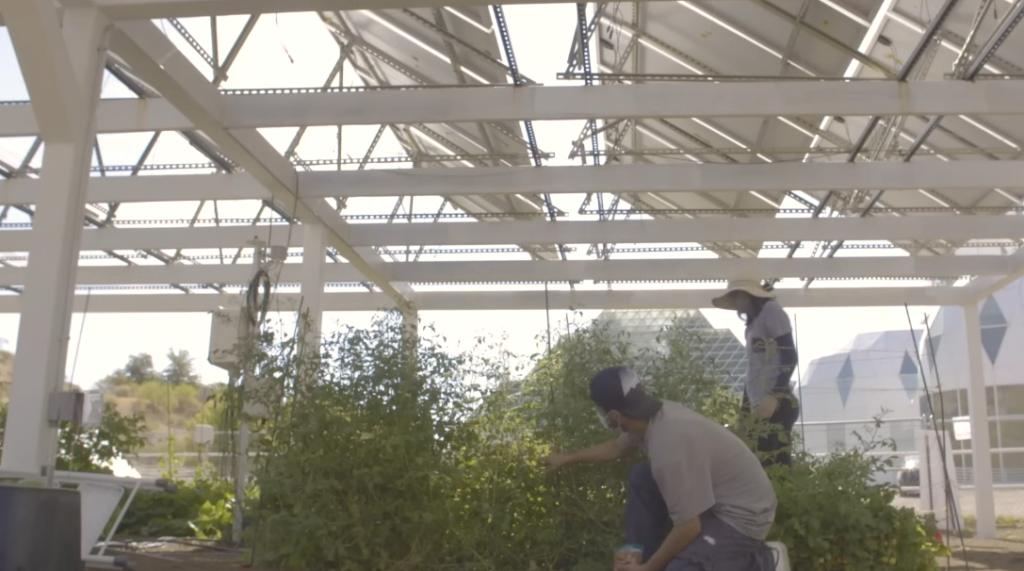
Many researchers have been taken aback by how well certain crops perform under panels as opposed to just enduring the conditions. A group from Chonnam National University in South Korea cultivated broccoli beneath solar panels that were positioned two to three meters above the ground at a 30-degree angle. The broccoli produced had a deeper shade of green, which made it more aesthetically pleasing to consumers, and it was in no way inferior to broccoli grown in the field. Higher-value crops can now be grown on previously marginal land in Kenya thanks to elevated panels that shield vegetables from extreme heat and moisture loss. Under those circumstances, the panels serve in part as infrastructure, prolonging the growing season and broadening the scope of what is feasible on stressed land.
In areas where agricultural economics are already being strained by drought conditions and irrigation costs, the water dimension is particularly important. Plants exposed to direct sunlight have a lower atmospheric demand for moisture and less evaporation from the soil’s surface thanks to panels. When compared to open-field conditions, studies have found increases in soil moisture of 35 to 73 percent under panels. Drought has made farming more costly and unpredictable in southern Italy, where Statkraft is building agrivoltaic projects. According to Costanza Rizzo, the company’s Agri-PV Senior Developer in Italy, farmers in the area are becoming less skeptical and more cautiously interested as the drought makes it more difficult to ignore the arguments for shade and moisture retention.
As this industry develops, it seems to be in a similar stage to that of organic farming or precision agriculture prior to their widespread adoption: sincere, technically sound, somewhat specialized, with a growing body of evidence but not yet a default assumption in farming practice. The difficulties are genuine. The most enduring issue is equipment access: solar panels placed at low heights obstruct the path of tractors and harvesters, and modern agriculture is highly mechanized. Mounting panels five meters above the ground is one way that some installations address this issue, but it is costly and currently unfeasible without subsidies. Others allow machinery to move between rows by using rotating panels that can tilt vertically. The engineering decisions have an impact on the per-acre economics as well as the energy output calculations, and neither solution is simple.
In order to optimize designs and remove obstacles to broader adoption, the U.S. Department of Energy has funded a special program called the Foundational Agrivoltaic Research for Megawatt Scale initiative. The University of Minnesota Extension is monitoring livestock-based agrivoltaic systems, in which sheep manage vegetation and graze beneath panels at the same time, doing away with the need for separate mowing operations. Statkraft and the University of Bari in Italy entered into a four-year research agreement with the specific goal of determining which crops thrive in southern European conditions under which panel configurations.
The rate at which agrivoltaics will expand from demonstration projects to a sizable share of agricultural land use is still unknown. The best crop-panel combinations are still being determined in field trials, the economics are site-specific, and many countries’ regulatory frameworks have not kept up with the practice. However, as both food systems and energy systems are under simultaneous pressure, it is becoming more difficult to refute the underlying logic, which holds that land is too valuable and scarce to be used for just one purpose when it can legitimately serve two. In South Korea, the broccoli beneath the solar panels is not an oddity. It’s a functional proof of concept. Whether farmers, developers, and policymakers choose to take it seriously at scale will largely determine what happens next.
