

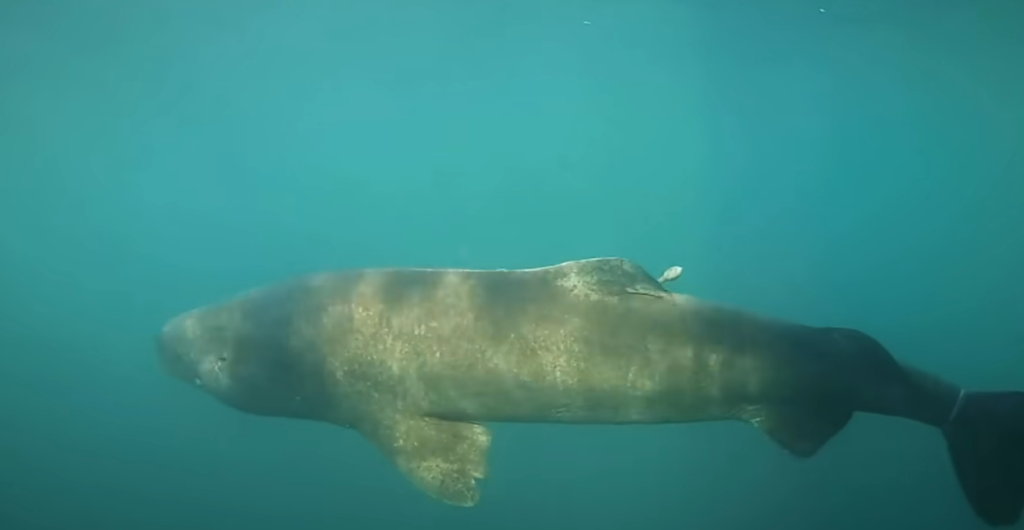
It outlives entire generations, but it moves more slowly than an escalator. The Greenland shark, which resembles a ghost in both appearance and behavior, is not merely ancient. It’s changing our perception of what longevity in nature looks like. At one point, scientists thought these animals were blind scavengers that floated across the dark waters of the Arctic. But that story has dramatically evolved, and with it, our understanding of aging, survival, and the role of patience in evolution.
For decades, the shark’s murky eyes, typically shrouded by dangling copepod parasites, misled biologists assume blindness. However, a group of marine scientists researching retinal structure earlier this year found something remarkably comparable to visual potential: functional, healthy light receptors hidden behind the blur. Perhaps these sharks are not blind after all. In a setting characterized by chilly darkness, they might just perceive differently—and more effectively—than one might anticipate.
They are slow, yeah. Exceptionally sluggish. One researcher compared them to a piece of living stone, growing at just a centimeter a year. Yet somehow, these animals manage to travel great distances—likely over entire ocean basins—without being noticed. Their reach is quite adaptable. We’ve hardly mapped their travels, as evidenced by one observation close to the Caribbean, thousands of miles from their typical range.
Back in 2016, researchers employed a clever workaround to calculate the age of Greenland sharks: radiocarbon dating of proteins in the lens of the eye. These proteins are time capsules of the shark’s birth because they are metabolically inert—once formed, they do not renew. One girl measured about five meters long was thought to be roughly 400 years old. Her birth most certainly occurred before Shakespeare’s last plays, even by cautious estimates.
| Item | Details |
|---|---|
| Species Name | Greenland Shark |
| Estimated Longevity | 272 to 512 years (radiocarbon range); median ~400 years |
| Discovery Methods | Eye lens radiocarbon dating and retinal molecular analysis |
| Research Locations | Arctic regions – Tremblay Sound, Scott Inlet, Svalbard, etc. |
| Notable Researchers | Jena Edwards, Nigel Hussey, Eric Ste Marie |
| Unique Traits | Slow-growing, possibly sighted, deep-water generalist predator |
| Conservation Concerns | Unknown reproduction cycles, late maturity (~150 years), climate shifts |
The accuracy of that method is a matter of debate. Nigel Hussey, who has spent much of his career studying these elusive giants, finds the concept extremely ingenious yet imperfect. Radiocarbon dating is calibrated for fossils and ancient relics, not centuries-old creatures. Nevertheless, he admits that the Greenland shark is “remarkably resilient” and most likely the longest-living animal.
Hussey witnessed a Greenland shark fly down the water column with surprising agility while diving close to Svalbard. Instead of floating aimlessly, it made deliberate motions, descending nearly vertically and precisely adjusting its location. That moment challenged everything we thought about how these sharks act. I recall hesitating when I read that narrative again because, for some reason, that picture seemed more personal than dramatic.
There’s a quiet intellect at work behind the surface. Their diet includes huge mammals—moose, polar bears, even narwhals—found whole in their stomachs. These meals were probably not all scavenged. Inuit oral stories recount Greenland sharks ambushing sleeping seals or sitting stealthily at breathing holes in the ice. These sharks don’t just tolerate; they strategize.
This adds to the frustration of their reproductive enigma. The last pregnant female was documented in 1950. We still don’t know where they give birth, how many pups survive, or how frequently they reproduce, more than 75 years later. The majority of Greenland sharks seen now are youngsters or subadults, according to marine biologist Jena Edwards, indicating that we might be witnessing the long-term effects of overfishing that halted decades ago.
Historically, their liver oil was extracted for machine lubricant, making them a target for commercial extermination through the early 20th century. Now that the strain has greatly reduced, the population may still be recuperating at glacial speed—each generation requiring roughly two centuries to mature.
Another layer of uncertainty is added by climate change. Ecosystems change as Arctic seas warm, but Hussey thinks Greenland sharks will adjust since they are generalist feeders. They are especially hardy since they can eat a variety of species, even if their feeding zones shift southward or deeper. They may still be vulnerable in ways we haven’t anticipated, though, due to the cascade consequences of changed food webs and ice cover.
There’s a conservation lesson buried in this patience. These sharks show the value of long life not as a luxury, but as a necessary for survival in difficult, altering surroundings. They move slowly but methodically, conserving energy in ways that are highly efficient for deep-ocean survival. Their perspective could be constrained by design, screening only what’s important. Even their skin, covered in parasitic life, seems to show a tolerance for cohabitation rather than a fight for control.
The thought of a creature outliving civilizations, traveling beneath the ice while revolutions unfurled above, is quietly profound. Greenland sharks serve as a reminder that progress isn’t always achieved at high speed. In some circumstances, survival prefers quiet, silence, and time.
As science goes deeper into the Arctic’s twilight zones, it’s becoming exceptionally evident that these sharks are not ancient outliers. They’re finely honed survivors—thriving in conditions we still struggle to model, and navigating through waters we have yet to fully map.
