

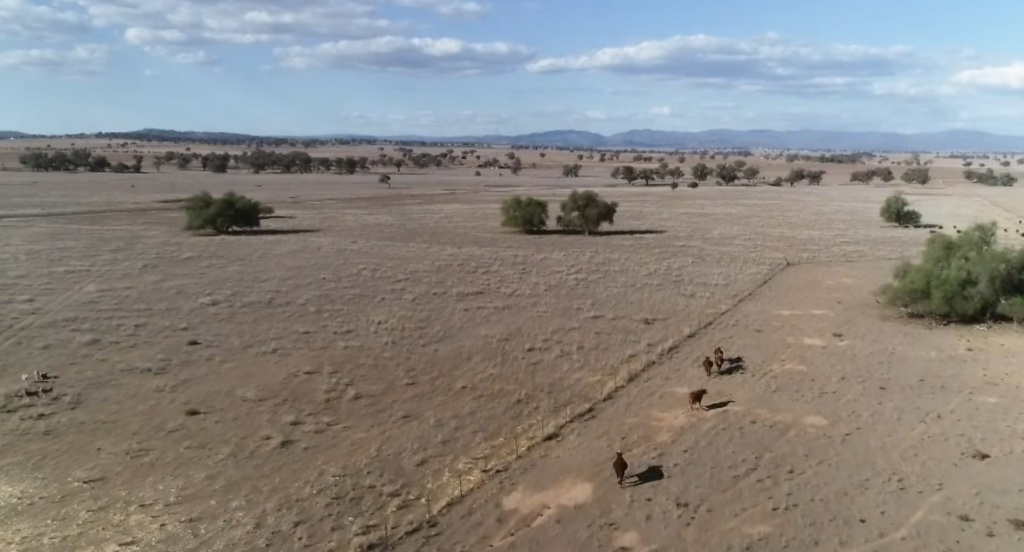
The hills outside of Santiago in central Chile now have a different appearance. At first glance, the color is still rolling and brown, but it feels flatter and almost dusty, suggesting something missing rather than seasonal. Farmers kick at soil that crumbles too easily while walking fields that used to retain moisture longer into the year. It’s a long time to wait for rain—fifteen years.
Around 2010, Chileans witnessed yet another dry cycle that gradually refused to end. There was a certain quiet optimism in the early years. People believed that things would improve the following winter. Then the next one. However, season after season, the rain continued to fall short of expectations, making what should have been transient into something much more stubborn. Eventually, scientists began referring to it as a megadrought instead of a drought.
That label has an unsettling quality. It implies both permanence and scale. A drought that acts more like a condition than an event.
Glaciers have been performing silent, unseen labor throughout the Andes, melting just enough each summer to sustain cities downstream, feed reservoirs, and keep rivers alive. Meltwater has increased significantly in extreme years, sometimes making up for rainfall deficits that would have otherwise severely damaged water systems. However, there is a price for that compensation.
These glaciers are getting smaller and losing mass more quickly than they can replenish it. According to certain estimates, by the end of the century, over half of their volume may vanish. Observing satellite photos over time gives the impression that something old is gradually being removed, as though the mountains themselves are being altered.
| Category | Details |
|---|---|
| Region | South America (Chile, Argentina, Andes region) |
| Phenomenon | Megadrought (multi-year extreme drought) |
| Duration | ~15 years (since around 2010) |
| Key Cause | Reduced rainfall + rising temperatures |
| Natural Buffer | Andes glaciers (rapidly shrinking) |
| Glacier Loss Projection | 55%–78% by 2100 |
| Economic Impact | ~$1.2 trillion (estimated across sectors) |
| Affected Sectors | Agriculture, mining, water supply, energy |
| Key Risk | Loss of glacier “water reserves” |
| Reference 1 | NASA Earth Observatory Drought Report |
| Reference 2 | Drought.gov Megadrought Overview |
Additionally, it poses an unanswered question: what happens when that backup runs out?
According to reports, glacier melt increased significantly above average levels in 2019, one of the driest years, momentarily stabilizing river flows. That bought time for cities, agriculture, and businesses that rely on consistent water supplies. However, it also hastened the depletion of the very resource that allowed for survival.
The system may have been taking inspiration from its future.
In areas like the Maipo River basin, where water sustains both large-scale agriculture and drinking supplies, there is a special tension. Vineyards cover valleys that were formerly dependent on steady snowmelt. These days, irrigation schedules are more precise, calculated, and occasionally unpredictable.
Employees adapt. Systems change. However, it seems that adaptation is turning out to be more reactive than anticipated.
Another layer is added by mining. About 25% of the world’s copper is produced in Chile, and the extraction process uses a lot of water for cooling equipment, dust control, and ore processing. That demand fits into the system in a typical climate. It begins to feel like pressure is building inside a closed loop during a megadrought.
The damage has started to be quantified by economists, with figures reaching the trillions over time, but those figures seem abstract in comparison to the smaller moments. An arid canal. A reservoir line is slowly descending. A farmer deciding which area of land should not receive water.
As this develops, there’s a sense that the crisis isn’t loud enough to compel quick action.
Maybe part of the issue is that nobody fully anticipated this. Even the most advanced climate models failed to predict a drought this persistent. Now, some researchers acknowledge that those models may underestimate extreme events, particularly in terms of duration. That doubt persists.
It’s still unclear if megadroughts in the future will exhibit comparable trends or worsen. Increased evaporation due to warmer temperatures weakens the entire hydrological cycle by drying soil more quickly and decreasing snowpack. However, it’s still unclear exactly what caused this drought to last so long and why it didn’t end.
Planning is made more difficult by this ambiguity.
On the ground, there is also a slight change in language. The term “desertification” is now more frequently used in Chile, not as a far-off possibility but as something that is slowly making its way south. Long restricted to the north, the Atacama Desert now feels less remote than it did.
There is a feeling that boundaries are being subtly redrawn by geography itself.
Different communities are reacting differently. Some areas are making expensive investments in desalination plants to extract freshwater from the ocean. In a nation where water has long been privatized, others are reexamining the politically delicate topic of water rights. While urban planners reconsider supply systems, farmers experiment with crops that require less water. It doesn’t seem like a comprehensive solution.
Because duration—rather than just water scarcity—is the deeper problem. One dry year is manageable. You can absorb two or three. At fifteen, expectations, behavior, and even identity start to shift.
It’s difficult to ignore how the topic of discussion has changed from recuperation to endurance.
Scientists believe that as the world warms, megadroughts could become more frequent. Though not constant, it occurs frequently enough to completely alter an area. If that is the case, South America’s current situation may be an early example rather than an anomaly. And there is weight to that possibility.
Because a system rarely reverts to its initial state once it has adapted to scarcity. Even though the cities and rivers continue to run, something fundamental shifts. A silent recalibration of sorts.
