

The idea of a thirty-foot dinosaur being remembered primarily for its teeth seems a little ridiculous. However, if you bring up the Nigersaurus in a museum or online discussion board, someone will unavoidably mutter, “That’s the one with 500 teeth.” Perhaps no other dinosaur has been reduced to a dental statistic so rapidly.
However, the humor wanes when one is confronted with a cast of a Nigersaurus taqueti’s skull. It has a broad, squared-off muzzle that looks almost mechanical, like a vacuum attachment set into bone. Instead of being securely nestled inside, the teeth are positioned in orderly rows along the very front edge of the jaws. It resembles an agricultural tool more than a prehistoric monster.
It is not a coincidental impression.
About 110 million years ago, Nigersaurus lived in what is now the Sahara Desert of Niger. This was not endless sand in the past. It was a system of lowland rivers, covered in ankle-deep mud, horsetails, and ferns. The fossils were discovered in Gadoufaoua, a secluded location where wind continues to move dunes during the night, occasionally re-covering findings from the previous day. Bones so thin that light could pass through them are described in field notes from the late 1990s. It’s difficult not to imagine scientists squatting beneath a blazing sky, raking sand away from vertebrae that hadn’t seen light since the Cretaceous.
Paul Sereno and his group weren’t merely adding another long-necked dinosaur to the list when they formally described Nigersaurus in 1999. They were subtly questioning preconceived notions about the lifestyles of giant herbivores. Most people think of sauropods as giraffes that reach high into treetops. The opposite was true for Nigersaurus.
| Category | Information |
|---|---|
| Scientific Name | Nigersaurus taqueti |
| Meaning | “Niger reptile” |
| Discovered By | Paul Sereno and team (1997–1999) |
| Location | Gadoufaoua, Niger (Sahara Desert) |
| Age | ~115–105 million years ago (Middle Cretaceous) |
| Length | Approx. 30 feet (9 meters) |
| Weight | Around 2–4 tons |
| Family | Rebbachisauridae |
| Distinctive Feature | Over 500 replaceable teeth |
| Notable Technology | CT-based digital skull reconstruction |
| Institution | University of Chicago |
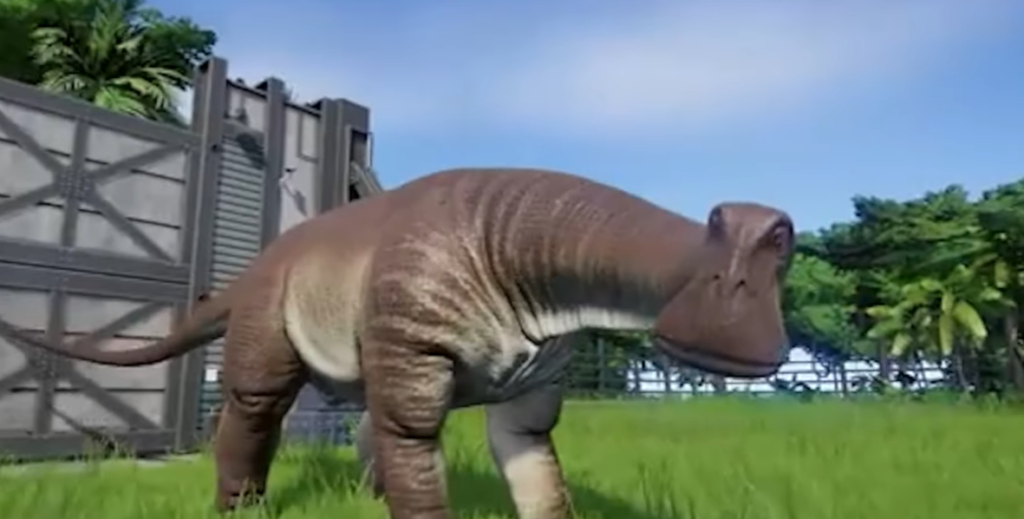
Later, CT scans showed something amazing: the structure of the inner ear indicated that its head was inclined downward by nature. This animal was not looking at the horizon, to put it another way. It had its eyes on the floor. all day.
It seems that Nigersaurus evolved for practicality rather than beauty. Up to seven replacement teeth were occasionally stacked behind each active tooth, and its teeth were changed every two weeks. Ingesting grit, sand, and silica-rich vegetation is the result of feeding on low-growing plants. Enamel is punished by that. Nigersaurus simply outpaced the damage, continuously renewing its teeth like a conveyor belt, rather than defending them.
It’s difficult to overlook the parallel when you watch cattle graze in a contemporary pasture, heads down, sweeping back and forth. Although a little tongue-in-cheek, the term “Mesozoic cow,” which some paleontologists have given it, accurately describes something fundamental. Nigersaurus wasn’t being careful with its browsing. They were cutting the lawn.
Even the skull itself seems unlikely. So open, so light, supported by cavities filled with air, like those in birds. And that delicacy is surprising for a four-ton creature. Today’s large mammals support their mass with heavy, thick bones. Nigersaurus and other dinosaurs adopted a different strategy, reducing their internal weight while expanding externally to reach remarkable proportions. Even now, this engineering solution seems to be ahead of its time.
How this feeding strategy influenced its day-to-day existence is still unknown. Did herds remove vegetation near the ground as they moved slowly across floodplains? Were they at risk from predators that were part of the same ecosystem as Suchomimus? Instead of scenes, the fossil record provides fragments. However, it seems realistic to picture a line of these enormous, broad-muzzled creatures sweeping across old wetlands, raking up dust and insects.
The cultural legacy of Nigersaurus must also be taken into account. Its name frequently sparks awkward jokes or pronunciation misunderstandings on the internet. Teachers gently refocus the discussion on anatomy and ecology in museum settings. It’s difficult to ignore how easily intricate paleobiology is reduced to viral trivia. The dinosaur is remembered by the public because of its curiosity, despite its awkwardness.
And maybe that makes sense. Because there is a truly radical animal underneath the meme. Dinosaur ecosystems were more layered than previously thought, as Nigersaurus demonstrated. Not every giant was aiming for the sky. Instead of towering sauropods like Apatosaurus, some were occupying a niche more akin to contemporary grazing mammals and controlling the understory.
It exudes a sense of quiet humility as it stands in front of its restored skeleton, its neck arcing modestly forward rather than dramatically upward. Success stories in evolution are not always about strength or height. Persistence is key at times. Teeth deteriorating, regrowing, and deteriorating once more.
