

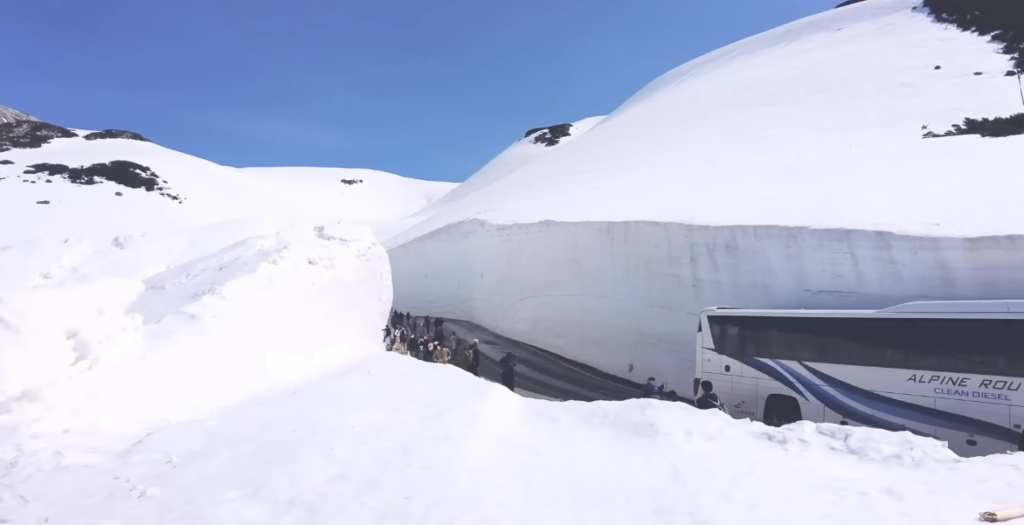
This winter in Aomori, the snow didn’t fall so much as it came in; it was heavy, persistent, and almost theatrical. Trains slowed to a crawl, rooflines vanished under thick white layers, and soldiers were once called in for shovels rather than defense. It’s difficult to ignore how the sheer weight of it all felt different this time—not just another snowy season, but something stronger, almost demanding.
Snow is nothing new in Japan. Heavy snowfall has long been considered a common annoyance in places like Sapporo, where winter is measured in meters rather than inches. However, it felt different this year. Snowfall in some places reached levels not seen in decades, burying roads, breaking power lines, and silently straining infrastructure. Even those who are used to severe winters seem to have been taken by surprise.
The story appears contradictory at first. Why would snowfall increase if the planet is warming? It’s a question that comes up in discussions, sometimes with sincere curiosity and other times with skepticism. However, scientists contend that the physics of a warming planet holds the key to the solution. More moisture is released into the atmosphere by warmer seas, particularly the Sea of Japan. That moisture turns into snow—more, heavier, and falling more quickly—when it collides with the chilly Siberian winds blowing south.
One can practically picture the process taking place while standing close to coastal towns along the Sea of Japan. Thick, powdery layers of moisture are dumped inland when cold air spills over comparatively warm water. This combination of cold air outbreaks and warmer oceans may be producing an amplified winter that is both familiar and oddly exaggerated.
The fact that not all snow is the same anymore is also becoming more widely acknowledged. These intense bursts, in which snowfall accumulates quickly over brief periods of time, are now referred to by meteorologists as “bomb snow.” Although the phrase seems dramatic, it doesn’t seem totally out of place when watching videos of entire neighborhoods being covered overnight. However, it’s still unclear if these occurrences will become the new norm or continue to be sporadic extremes.
| Category | Details |
|---|---|
| Country | Japan |
| Key Regions Affected | Hokkaido, Aomori, Niigata |
| Event | Record-breaking snowfall (Winter 2026) |
| Climate Factor | Warmer sea temperatures increasing moisture |
| Scientific Insight | ~7% increase in snowfall linked to climate change |
| Key Phenomenon | “Sea-effect snow” and cold air outbreaks |
| Impact | Infrastructure collapse, transport disruption, fatalities |
| Long-Term Trend | Overall decline in average snowfall |
| Reference 1 | NASA Earth Observatory Snow Analysis |
| Reference 2 | Tokio Marine Climate Insight |
It has been more difficult to overlook the human cost. What might otherwise be considered a seasonal spectacle has taken on a somber tone due to dozens of deaths, many of which involved elderly residents clearing snow from rooftops. Managing heavy snowfall feels more difficult every year in smaller towns with aging and declining populations. As this develops, there is a subtle conflict between tradition and evolving reality, between resiliency and vulnerability.
The long-term trend further complicates the discussion. Over the past few decades, overall snowfall in Japan has decreased despite these heavy snowfalls. Generally speaking, winters are becoming warmer. In some places, snow is increasingly becoming rain. Once consistently covered in snow early in the season, Mount Fuji itself has shown indications of a delay. It’s a paradox that defies easy explanation.
There’s a feeling that this complexity hasn’t been fully acknowledged by the general public. Buried streets are cited by some as proof that the earth cannot possibly be warming due to heavy snowfall. On the other hand, some contend that these extremes are precisely what a disturbed climate looks like. As it frequently is, the truth doesn’t seem as fulfilling. more subtle. less practical.
The experience of Japan is consistent with a larger trend observed elsewhere. Because warmer air retains more moisture, it can cause heavier rainfall in some areas and, in certain situations, heavier snowfall in others. It’s a messy shift rather than a uniform one, changing the seasons in ways that seem erratic. For example, ski resorts may experience record snowfall one year and unsatisfactory conditions the following. Companies adjust, but not without hesitation.
Infrastructure is also undergoing testing. The weight of frequent snowstorms has caused rail networks, which were built with accuracy and efficiency, to falter. Travelers are stranded due to airport closures. In certain places, accumulated snow has caused buildings to collapse. These are signals—minor, cumulative stresses on systems designed for a different climate—rather than isolated incidents.
However, a peculiar form of resilience is also apparent. Local governments swiftly deploy resources, communities organize snow-clearing operations, and residents modify routines to deal with changing circumstances. It’s steady but not dramatic. Realistic. Human.
