

Watching ski resorts in California close because it is too hot to operate in March is truly disorienting. The Sierra Nevada resorts closed because it was too hot to ski or, for that matter, to stand in the sun for any length of time, not because there wasn’t enough snow. The National Park Service put up trail closure signs at Phoenix’s Camelback Mountain to alert hikers to the dangerously high temperatures. The well-known wildflower superbloom in Death Valley, which attracts tourists each spring, came to an early end as temperatures rose above what the desert’s native plants could withstand. These pictures don’t quite fit the mental image that most people associate with “March in the American West.”
Climate historians use superlatives to describe the numbers behind California’s heat dome, but they are insufficient. Four locations in Arizona and California experienced simultaneous temperatures of 112 degrees Fahrenheit (44.4 degrees Celsius) on a Friday in mid-March 2026. That was a full four degrees hotter than the previous record for the hottest March day ever recorded in the continental United States. It was just one degree away from being the hottest day ever recorded in the Lower 48 states in April. These records weren’t set during a recognized drought cycle in July. They were scheduled for March, when a large portion of the nation is still debating whether to keep the winter coat in the closet.
Maximiliano Herrera, a climatologist and weather historian who tracks global temperature extremes with the obsessive precision of someone who has spent decades knowing what the numbers are supposed to look like, created a list of 14 states that experienced their hottest March day ever during this one event. California, Arizona, Nevada, Kansas, New Mexico, Nebraska, Utah, South Dakota, Missouri, Iowa, Colorado, Wyoming, Minnesota, and Idaho. In a six-day period, at least 479 weather stations in those states broke March temperature records, according to NOAA’s National Center for Environmental Information. For 149 years, one station in Winnemucca, Nevada, had maintained records. That record was broken. The record was 136 years old in Elko, Nevada. That one also fell. According to Herrera, the heat in Mexico broke records that had been in place since May, not March. Some of those records were broken by as much as 14 degrees Fahrenheit. He used July 1936, one of the worst months of the Dust Bowl, as a point of comparison. March 2026 outperformed it.
Key Facts: California’s March 2026 Heat Dome
| Event | Record-breaking heat dome, March 2026 — western U.S. and spreading east |
| Peak Temperature | 112°F (44.4°C) at Buttercup & Squaw Lake, California — new state March record |
| Previous U.S. March Record | Broken by 4°F (2.2°C) |
| States Setting New March Records | 14 states: CA, AZ, NV, KS, NM, NE, UT, SD, MO, IA, CO, WY, MN, ID |
| Weather Stations Breaking Records | At least 479 NOAA stations (March 13–19); 1,472 daily records also shattered |
| Oldest Record Broken | Winnemucca, Nevada — 149-year-old record |
| Climate Attribution Finding | Heat made “virtually impossible” without climate change; 800× more likely due to it |
| Climate Change Temperature Addition | At least 4.7°F (2.6°C) added to the event (World Weather Attribution, Imperial College London) |
| Key Meteorologist | Gregg Gallina, National Weather Service Weather Prediction Center |
| Duration | Flagstaff, AZ: 11–12 straight days above previous March record |
| Reference Links | Record Heat Dome Spreading Across U.S. – AP News · Heat Wave Smashes 149-Year-Old Record – AccuWeather |
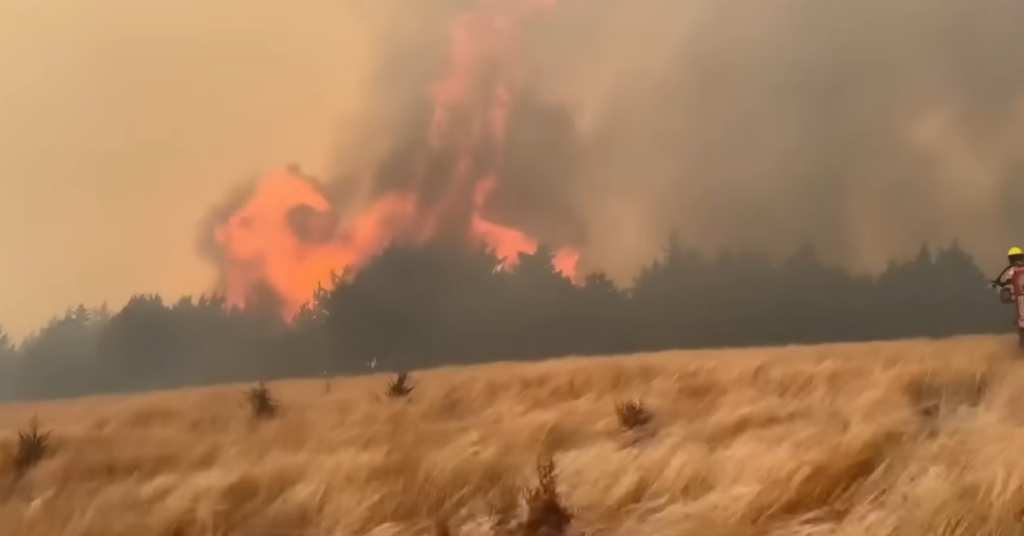
Even though the mechanism’s scale is still difficult to comprehend, it is not mysterious. According to National Weather Service meteorologist Gregg Gallina, a heat dome is created when high pressure in the upper atmosphere acts like a pot lid, trapping hot air over an area and preventing the typical mixing and movement that would cool things down. The jet stream, which typically moves weather systems across North America eastward, stalled at the same time. It became stuck as far west as Hawaii, where the worst flooding the islands had experienced in twenty years was being caused by an unrelated storm system that was dumping more than a meter of rain. There was nothing to advance the heat dome because the jet stream was essentially frozen in place. Eleven or twelve days in a row were hotter in Flagstaff, Arizona, than the city had ever recorded in March in any of its data years.
Even in the context of exceptional recent summers, this event was remarkable due to its early arrival and widespread dissemination. The physical area covered by this heat dome, according to weather historian Chris Burt, author of the book “Extreme Weather,” probably surpassed two other historical occurrences: the 2012 heat wave that engulfed the Upper Midwest and Northeast, and the 2021 Pacific Northwest heat dome that killed hundreds of people in Portland and Seattle on days when cities built for mild maritime weather lacked infrastructure for 115-degree temperatures. According to Burt, this March event was likely larger than both, but it wasn’t as lethal, in part because the extreme heat of March doesn’t pose the same physiological risk as the same temperatures in July humidity.
That distinction does provide some relief, but not as much as one might think. On the Friday when the highest temperatures were recorded, a team of international climate scientists from the World Weather Attribution project released a quick analysis. Their conclusion was clear and sobering: the heat was “virtually impossible” without human-caused climate change. Not improbable. Not uncommon. Almost impossible. The temperature was raised by at least 4.7 degrees Fahrenheit (2.6 degrees Celsius) due to the burning of coal, oil, and natural gas. Compared to a world without emissions-driven warming, the event was 800 times more likely to happen in the current climate. 800 times is the kind of number that takes some time to process.
As the event started its slow eastward crawl toward the Plains, the downstream effects of this specific heat dome were still being felt. Due to the unusual warmth, mountain snowpack in Colorado and California, which was already at record lows in some basins prior to the event, was melting weeks ahead of schedule. In the West, where summer water supplies for cities, agriculture, and firefighting depend on snowmelt arriving gradually through spring, that is extremely important. The water runs off too early when the mountains lose their snowpack in March rather than May, leaving dry soil and depleted reservoirs ahead of wildfire season. Photographs taken on March 21 of the water levels in Colorado’s Dillon Reservoir revealed a narrative that hydrologists have been recounting in reports for years, but now the pictures were providing the explanation.
The speed at which these events are cycling is difficult to ignore. The heat dome in the Pacific Northwest in 2021 felt unheard of. Both the 2023 and 2024 summer heatwaves shattered previous records. And now comes a March event that, according to meteorologist Jeff Masters of Yale Climate Connections, puts Flagstaff in a position it has never held before, not in any March on record. “Basically the entire U.S. is going to be hot,” Gallina declared at the height of the event. “There is a very wide range of record temperatures. That’s the truly strange thing.
