

Sheila Irvine starts her mornings with calm urgency. She rushes through her tasks, not because she dreads them, but because something far more interesting awaits—her unique glasses. Once they’re on, she sees letters. Not blurred. Not shadows. Letters.
That simple transformation—of symbols becoming readable—was previously inconceivable for someone diagnosed with geographic atrophy, the advanced form of dry age-related macular degeneration. Yet, within a humble operating theatre at Moorfields Eye Hospital in London, a chip the size of a SIM card has started a quiet revolution in how we understand blindness, and more significantly, how we might reverse it.
The treatment that gave Sheila back her vision is extremely creative in its design. A wireless photovoltaic implant, known as the PRIMA system, is inserted under the retina using a minimally invasive operation. At 30 microns thick—barely half the diameter of a human hair—it lays under the center of the macula, quiescent until activated by a pair of AI-enhanced augmented-reality glasses.
Once turned on, the device operates like a solar panel. The glasses record images through a tiny video camera, which fires infrared signals onto the chip. This energy then stimulates the remaining retinal cells. These signals, analyzed by a pocket computer, are converted into vision. What emerges isn’t a nebulous feeling of light or shape. It’s letters. Words. Full sentences.
Reading again is not instantaneous. It requires weeks of meticulous adjustment, including learning how to keep one’s head level, precisely operate the zoom function, and discern between identical shapes. Patients like Sheila train to discern not only forms but meanings. Additionally, every stride forward restores a degree of confidence that blindness had previously taken away.
| Topic Area | Details |
|---|---|
| Location | Moorfields Eye Hospital, London |
| Breakthrough Technology | PRIMA bionic eye implant paired with augmented-reality glasses |
| Condition Treated | Dry age-related macular degeneration (AMD) with geographic atrophy |
| Trial Results | 84% regained reading ability; average gain of 25 letters (5 lines on an eye chart) |
| Key Patient Example | Sheila Irvine, 88, regained ability to read and do puzzles after complete central vision loss |
| Developer | Science Corporation, California |
| Future Outlook | Not yet licensed, but may be NHS-accessible in the next few years |
| Research Reference | https://www.nejm.org/doi/full/10.1056/NEJMoa2309938 |
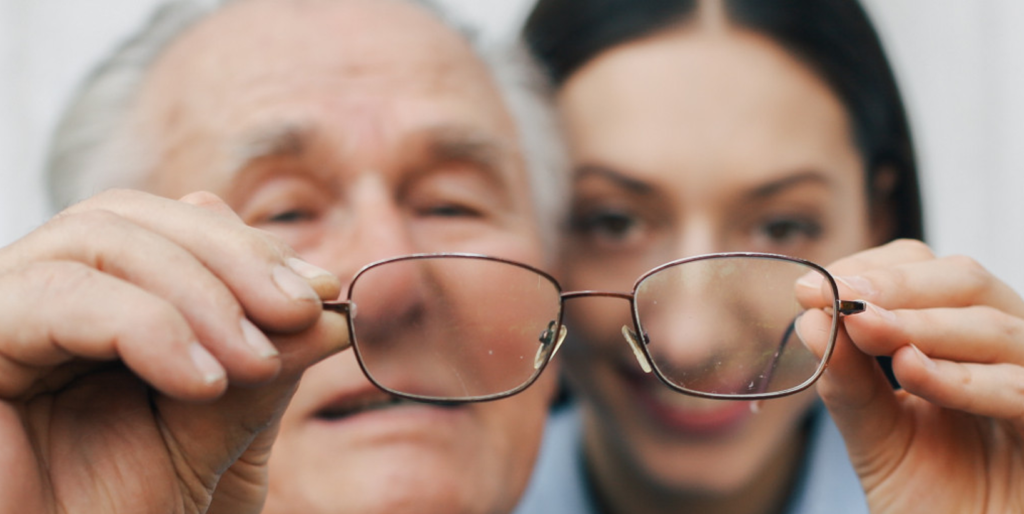
Over the past decade, initiatives to restore eyesight have frequently felt abstract—promising but inadequate. This experiment, however, feels different. Of the 32 individuals participated across Europe, 27 regained the ability to read. Not partially. in a significant way. On average, they could read five additional lines on a vision chart. For many, that meant recognizing labels, instructions, or the names on mail again.
“Two black discs” in the middle of her eyes were how Sheila characterized her previous eyesight. Peripheral vision remained, but the loss of center sight rendered her functionally blind. When she had to give up her driving license years ago, she cried. Now, at 88, she laughs lightly about being a “happy bunny” and returns to her crosswords.
The PRIMA device provides a very effective way to avoid damaged retinal cells and transmit functional vision directly to the brain by utilizing tiny solar technology and AI-driven picture processing. No deterioration in peripheral vision was found in any patient—a detail that’s extremely advantageous given how vital even residual sight is for balance and mobility.
The London trial was part of a bigger European investigation supervised by Dr. Frank Holz of the University of Bonn. The UK arm was managed by Mr. Mahi Muqit, a distinguished doctor and surgeon at Moorfields. “We’ve restored meaningful central vision for the first time,” Muqit said. His use of the word “meaningful” remained with me—not technical vision, nor experimental light perception, but something practical, intimate, and human.
Inside the hospital, I witnessed Sheila sit with a tablet barely inches from her face. Her posture, helped by a cushion under her chin, steadied the video feed. There was a letter. Then another. She concentrated more with each one. The act appeared meditative—slow, methodical, packed with weight. She once made a joke that determining if a shape was an O or a C required more mental effort than her previous employment.
What impressed me most, though, was not the triumph itself, but the ceremonies around it. Sheila doesn’t use the gadget outside. She wants to stay rooted in her regular routines since it requires too much concentration. The spectacles aren’t magical—they’re tools. What she’s gained isn’t continual sight, but agency.
In the perspective of current treatments for dry AMD, this approach is extraordinarily effective. There are no licensed treatments that restore sight for these patients. Not one. For five million people affected globally, the arrival of a gadget that actually improves quality of life heralds a turning point.
For early-stage developers, PRIMA’s tale is also a validation. Science Corporation, the California-based biotech behind the gadget, was founded with an emphasis on neural interfacing. Their approach—pairing minimally invasive technology with AI interpretation—shows how biomedical design can intersect with patient-centered outcomes.
During the study, users were encouraged to explore the gadget in ways beyond reading. One patient utilized it to navigate the Paris Metro. Others returned to interests long abandoned. That kind of adaptation indicates the system is very adaptable. It’s not only about vision—it’s about re-entering life, one detail at a time.
The implant is not yet licensed for general usage. Questions persist about pricing, distribution, and long-term durability. But the roadmap is clear. The team has produced something especially promising by combining AI, photovoltaic engineering, and ophthalmology surgery.
Dr. Peter Bloomfield of the Macular Society termed the discoveries “fantastic news.” More than joy, his tone expressed relief. Dry AMD has been a challenging frontier, typified by stagnation. Now, hope feels tangible.
Sheila’s story is far from over. She continues to push herself and train. Her favorite exam is reading the tiny print on the back of soup cans. There are days that are better than others. However, progress has been made. And more crucially, there’s opportunity.
Reading again may not seem radical, but when you’ve lost that skill for decades, each word becomes a small celebration.
And for those of us watching—reporting, documenting, hoping—this technology reminds us that sight is more than function. It’s belonging, identification, and a genuinely human form of freedom.
Disclaimer
Nothing published on Creative Learning Guild — including news articles, legal news, lawsuit summaries, settlement guides, legal analysis, financial commentary, expert opinion, educational content, or any other material — constitutes legal advice, financial advice, investment advice, or professional counsel of any kind. All content on this website is provided strictly for informational, educational, and news reporting purposes only. Consult your legal or financial advisor before taking any step.
