

The desert around Tabuk remains silent around morning. But the silence isn’t peaceful—it’s heavy, interrupted only by the distant whirl of machinery. This is where Saudi Arabia’s most ambitious urban experiment, The Line, is happening.
Originally envisioned as a 170-kilometer stretch of high-density futuristic living, The Line was touted as a clean, car-free utopia with a five-minute walk to everything. But lately, that promise has starting to feel like a mirage. Complaints are rising—from workers, residents, and planners. Not all of them loud, but most of them urgent.
Construction workers, largely migrants, describe an experience that strikingly contrasts the project’s polished branding. They spoke of 16-hour shifts under terrible heat, inconsistent salaries, and hours-long unpaid bus rides. One worker said that by the time he returns to his dorm, he’s left with just four hours to rest before awakening to do it again. Saudi legislation regulates working hours at 60 per week. Many of them are beyond 80.
It’s not simply the hours. It’s the debt. Recruitment fees—often more than $1,000—are paid up front, borrowed from family or friends. Promised positions in hospitality or housekeeping turn out to be arduous roles in construction. Some haven’t been paid for months. Others are threatened with fines if they ask to change employers. Their words are powerful. One said, “We’re treated like beggars.” Another: “I don’t feel like I’m here to work—I feel like I’m here to disappear.”
| Aspect | Detail |
|---|---|
| Location | Tabuk Province, Saudi Arabia |
| Project Name | The Line (part of NEOM megaproject) |
| Planned Length | Originally 170 kilometers, scaled down to 2.4 kilometers (by 2030) |
| Initial Budget | Estimated $500 billion |
| Key Issues Reported | Labor abuses, forced displacement, privacy concerns, scaling back |
| Affected Groups | Migrant workers, Huwaitat tribe, early-stage residents |
| Project Status | Under construction, facing delays and international scrutiny |
| Surveillance Features | AI-powered data collection, biometric monitoring, smart home tracking |
| Research Sources | Human Rights Watch, ITV, Wall Street Journal, NEOM internal policies |
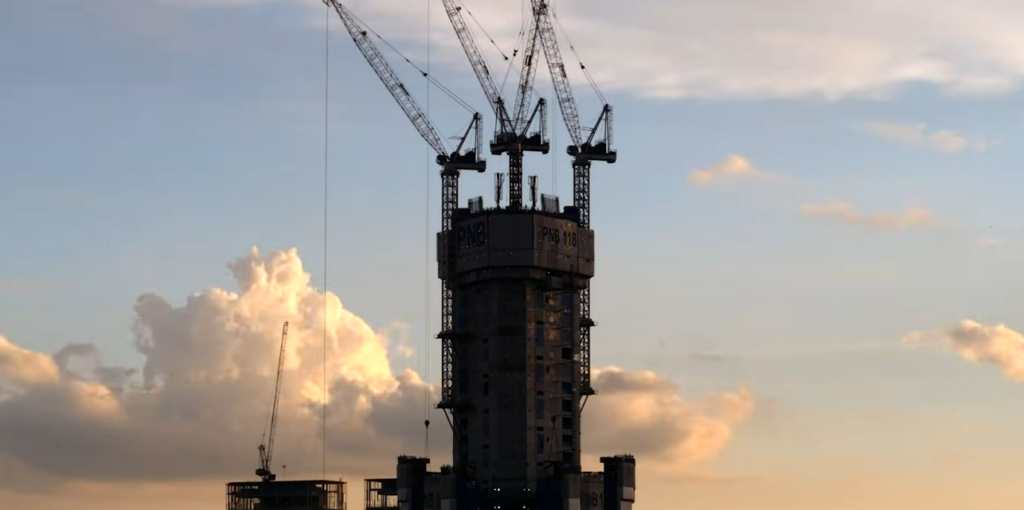
And yet, above them, the skyline continues to build. NEOM’s leadership requires contractors follow international labor standards. But according to various human rights organizations, enforcement is weak and primarily symbolic.
A different form of displacement has unfolded above the building zone. The Huwaitat tribe, indigenous to this region, has experienced expulsion from their native territory. In 2020, protests turned deadly. Security personnel shot and murdered a local activist, drawing international outrage. For many inhabitants, the “blank slate” of NEOM came at the cost of communities that had lived there for centuries.
This image of a blank slate implies a deeper pain. The Line is being created not simply as a metropolis, but as a regulated environment. AI will monitor and regulate energy use, water flow, traffic, garbage, and even social conduct. Cameras are implanted into every surface. Home sensors and cellphones are meant to collect real-time behavioral data. Proponents claim it efficient. It is criticized for being intrusive.
According to certain internal reports, residents might receive benefits like discounts, improvements, and access in return for their personal information. Others fear the machine may not ask at all. For many, the line between convenience and coercion is becoming dangerously thin.
Early in 2025, there were indications of a reduction in scale. From a 170-kilometer target, forecasts for 2030 were cut to just 2.4 kilometers. The population targets have been lowered. The influx of foreign investment is becoming more cautious. The Line is still very much under construction—but the stats imply it’s being quietly recalibrated.
Urban planners have began challenging its basic rationale. In a typical city, people naturally congregate, evolve, and connect. In The Line, two randomly located inhabitants could dwell 50 kilometers apart. The layout lacks organic flexibility despite its attractiveness. There’s no square to stroll into, no unexpected turn to uncover. It’s less a city and more a corridor.
I remember being near a transport engineer who softly shook his head. He remarked, “A train can get you from one end to the other.” “But what if disconnection rather than distance is the issue?”
For a project so dedicated in connectivity, that irony feels particularly harsh.
The underlying premise of The Line isn’t without value. Compact urban design. Reduced emissions. Modern sprawl is being rethought. In principle, it’s very effective. But in actuality, the execution has moved far from its ideals. Bold ideas can have unexpected effects if they are not properly supervised, particularly when they are developed quickly, on a large scale, and under duress.
There is yet time, though. The optimism that founded this city can be diverted. The project might become a testbed for labor reform, data rights, and cultural integration—if those guiding it choose to listen. That would necessitate slowing down, reassessing priorities, and giving human dignity equal weight with architectural vision.
A line is still being drawn at the desert’s edge. Whether it becomes a symbol of what’s possible or a cautionary tale depends on what comes next.
