

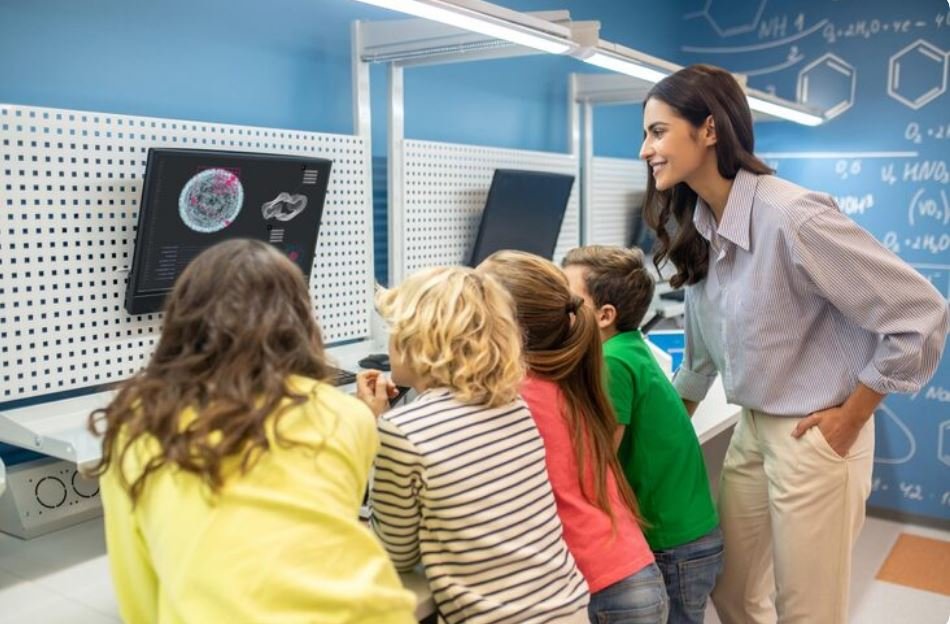
Recess is being redesigned as discovery time rather than downtime in many contemporary classrooms. Schools now view it as a creative laboratory where kids can experiment with concepts just as freely as inventors do with prototypes. It’s a striking illustration of how time can transform education in incredibly human ways when it is reimagined rather than diminished.
For example, George Gervin Prep Academy has transformed its playgrounds into innovation studios. Students design simple machines, construct obstacle courses, and create games with rules they come up with together instead of just playing tag. Instead of giving instructions, teachers watch, letting kids learn how creativity fosters confidence and teamwork. The outcomes, which include increased self-directed learning, enhanced empathy, and better focus, have been especially inventive.
| Aspect | Description |
|---|---|
| Concept | Transforming traditional recess into structured “innovation time” that promotes creativity, collaboration, and experimentation. |
| Core Purpose | To develop curiosity, empathy, and problem-solving through unstructured yet guided exploration. |
| Educational Approach | Merges play, design thinking, and social learning to build essential life skills. |
| Inspiration | Drawn from initiatives by the LiiNK Center for Healthy Play and Unlocking Time research. |
| Global Examples | Schools in Finland, Singapore, Denmark, and the U.S. integrating flexible learning schedules. |
| Benefits | Enhanced focus, stronger creativity, improved teamwork, and increased academic performance. |
| Influential Voices | Shanna Peeples, Tony Wagner, and Vicki Phillips on time-based innovation in education. |
| Societal Impact | Encourages resilience, curiosity, and adaptability among future thinkers. |
| Similar Practices | Inspired by corporate “innovation hours” at Google, 3M, and IDEO. |
This trend is indicative of a larger shift in the way educators view time. Schools now see recess as an opportunity to foster creativity rather than as a disruption. Time itself is a design resource, as Forbes’ Vicki Phillips points out. Flexible scheduling unlocks learning potential much more efficiently than longer school days ever could.
Enhancing play is the goal of recess innovation, not reducing play or introducing technology. Teachers foster critical thinking without the weight of grades by fusing creative prompts with unrestricted movement. As students learn to try new things, fail safely, and work together to improve ideas, the method has shown remarkable success in fostering a growth mindset.
“Innovation Recess” has been incorporated into the weekly schedule in one Texas district. Youngsters solve real-world problems in small groups, like creating miniature bridges, designing water filters, or redesigning their playground to be more inclusive. It’s infectious energy. Even the quietest students, according to teachers, become notably more talkative and frequently assume leadership roles during these sessions.
This changing paradigm is similar to corporate innovation tactics that were previously only used by adults. For instance, Google’s 20% time policy is well-known for encouraging staff members to dedicate a portion of their workweek to passion projects, which eventually led to the creation of products like Gmail. In a similar vein, 3M’s 15% rule gave rise to the Post-it Note, a representation of artistic freedom. By implementing these ideas, schools are demonstrating that creativity can be fostered from an early age.
According to author and educator Shanna Peeples, genuine innovation starts with patience and empathy. She contends that traditional scheduling frequently denies teachers and students the time they need to think, reflect, and try new things. That’s what recess innovation provides them. Through guided exploration in place of strict instruction, it enables students to make connections between concepts through play as opposed to repetition.
The advantages extend beyond inventiveness. According to research from the LiiNK Center for Healthy Play, taking several brief breaks throughout the day greatly enhances concentration and academic achievement. Children’s brains are noticeably more open to learning when they are active. That focus becomes passion when you add the element of invention. Teachers have reported much lower stress levels, deeper curiosity, and better behavior.
Students at Loudoun County Elementary use their innovation block to prototype community projects, such as creating toys that teach math concepts or designing greenhouses for nearby gardens. Despite their simplicity, the projects teach important lessons: creativity flourishes in environments that value curiosity. Despite being the most fruitful learning period of the week, teachers characterize the sessions as “organized chaos.”
Finland and Denmark, among other nations, have long acknowledged the importance of flexible scheduling in education. Students in Finland receive up to four recesses every day, a practice that has been shown to improve emotional well-being and motivation. While Ireland provides a “Transition Year,” a period of time between academic phases intended for exploration and personal development, Singaporean schools incorporate “flex time” for passion projects. The takeaway from each of these instances is strikingly consistent: learning becomes permanent when educational institutions place an equal emphasis on creativity and content.
Psychologists find that the emotional impact is remarkably similar to that of professional innovators. Play is especially helpful for building resilience because it activates the same reward pathways as creative problem-solving. Students gain the ability to control their frustration, adjust to shifting circumstances, and value effort over perfection during innovation recess. Thinkers, not just test-takers, are shaped by these attributes.
The change has been immediately apparent to parents. Children now discuss school with renewed enthusiasm, according to many reports. They continue projects at home, such as building, sketching, or experimenting with their families, rather than dreading homework. In some schools, students showcase their creations inspired by playgrounds to their communities on “family innovation nights.”
This movement represents a cultural return to the origins of learning as inquiry. It is influenced by modern proponents like Sir Ken Robinson, who felt that creativity should be at the center of every classroom, as well as early education pioneers like Maria Montessori. Schools are fostering independent thinkers who view learning as an adventure rather than a task by letting creativity blossom from play.
Interestingly, technology is only a minor factor in this change. The emphasis is still tactile even with the availability of tablets and coding kits. Simple supplies like cardboard, markers, and leftover wood encourage creativity. According to one principal, “students become more creative the fewer instructions they receive.” The goal is to humanize innovation rather than digitize recess.
Teachers’ approaches to lesson planning are already changing as a result of the change. Teachers work together to match classroom themes with experiments during recess. For example, a physics science lesson might motivate students to construct a playground zipline, while a literature class might result in storytelling games that are acted out on the field. By fusing theory and creativity in ways that are both organic and incredibly captivating, this integration maintains learning fluidity.
The most promising aspect of these programs is how they develop skills that are ready for the future without the need for formal education. Through action rather than abstraction, students acquire teamwork, communication, and critical thinking skills. They grow more self-aware, more flexible, and much more willing to take intellectual chances. This might be the most cost-effective investment schools can make if they want long-lasting change: not in infrastructure or technology, but in time itself.
Disclaimer
Nothing published on Creative Learning Guild — including news articles, legal news, lawsuit summaries, settlement guides, legal analysis, financial commentary, expert opinion, educational content, or any other material — constitutes legal advice, financial advice, investment advice, or professional counsel of any kind. All content on this website is provided strictly for informational, educational, and news reporting purposes only. Consult your legal or financial advisor before taking any step.
