

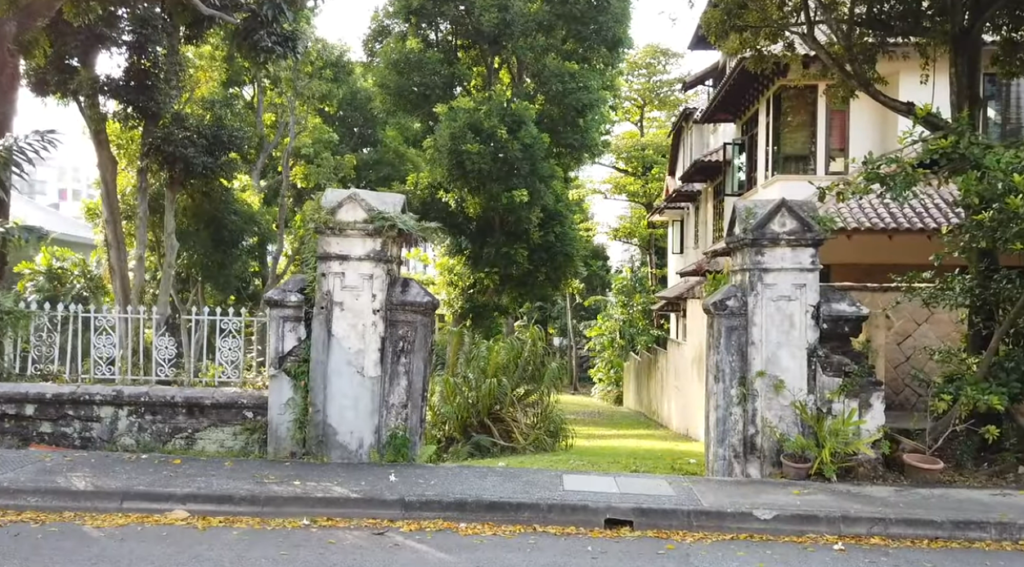
You might easily miss it, walking through the green outskirts of Singapore’s Orchard neighborhood, where condos and business mix into quiet roadways. However, 38 Oxley Road, with its worn red bricks and modest building, subtly carries a heritage that influenced the course of a country.
Constructed in 1898, the mansion originally served as a private residence for a Dutch trader, long before it became the cradle of Singapore’s political awakening. The house underwent a steady transformation when Lee Kuan Yew and his family moved in in the 1940s; there were no renovations or extravagance, only the quiet accumulation of memory and consequence.
History was carelessly produced in its basement. There, the People’s Action Party was formed—an act that would later define Singapore’s postcolonial direction. However, the house was just a home to the people who lived there: shared meals, worn wooden staircases, quiet in the morning, and laughing behind closed doors.
The future of the mansion became a major topic of discussion following Lee’s death in 2015. When his daughter, Lee Wei Ling, moved out, his will stated that he wanted the property to be demolished. It was a personal appeal based on his conviction that group goals should always take precedence over personality cults.
| Detail | Information |
|---|---|
| Address | 38 Oxley Road, Singapore 238629 |
| Built | 1898 |
| Original Developer | Hermann Cornelius Verloop |
| Famous Resident | Lee Kuan Yew (First Prime Minister of Singapore) |
| Family Dispute | Involved Lee Hsien Loong, Lee Hsien Yang, and Lee Wei Ling |
| Historic Meetings Held | First People’s Action Party meeting in the basement |
| National Monument Status | Gazetted as National Monument on December 12, 2025 |
| Current Debate | Conservation vs. fulfilling Lee Kuan Yew’s demolition wish |
However, family dynamics added tension to that wish. Lee Hsien Loong, Singapore’s Prime Minister, and his siblings, Lee Wei Ling and Lee Hsien Yang, found themselves caught in a public quarrel. The dispute evolved into a representation of openness, responsibility, and legacy rather than merely being about property.
This wasn’t only a familial conflict; it became a subject of national scrutiny. Public remarks, parliamentary explanations, and legal evaluations turned a private situation into a topic that dominated newspaper pages and public forums. It pushed Singaporeans to reflect—what do we maintain, and at what cost?
In 2018, a ministerial committee laid out possibilities. They ranged from saving just the historically relevant basement to preserving the complete structure to removing it entirely in accordance with Lee’s wishes. Each alternative has emotional and political repercussions, making consensus surprisingly difficult.
When Lee Wei Ling passed in 2024, the matter returned with renewed intensity. The residential life of the home came to an end with her passing. Lee Hsien Yang reiterated the demolition request, claiming that the family’s dedication to Lee Kuan Yew’s desires need to be respected. But the Ministry of Culture and National Heritage Board intervened.
The home was formally gazetted as a national monument in December 2025 following a comprehensive evaluation and public discussion. Despite being legally definitive, this action caused emotional division in the population.
Many felt reassured—preserving such a cornerstone of Singapore’s political formation seems particularly beneficial for future generations. It allows younger citizens to engage with history not through textbooks but through settings where real decisions once occurred.
Others, however, questioned if this behavior clearly opposed Lee Kuan Yew’s goal. Was it impolite to disregard his clear request? Or was it a reasonable compromise to preserve a national icon where the nation’s future had formerly been pondered over coffee and beneath bare bulbs?
Remarkably, authorities stressed that the interior will remain unaffected by show. Personal treasures will not be turned into a museum in the residence. Instead of transforming private areas into public galleries, its exterior will be retained as a silent witness—an anchor of memory.
Standing at the frontier of heritage and principle, 38 Oxley Road demonstrates how places can expand beyond their initial purpose. It presents a lesson that is exceptionally innovative: how a building, modest in structure, may define the tone of a nation’s destiny.
It also makes one think about how nations handle the legacy of their founding leaders. Notably pragmatic, Singapore is now opting to leave a portion of its history physically intact—possibly not to glorify, but to reflect.
That ruling creates a precedent. In the coming years, additional sites that formerly housed key national moments may receive equal attention. And younger Singaporeans, living in a world of glass buildings and seamless computing, will benefit from tangible points of reference—places where tales live through timber and time.
The tale of 38 Oxley Road has always had a subdued seriousness for me. It was never about its architecture or its lawn. Its louvered windows once let in light during pivotal discussions that altered people’s lives. It was the way that modest and simple cellar housed a concept that would someday expand into skyscrapers, laws, and advancement.
By safeguarding the site, Singapore hasn’t only protected a house. It has preserved a question: How should we combine personal wishes with national memory?
The city-state demonstrates that sometimes stepping forward necessitates stopping at the door of the past by posing that question, reaffirming its dedication to deliberate remembering.
Surprisingly, that pause could influence future generations.
