

The instruments used in education have always changed. Once a symbol of advancement, the chalkboard was followed by the projector, laptops, and tablets. Classrooms that might exist entirely in the metaverse are the next big change that education is about to undergo. It is an emerging reality based on the combination of AI, VR, and human imagination rather than a far-off fantasy.
Imagine students from different continents entering the same virtual forest as avatars to study ecology and discover biodiversity. They can all perform simulated experiments, view plant structures, and discuss the outcomes in real time. Although it feels a lot like fieldwork, it is incredibly effective and long-lasting. These scenes demonstrate how metaverse classrooms could increase access to global education while obfuscating the distinction between digital and physical learning.
Researchers Leyli Nouraei Yeganeh and Nicole Scarlett Fenty created the Meta-MILE framework, which demonstrates how immersive learning can change students from passive recipients of information to active participants. Virtual simulations, gamified goals, and AI analytics are combined to create environments that dynamically adjust to the preferences and pace of each learner. Lessons now develop interactively rather than linearly.
Virtual reality courses that use immersive storytelling to teach empathy are already being tested by institutions like Stanford University. While VictoryXR has created whole virtual universities where students can explore human anatomy, study stars in space, or create robots in virtual labs, Meta and Microsoft have both introduced platforms that allow teachers to teach using 3D avatars. These illustrations demonstrate how the metaverse can vividly bring abstract concepts to life.
| Attribute | Details |
|---|---|
| Concept | Virtual, augmented, and mixed-reality environments designed for immersive education |
| Key Technologies | VR, AR, AI, Blockchain, 5G |
| Key Institutions Adopting | Stanford University, Meta, Microsoft, VictoryXR, Decentraland |
| Benefits | Immersive learning, accessibility, gamification, personalized education |
| Challenges | Cost, technical literacy, health impact, ethical concerns |
| Future Vision | Hybrid learning, AI tutors, decentralized credentials |
| Reference | Preprints.org Study |
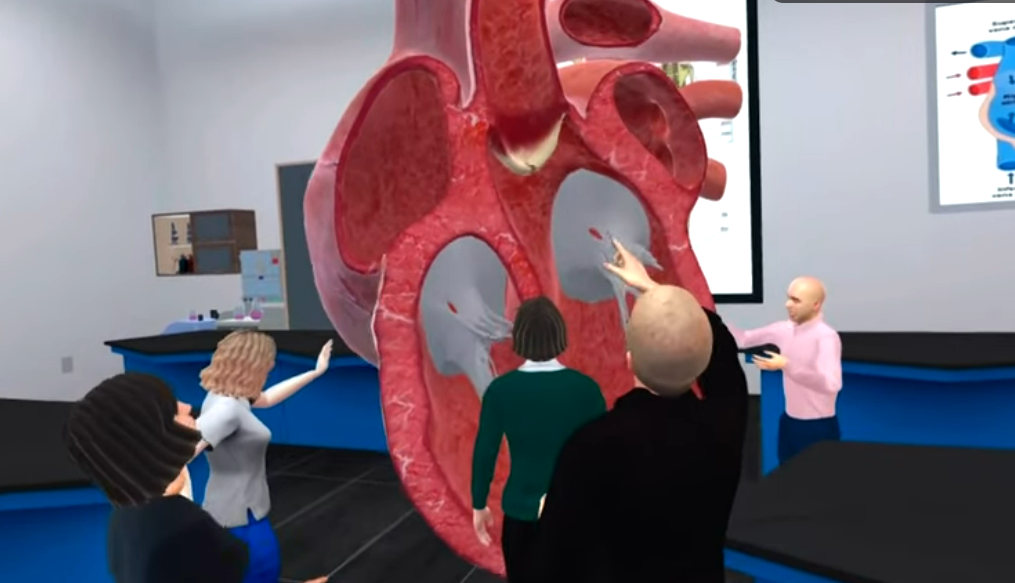
Personalization is the metaverse’s greatest asset. Learning gaps can be found and content can be adjusted using AI-driven analytics. A linguistic learner could engage with AI tutors for conversational practice, while a visual learner could use holographic models to explore intricate physics concepts. This method is especially useful for overcoming learning disabilities and making sure that no student feels excluded.
Gamification further improves this interaction. Students advance through quests, achievements, and digital rewards rather than just exams and grades. Gamified learning significantly increases motivation and retention, according to platforms like Immerse and ClassVR. According to research from the University of Maryland, immersive virtual reality classrooms can boost student engagement by over 60%, which is a very positive statistic for teachers.
However, there are real obstacles associated with these developments. For many schools, fast internet connections and high-quality VR headsets are still prohibitively expensive. This leads to a digital divide in underfunded areas that may exacerbate inequality rather than reduce it. Nearly half of students worldwide still do not have reliable access to broadband, according to UNESCO. Infrastructure and affordability must advance concurrently if the metaverse is to live up to its potential.
Safety and health are also urgent issues. Extended VR use may result in motion sickness, eye strain, or confusion. Younger students are particularly at risk because their developing brains might find it difficult to discriminate between real-world and virtual settings. In order to ensure that technology improves focus rather than causes fatigue, experts recommend moderation and set session durations.
Teachers themselves have a steep learning curve. More than just subject-matter knowledge is needed to teach successfully in a metaverse classroom; technical fluency, creativity, and ease using AI-powered tools are also necessary. More than 60% of teachers, according to surveys, feel unprepared for teaching in virtual reality, underscoring the pressing need for digital pedagogy courses and professional development.
Innovation must coexist with privacy and ethics. Large amounts of biometric and behavioral data, such as voice modulation and gaze tracking, are gathered by virtual classrooms. In the absence of stringent safeguards, this data may be exploited. Transparency is still essential to upholding public confidence, but blockchain technology provides a partial solution by protecting academic records and identity verification.
Notwithstanding these reservations, the metaverse has a lot of creative potential. By 2027, analysts estimate that global investments in educational technology could surpass $600 billion, with VR and AR tools accounting for a large portion of that growth. Immersion learning is not just for schools, as evidenced by the use of virtual environments for employee training by major corporations such as Accenture and PwC. The abilities gained from these experiences—adaptability, teamwork, and critical thinking—are becoming more and more important in all sectors.
It could have a transformative effect on culture. According to visionaries like Sal Khan and Bill Nye, the metaverse has the potential to democratize educational access. One day, students could explore the universe with Neil deGrasse Tyson leading them through a virtual galaxy or listen to a history lecture given by a digital version of Barack Obama. These kinds of experiences are not only motivational but also have the power to transform lives, particularly for students in underprivileged communities.
The advantages for the environment are also very evident. According to Binghamton University, metaverse classrooms could reduce energy consumption and carbon emissions by up to 60% by eliminating physical infrastructure and daily commuting. Education, which is frequently criticized for using too many resources, could emerge as a silent leader in sustainability.
The metaverse has the potential to transform lifelong learning beyond early childhood education. Healthcare workers could practice emergency protocols, engineers could model complicated machinery repairs, and adults could retrain in virtual workplaces. Learning becomes an ongoing, dynamic, and extremely effective process on these virtual campuses.
Nonetheless, governments must guarantee fair access. Fair pricing models, open-source cooperation, and public funding will be essential. Education shouldn’t be a luxury for people who can afford expensive headphones, but rather a shared right. Learning could become universally accessible rather than digitally divided if the metaverse is handled carefully.
