

It began, rather surprisingly, with a drill and a cube. Mathematicians have long held that a tunnel big enough to let a copy of itself pass through can be found in any convex shape, no matter how strange. That was the core of the Rupert property, and for more than 400 years, the concept remained remarkably resilient. But when Sergey Yurkevich and Jakob Steininger presented their noperthedron, that assurance broke.
This polyhedron wasn’t just oddly shaped. It was carefully crafted to withstand its own twin, with 90 vertices, 240 edges, and 152 carefully positioned faces. No duplicate could pass through any tunnel, no matter how well-placed. No one else was able to demonstrate that Rupert’s rule had a limit, but the noperthedron was remarkably successful in defying convention.
Despite decades of searching, mathematical optimists were unable to find any counterexamples. The search was halted by this shape. Its geometry was tested, simulated, and calculated with remarkably obvious logic. It still took almost everyone by surprise. The normally muted emotional undertone in the mathematics community sounded like a low gasp. That was because the new evidence was so strong, not because they had been irresponsible.
Key Context Table
| Element | Details |
|---|---|
| Discovery | Two new mathematical shapes: the noperthedron and the einstein tile |
| Researchers Involved | Jakob Steininger, Sergey Yurkevich, David Smith |
| Year(s) of Discovery | 2023 (einstein tile), 2025 (noperthedron) |
| Broken Rules | Rupert property (3D); Aperiodic monotile conjecture (2D) |
| Significance | Challenges century-old geometric assumptions; inspires new math fields |
| External Reference | Scientific American – Oct 28, 2025 |
It was not by accident that Yurkevich and Steininger discovered this discovery. When they were watching a YouTube video about the old Prince Rupert’s cube, their adventure started. The process of creating potential shapes, removing those that were acceptable, and pursuing a form that refused to cooperate became an obsession with algorithms. Driven by steady intuition and computational geometry, their discovery process was both profoundly human and incredibly efficient.
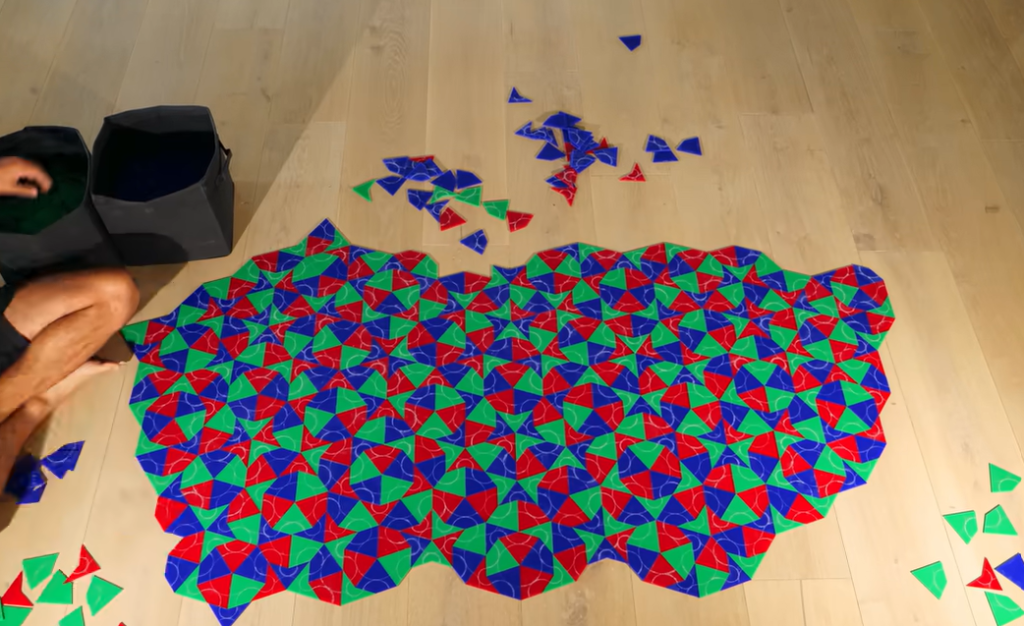
The so-called Einstein tile, which David Smith found in 2023, was another shape that broke the rules and was equally fascinating but a little earlier. Smith, a tiling enthusiast and hobbyist, discovered a 13-sided figure that completely tiles a surface but never repeats. This form, called “The Hat,” broke another, equally obstinate presumption: that no single tile could create an aperiodic pattern by itself.
In contrast to the neat regularity of squares or hexagons, The Hat spreads out in a dance that never ends. What made it revolutionary was its unexpectedness, which was surprisingly inexpensive in its simplicity. It was Smith’s kitchen table and a pile of paper tiles, not a lab, that led to his discovery. After generations of professional mathematicians had failed to solve the problem, he succeeded with perseverance and traditional craftsmanship.
The mindset is what connects these two geometric provocations, not just the mathematical rebellion. Neither resulted from conventional academic posture, but rather from persistent inquiry and surprising revelation. These researchers—one a professor and the other a retiree—helped redefine geometry by rephrasing old problems.
Their influence is not merely hypothetical. Researchers can improve their ability to model space by learning how shapes behave—or don’t behave. For instance, in materials science, aperiodic patterns can aid in the creation of materials that are more resilient or energy-efficient. It’s equally important to know what can’t fit through itself in computer graphics and architecture. Because they highlight the fact that exceptions frequently matter more than the rule, these discoveries are especially novel.
The degree to which the research was tactile and visual is one of the most obvious similarities between the two situations. The noperthedron was created using virtual slicing and 3D visualization. Scissors, perseverance, and a readiness to make mistakes were the sources of the hat. It demonstrates how mathematics’ roots remain grounded, influenced by paper and motivated by curiosity, even as it becomes more abstract.
As I read the technical papers, one thing caught my attention: the noperthedron was put through five-dimensional pass-through testing. Conceptual dimensions that assisted in examining all potential orientations rather than space as we know it. Drilling a 3D shape with imaginary axes is a poetic mental leap. Math is exciting when it involves thought experiments like this. It’s also very obvious why so few people took the risk.
As a result, these moments are important. They reshape our thinking in addition to giving us new forms. Everything close to a fundamental assumption needs to be reexamined when it fails, particularly if it has subtly guided hundreds of proofs. Significantly clearer interpretations of space and structure are the result. Better questions come to mind.
These days, mathematicians are going over earlier “proofs” with new skepticism. Would the noperthedron be the only shape like it? Is there a monotile that is simpler? These games go beyond academics. They allude to a structure that is developing beneath logic itself. It’s as if mathematics, which is usually thought of as being inflexible, has chosen to relax.
The emotional core for me is the way these discoveries rekindle awe. Not because they are ostentatious, but because they have been earned. Ideas that are incredibly durable don’t fall apart easily. When they do, it’s time for introspection and celebration. It is uncommon to witness real-time math rewriting.
But that’s what just took place.
