

A young girl used to sit and sing during class at a school in Kolhapur called Vidyapit. Singing was just what came out of her, not because she was performing. By most accounts, the teachers thought it was more irritating than endearing. Decades after it had ceased to matter whether she knew her multiplication tables, she would return to that school as a legend and sum herself up for the gathered students in two words: “Very naughty.”
On April 12, 2026, Asha Bhosle passed away in a Mumbai hospital at the age of 92. A Guinness World Record, two Grammy nominations, a Dadasaheb Phalke Award, a Padma Vibhushan, more than 12,000 recorded songs, and a voice that had become ingrained in the cultural memory of an entire subcontinent are just a few of the things she left behind. She also had very little formal schooling. There is an odd calmness between the two facts, as if the second clarifies the first or perhaps the first eliminated the need for the second.
Her father, Pandit Deenanath Mangeshkar, was a Marathi stage actor and classical singer whose voice and sensibility filled the Sangli family home. Asha was nine years old when he passed away. After the family relocated, first to Kolhapur and then to Mumbai, full-time education was not an option due to the math of survival. To support the family, she and her older sister Lata started performing in movies. She recorded her first professional song for the Marathi movie Majha Bal when she was ten years old in 1943. She was done with school, whatever it had been.
Asha Bhosle Education: The Girl Who Left School at Nine and Became the Most Recorded Artist in History
| Category | Details |
|---|---|
| Full Name | Ashalata Dinanath Mangeshkar (later Ganpat Bhosale) |
| Date of Birth | September 8, 1933 |
| Place of Birth | Goar, Sangli State, British India (now Maharashtra, India) |
| Date of Death | April 12, 2026 |
| Age at Death | 92 |
| Father | Pandit Deenanath Mangeshkar — classical singer and Marathi stage actor |
| Age at Father’s Death | 9 years old |
| School Attended | Balmohan Vidyamandir, Mumbai (brief attendance) |
| Also Attended | Vidyapit School, Kolhapur (childhood) |
| Formal Education Level | Dropped out of school at age 9–10; no formal higher education |
| First Professional Song | “Chala Chala Nav Bala” — Marathi film Majha Bal (1943), age 10 |
| Self-Description | “Accident singer” — learned by listening to her father and sister Lata |
| Honorary Degree 1 | Honorary Doctorate — University of Amravati (Literature) |
| Honorary Degree 2 | Honorary Doctorate — North Maharashtra University / University of Jalgaon (Literature) |
| Honorary Degree 3 | Honorary Doctor of Arts — University of Salford, UK (awarded October 7, 2019) |
| Additional Honor | First Doctor of Literature (D.Litt.) — Jodhpur National University |
| Career Span | 1943–2026 (over 83 years) |
| Songs Recorded | Over 12,000 (in 20+ Indian and foreign languages) |
| Guinness Record | Most recorded artist in music history (acknowledged 2011) |
| Key Awards | Dadasaheb Phalke Award (2000); Padma Vibhushan (2008); Maharashtra Bhushan (2021) |
| Grammy Nominations | Two — Legacy (1997); You’ve Stolen My Heart (2006) |
| Expressed Regret | Wished she had learned English formally to pursue greater international career |
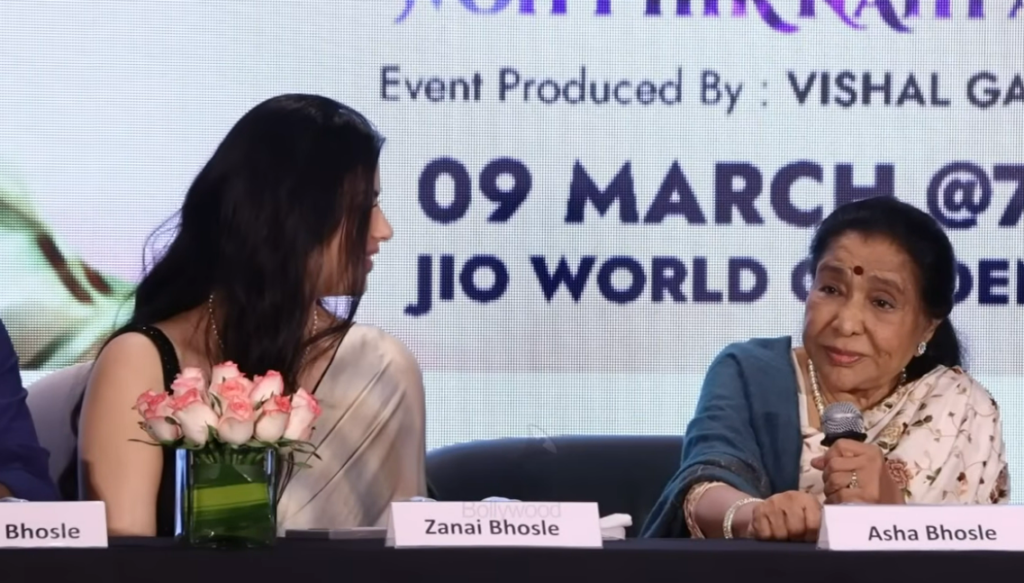
She briefly attended Mumbai’s Balmohan Vidyamandir, but her time there was measured in months rather than years. Years later, she described her struggles with multiplication tables, the unfamiliarity of classrooms for a girl whose true education took place in rehearsal rooms and recording studios, listening to her father’s disciples, and seeing her sister perform in front of a microphone. Throughout her life, she referred to herself as “an accident singer”—someone who acquired her skills through unrelenting, nearly obsessive attention to music in all its forms rather than through any formal training.
However, that description falls short of what she truly created. An education that doesn’t resemble a traditional one is not the same as an accident. Asha Bhosle was learning musical theory, vocal technique, stylistic range, and compositional logic by the time she started recording in the 1950s and 1960s. This was similar to how people learn a language when they are completely immersed in it—not through grammar textbooks but through regular daily use. Throughout her career, she continued to practice her voice every day, or riyaaz. According to her, music is “equivalent to breathing.” She became proficient in ghazal structure to the point where her performance in Umrao Jaan earned her a National Film Award. She became proficient in western pop phrasing to the point where Cornershop wrote an international number one in her honor, the Black Eyed Peas sampled her in a worldwide hit, she sang with Boy George, worked with the Kronos Quartet in California, and received a Grammy Award nomination for Best Contemporary World Music Album.
In her subsequent interviews, she most frequently and candidly expressed regret regarding English. Looking back over the course of an incredible career, she believed that she might have advanced even further in Western music if she had had a formal education in English. She felt that only language had prevented her from achieving the worldwide pop crossover that she sensed was possible but never quite attainable because of her voice, style, and vocal flexibility. This has a poignant and telling quality. Despite having 12,000 recorded songs, a Guinness World Record, and five decades of collaborations with foreign artists, the woman continues to compare herself to what she could have become if she had continued her education.
Eventually, the universities that were unable to educate her as a child came to her. She received an honorary doctorate in literature from the University of Amravati. The University of Jalgaon and North Maharashtra University followed suit. She received an honorary Doctor of Arts degree from the University of Salford in the United Kingdom on October 7, 2019. This was a formal academic acknowledgement from a university in the nation whose language, regrettably, she had wished she had learned more thoroughly as a child. She was awarded the first Doctor of Literature at Jodhpur National University. She described these accolades as a sort of full-circle moment, with the educational community recognizing what the recording industry had known for decades.
It’s difficult to avoid feeling something particular about that arc; it’s not sentimentality per se, but something more subdued. A girl’s family is hungry, so she leaves school at nine. She has dedicated eighty-three years of her life to learning, practicing, adapting, and creating with a level of discipline that most people with formal education can never match. Then the organizations that had previously denied her access lined up to place their names beside hers.
She once claimed to have seen the music, not just heard it, with the notes flowing through her like a tangible object. That does not characterize an uneducated person. That describes a person who was educated in a way that cannot be recorded on a transcript.
