

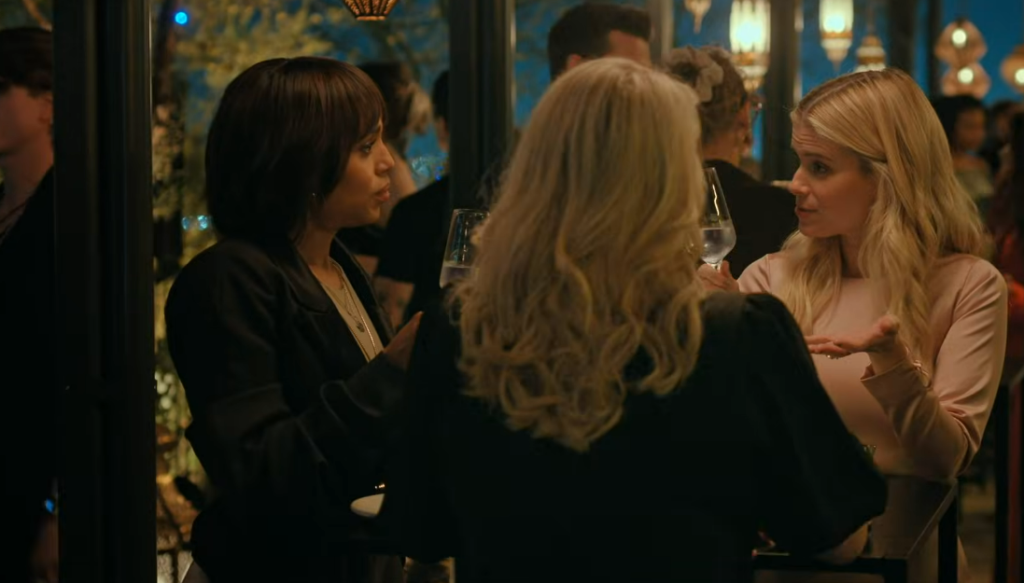
The first scene lasts longer than it should. Three slightly inebriated women dancing under warm lights that make everything appear softer than it actually is, laughing in a way that feels both genuine and staged. Social media adores moments like this, which are meticulously disorganized and emotionally staged. Nevertheless, something seems strange even in that initial frame.
It’s difficult to ignore the fact that their eyes aren’t completely filled with laughter.
The new Apple TV+ series “Imperfect Women” starts with that unsettling contrast and never lets go. Three friends, Eleanor, Mary, and Nancy, are at its core. From a distance, their lives seem stable, but upon closer examination, they start to fall apart. Everything is accelerated by a murder, but the fissures were already present, developing covertly over years of minor concessions and unsaid animosity.
The crime doesn’t seem to be the main focus of the show. It has to do with the performance.
As Eleanor navigates her refined world of wealth, power, and carefully manicured appearances, it becomes evident that she is not only controlling her life but also how it is perceived. Beneath the controlled elegance with which Kerry Washington portrays her, there is a tighter, almost brittle quality. The character might not be entirely aware of the boundaries between her private and public selves. And it seems deliberate to be ambiguous.
Elisabeth Moss’s character Mary represents the other extreme. With kids, financial strain, and a home that feels lived in rather than staged, her life is less refined and more chaotic. In one scene, she is trying to deal with the fallout from her friend’s death while juggling household noise, her face torn between denial and exhaustion. This type of unraveling is more subtle, less obvious, and possibly more truthful.
That contrast has a familiar quality. The real life versus the polished one. The version you show and the version you survive.
The story begins with Nancy’s death, which lingers like a question. Her life’s layers of contradiction—ambition mixed with insecurity, desire entangled with regret—are revealed through flashbacks and fragments. Although it’s never quite clear what that something is, Kate Mara’s portrayal implies a woman who is constantly fleeing from it.
Perhaps that’s the point.
The idea that perfection is not only unattainable but also actively harmful is heavily emphasized in the series. These women are shaped by expectations that don’t quite fit, rather than just being flawed. The ideal spouse. The faithful companion. The calm expert. Over time, the weight associated with each role appears to distort rather than strengthen.
| Category | Details |
|---|---|
| Title | Imperfect Women |
| Genre | Psychological Thriller |
| Release | March 18, 2026 |
| Platform | Apple TV+ |
| Creator | Annie Weisman |
| Main Cast | Kerry Washington, Elisabeth Moss, Kate Mara |
| Core Theme | Friendship, secrets, identity, pressure of perfection |
| Central Plot | Murder investigation exposing hidden lives |
| Critical Reception | Mixed (IMDb ~5.5/10, Rotten Tomatoes ~41%) |
| Reference 1 | IMDb – Imperfect Women |
| Reference 2 | Apple TV+ Official Page |
In one scene, a character makes a choice that is clearly incorrect and bordering on reckless. Nevertheless, there’s an odd logic to it as you watch it play out. It’s recognition rather than justification. Individuals don’t break easily. They slowly bend until something gives.
Whether the show wants viewers to understand or condemn these women is still up for debate.
It’s easy to understand why there has been disagreement among critics. Certain moments seem excessively manufactured, almost glossy, which lessens the emotional impact. Occasionally, the conversation veers into well-known territory, touching on concepts of pressure and identity without always delving deeper.
But then, out of nowhere, the show finds a more subdued moment—a look, a pause, a slightly off-rhythm line—and it feels authentic once more.
It seems that “Imperfect Women” is more fascinating for its minor observations than for its more significant plot twists.
The program draws from a wider source outside of the story. Although the pressure to look “together” is not new, it seems more intense these days. Everyday life has become a continuous presentation on social media, with flaws removed or repackaged to make it more palatable.
In this way, the series seems more like a reflection than a work of fiction.
There’s a subtle unease as you watch these characters navigate their broken lives. Not because their decisions are startling, but rather because they are well-known. the concessions. the mysteries. The silent bargaining between your current self and your ideal self. The title may serve as a warning in addition to being descriptive.
And then there’s the friendship itself, which is handled in the show with a mixture of suspicion and affection. Long-term bonds, it suggests, aren’t always stable. People’s ability to harm one another increases with proximity. The concept of unconditional loyalty is undermined by both minor betrayals and more significant discoveries. Even so, there are times when the connection seems sincere, almost brittle.
Even when the plot slows down, the tension between care and damage keeps the narrative going. After every episode, it begs the question of how much flaws a relationship can withstand before failing.
The answer is not simple.
The focus has already changed by the time the investigation starts to reveal more than it hides. The people entangled in the mystery are more important than the mystery itself. Their decisions, their blind spots, their efforts to cling to something that might already be lost.
