

A reboot of something that people truly love is associated with a certain kind of anxiety. Not the general curiosity about a franchise extension, but the particular fear of witnessing something very intimate be transferred to new individuals and a new era. That kind of property is Harry Potter. Millions of people who grew up reading the books in the late 1990s and early 2000s grew up with the films that came after, despite their occasional mess and flaws. Rupert Grint, Emma Watson, and Daniel Radcliffe. Snape by Alan Rickman. Michael Gambon’s Dumbledore followed Richard Harris’s. They are more than just performers. They are the faces of the first stories that inspired a particular generation to care about stories at all.
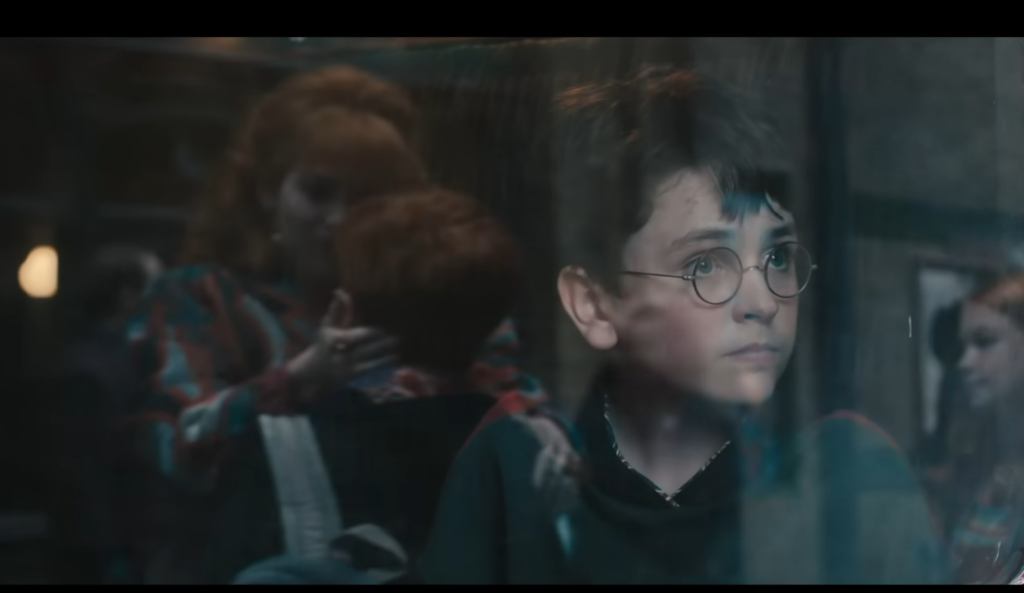
This explains why the first official teaser for HBO’s Harry Potter series, which debuted on March 26, 2026, carried the weight that it did. The Hogwarts Express cutting through mist, the Great Hall, a Quidditch match, Harry’s miserable life with the Dursleys in a suburban house somewhere relentlessly ordinary, and the Sorting Hat settling on a nervous young head were all covered in less than two and a half minutes. The pictures were identifiable. The faces weren’t. In roughly ninety seconds of screen time, three unidentified children—Dominic McLaughlin as Harry, Arabella Stanton as Hermione, and Alastair Stout as Ron—carry the weight of something massive. Really, it’s difficult to draw many conclusions from a teaser. The most memorable scene, however, was when Stout’s Ron asks Harry if he is actually the Harry Potter on the Hogwarts Express and, upon confirming the scar, makes a tiny, happy “pew!” gesture at his own forehead. Despite all the odds, it is instantly endearing.
Key Facts: Harry Potter HBO TV Series
| Series Title | Harry Potter and the Philosopher’s Stone (Season 1) |
| Network / Platform | HBO / Max (global); JioHotstar (India) |
| Premiere Date | Christmas 2026 |
| Total Planned Seasons | 7–8 (one per book, across approximately 10 years) |
| Episodes (Season 1) | 8 episodes |
| Showrunner | Francesca Gardiner (Succession) |
| Lead Director | Mark Mylod (Succession, The Menu) |
| Harry Potter | Dominic McLaughlin (newcomer) |
| Hermione Granger | Arabella Stanton (newcomer) |
| Ron Weasley | Alastair Stout (newcomer) |
| Albus Dumbledore | John Lithgow |
| Severus Snape | Paapa Essiedu |
| Rubeus Hagrid | Nick Frost |
| Professor McGonagall | Janet McTeer |
| Score Composer | Hans Zimmer (via Bleeding Fingers Music) |
| Estimated Budget | ~$100 million per season; $4.2 billion total project |
| J.K. Rowling’s Role | Creative input; retained involvement |
| Reference Links | First Teaser – Harry Potter Official · Full Cast Guide – Variety |
HBO has made its most obvious bets on the adult cast. John Lithgow, a two-time Emmy winner with a wide range, is an intriguing choice to play Albus Dumbledore. However, his energy differs greatly from that of Harris or Gambon’s portrayals. With two Oscar nominations, Janet McTeer’s portrayal of Professor McGonagall offers significant dramatic credibility. Perhaps the most difficult choice to envision is Nick Frost as Hagrid. Frost is best known for his comedic abilities, and the part will require him to maintain a kind of warm, lumbering gravity that Robbie Coltrane did with ease. Each of these actors is capable and intelligent. One of the main questions that won’t be addressed until the cameras roll and the show airs at Christmas is whether they’ll fit in with roles that are so closely linked to their predecessors.
The most controversial aspect of this production since its announcement has been the casting of Snape. The Ghanaian-English actor Paapa Essiedu, who is well-known in Britain for his roles in Black Mirror and I May Destroy You, is truly outstanding. Additionally, he is a Black man playing a part that J.K. Rowling described as pale-skinned and greasy-haired in her own text, and which became inextricably linked to Alan Rickman’s specific kind of ominous pallor. Because of the intense backlash, HBO acknowledged that a robust security operation had been put in place around the production. Essiedu has openly discussed receiving death threats that involve specific, believable acts of violence. “I’ve been told, ‘Quit, or I’ll murder you,'” he replied. “I’m playing a wizard in Harry Potter.” The serenity with which he says that is either a sign of exceptional poise or the distinctively British ability to downplay something terrible. Most likely both. The actor who portrayed Lucius Malfoy in the original movies, Jason Isaacs, described the critics as racist and called Essiedu one of the greatest actors he had ever seen. That seems like the right read, at least.
The creative team is qualified to handle this with seriousness. The showrunner is Francesca Gardiner, who worked on Succession. Mark Mylod is an executive producer and director of several Season 1 episodes. He also created The Menu and directed some of Succession’s most tightly controlled episodes. Perhaps the most comforting aspect of the project from a craft perspective is their shared sensibility, which is character-driven, precise, and at ease with dark humor and real human weight. It’s also noteworthy that Hans Zimmer was chosen to compose the series’ soundtrack instead of bringing back John Williams’s instantly identifiable themes from the movies. Using Williams’s music would have made the show seem like a cover of itself because it is so deeply ingrained in the cultural memory of Harry Potter. Although it will surely disappoint a generation whose emotional reaction to those three notes from Hedwig’s Theme is essentially Pavlovian, Zimmer’s original composition is a true declaration of independence.
According to reports, HBO is spending about $100 million every season, with a projected total of $4.2 billion for all seven planned seasons. Somewhere in the UK, a miniature version of Hogwarts and its environs has been built. The chairman and CEO of HBO, Casey Bloys, has already cautioned viewers not to anticipate yearly releases because that is just not how shows of this magnitude are produced. Both House of the Dragon and The Last of Us have comparable timelines, and neither film requires its main actors to age realistically over the course of a seven-year plot on a two-year production schedule. For the next ten years, the production team will be carefully navigating the logistical challenge of the lead trio of young actors growing older more quickly than the show can keep up.
The more contentious aspects of the series, such as J.K. Rowling’s involvement, the transgender controversy that has caused a public rift between her and several original cast members, and the particular difficulty of extending books that many fans are familiar with into eight-episode seasons without either padding them thin or truly surprising an audience that has spent twenty years with these stories, are still unclear. It seems like HBO wants this to be a prestige show rather than a nostalgic one. Christmas 2026 will start to address the question of whether it can be both.
