

In addition to completely changing the way we use technology, Steve Jobs subtly altered the guidelines for individual productivity. He wasn’t lazy or trying to establish his brand when he wore the same black turtleneck every day. The tactic was strategic. A really lucid and deliberate one.
Unlike most individuals, he realized that every minor choice has a price. How to eat. What to dress up in. When to respond to emails. These decisions eventually take away from your ability to concentrate on things that are truly important. Decision fatigue is the term used by psychologists to describe this gradual loss of mental energy.
It was not just Jobs who viewed decision-making as a limited resource. During his time in office, Barack Obama notably wore only gray or navy suits. According to Mark Zuckerberg, wearing a gray shirt every day allows him to “spend less energy on trivial decisions.” The uniform turned into a deliberate strategy to safeguard cognitive clarity for each of them.
Our capacity to make wise decisions declines during the day, according to psychologist Roy Baumeister’s studies. Our discipline decreases as we make more decisions. Hospitals, grocery stores, and even courtrooms have confirmed that finding. After experiencing mental exhaustion, people often make less deliberate or riskier decisions.
| Concept | Definition and Impact |
|---|---|
| Decision Fatigue | Mental decline in decision-making after repeated choices |
| Steve Jobs’ Uniform | Black turtleneck, Levi’s jeans, New Balance sneakers |
| Purpose | To reduce trivial decisions and preserve cognitive energy |
| Other Practitioners | Barack Obama, Mark Zuckerberg, Albert Einstein |
| Psychological Basis | Based on cognitive load theory and executive function research |
| Credible Source | https://www.cnn.com/2015/10/09/tech/decision-fatigue-same-clothes |
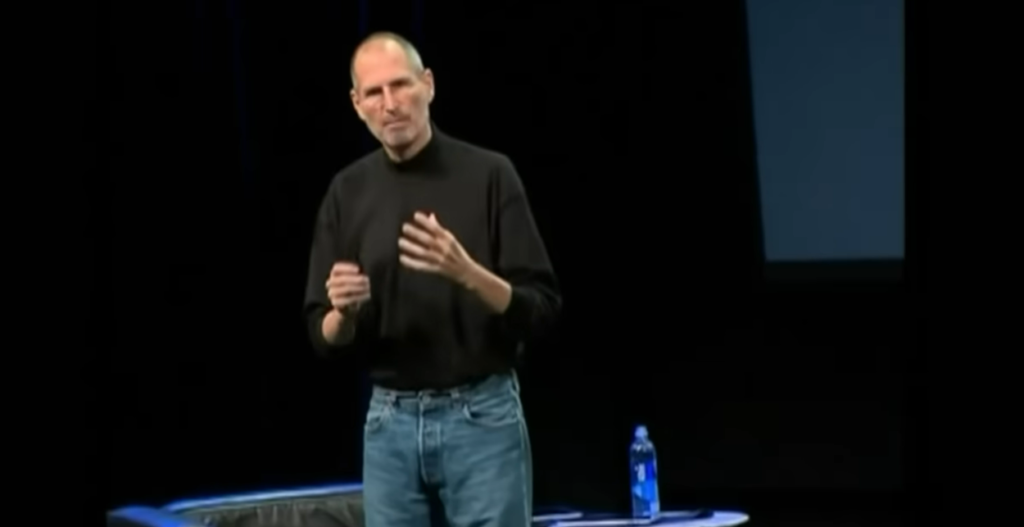
Jobs decided to automate routine tasks after realizing this. He made room for better thinking by getting rid of choices like what to dress. This small gesture to ease friction turned into a very effective mental defense.
Surprisingly, I remember reading that his turtleneck served as a mental firewall.
It’s not just about clothes for a lot of us. Before noon, we are faced with countless options, including schedule conflicts, notifications, and selecting among five productivity apps that all claim to “simplify life.” Interestingly, these technologies can have the opposite effect. Quickly and silently, the cognitive clutter accumulates.
Reducing little decisions can be especially helpful. Maintaining basic habits, such as writing times, gym attire, and morning meals, helps focus on more important duties. That isn’t monotonous. It’s architecture. It’s a method of organizing our day such that there are less obstacles, fewer stalls, and more cerebral stimulation.
You can use Jobs’ ideas without having to adopt his style. Whether you are a CEO or a teacher, little systems provide comfort. Recurring wardrobe combinations, prearranged meals, or focused hours all help to cut down on decision clutter. Additionally, they do so without stifling creativity—quite the contrary.
Better decisions can be made when we eliminate needless options. You don’t express yourself less. You are more intentional. And in situations where time is of the essence and concentration is crucial, that level of clarity can be quite useful.
It is easy to underestimate the amount of energy that is silently expended choosing between tasks that yield minimal benefits. Despite our intelligence, it is shockingly simple to overwhelm our minds. Uniformity—not rigidity, but a wonderfully effective buffer—comes into play here.
Perfectionism does not create the most effective practices. They react to turmoil. Jobs’ lack of style didn’t prevent him from simplifying his outfit. He did that because he was more interested in clarity than in novelty. And by keeping his concentration, he produced more.
There is, however, a limit. You won’t be able to avoid restless nights or incessant digital noise with uniforms. There are levels of decision fatigue. Lifestyle, mental health, and surroundings all influence it. The premise, however, is valid. You can lessen core stress by eliminating friction at the edges.
Airlines utilize checklists as well. They practice their rites. Performers adhere to warm-up routines. These are forces that increase, not limitations. They guard against the deterioration caused by unpredictability.
Building your day with intention is a timeless lesson for younger professionals and students. Automate what can be repeated. Opt for extremely effective instruments rather than ones that are merely trendy. Put in your finest mental hours on worthwhile projects. Let systems that need less work handle the rest.
I have discovered over the years that my afternoons become lighter when I eliminate a small number of small decisions from my mornings. I wasn’t particularly quick. But I was more composed and concentrated. This change feels subtle, yet it has a significant impact.
We need better habits, not just better tools, as Jobs recognized early on. The tools are frequently changed. Habits hold true. Additionally, you don’t have to constantly reinvent discipline when your default choices are wise. You reside within it.
His uniform was a limit, not just a way to dress every day. This is one issue I won’t waste time thinking about, it stated. And there was room for talent to move inside that boundary.
The message isn’t to dress like a tech star, after all. It’s to think in unison. Decide on clarity. Minimize the noise. Your day’s unseen architecture should be made very evident. By doing this, you protect focused attention, the most valuable commodity of the current world.
