

Musselburgh Old Course doesn’t aim to dazzle with opulent architecture or brand-new amenities. Rather, it provides an incredibly unique experience: a true link to the game’s origins. It serves as a subdued reminder that golf wasn’t always a spectacle but rather something far more straightforward and grounded. It is situated inside the oval of an operational horse racing track.
The Scottish lawyer Sir John Foulis recorded in his ledger that he had lost a wager “at Golfe at Musselburgh” in 1672. That one line has become the cornerstone of one of golf’s most revered locations, despite the entry feeling almost laughably unimportant. Mary, Queen of Scots, is said to have performed there as early as 1567, giving a regal touch to an already rich tapestry.
This nine-hole course is only slightly over 3,000 yards long by today’s standards, yet it offers an incredibly immersive experience. There is no airbrushing of the fairways for television. Due to the influence of time, wind, and horses running between competitions, they are erratic. Strangely, hoofprints are included in the scenery and are not seen as damage but rather as a feature of the game. That in and of itself speaks something about Musselburgh’s philosophy, which prioritizes authenticity over looks.
| Category | Information |
|---|---|
| Location | Musselburgh, East Lothian, Scotland |
| First Recorded Play | 1672 (possibly earlier, Mary Queen of Scots in 1567) |
| Course Type | 9-hole links course inside a horse racing track, par 34 |
| Historic Significance | Hosted The Open Championship six times (1874–1889) |
| Unique Features | Use of hickory clubs, hoofprints allowed, Mrs. Forman’s Inn refreshment stop |
| Club Restoration | Re-established in 1995, clubhouse restored to historical standards |
| Key Contribution | Origin of 4.25″ golf hole diameter, invention of “brassie” club |
| Website | musselburgholdcourse.com |
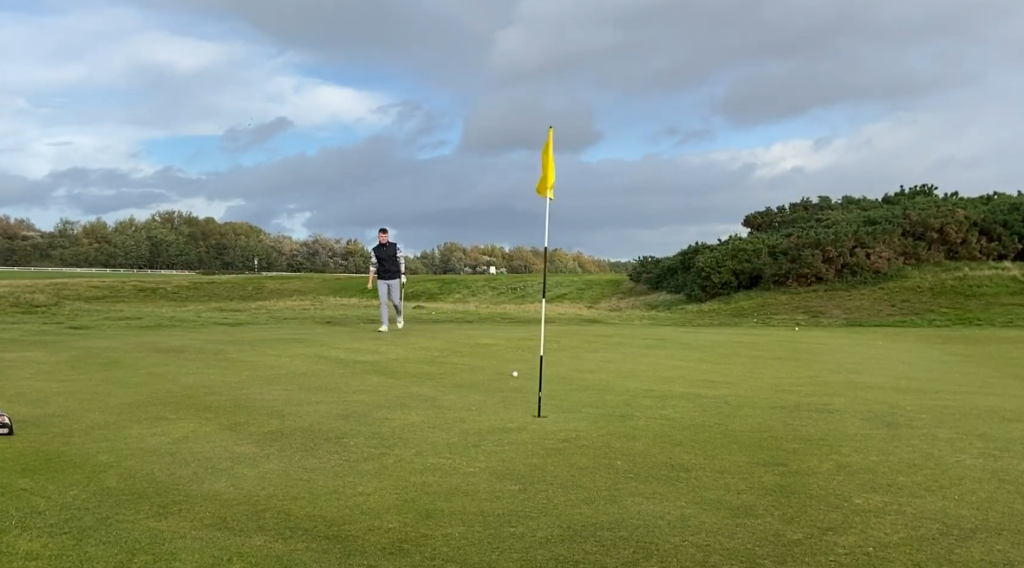
This modest piece of land was hosting the largest sporting event by the late 1800s. It hosted the Open Championship six times between 1874 and 1889. In addition to winning championships, winners like Bob Ferguson and Mungo Park also earned their position in a tradition that is still murmuring over the greens. The Open’s current cycle may no longer feature the course, but its impact hasn’t diminished.
The fourth hole, which is arguably the most popular, used to be next to a little bar called Mrs. Forman’s Inn. Players used to stop in the middle of a game to get a drink from the back window, a gesture that feels both charming and strangely opulent by today’s standards. Even though the hatch has long since vanished, the memory endures, delicately etched on the breeze.
Musselburgh’s impact on golf extends well beyond sentimentality. Shots off harder surfaces were much more reliable after the introduction of the “brassie,” a metal-plated hardwood club. The golf hole cutter, whose design resulted in the now-standard 4.25-inch hole size utilized on every course across continents, was a more subtly innovative development. These footnotes are fundamental, not ornamental.
Players from all over the world are drawn to Musselburgh for a reason. The Hickory Challenge, in which competitors use clubs with a traditional hickory shaft, is one of its most endearing offers. It is a remarkably changing event. Compared to contemporary titanium, the clubs respond with a different rhythm and feel alive, flexing lightly. There is a softer, more reverent sound of contact, and many people say the action is more spiritual than athletic.
In 1995, the clubhouse underwent a meticulous restoration, embodying the same harmony between practicality and respect. It was formerly home to the Royal Burgess Golfing Society, but now it serves as a bridge between generations. Instead than romanticizing the past, the structure lets it do the talking. Tea, conversation, old photos, and tales exchanged over aged tables are all still ingrained in the culture.
After reading about how the original hole size cutter was created here, I stopped once when I was approaching the sixth green. It felt really straightforward, but it had a significant impact. This small piece of land has more to do with the game than most players would ever realize.
The training is currently run by East Lothian Council, and their level of care is quite impressive. Musselburgh seems to flourish because it never pretends to be more than it is, in contrast to many heritage venues that struggle to strike a balance between preservation and usability. Pride in the area is strong. Every sign, post, and bench feels like it belongs there, and the grass is mowed with deft accuracy.
Arriving with curiosity, tourists depart with respect. Iona Stephen of Sky Sports recently recorded a unique episode here, where she demonstrated the exquisite blending of heritage with contemporary appreciation while playing with hickory clubs. It’s simple to see why golfers from Indiana to Tokyo sign up as foreign members; they’re joining a narrative rather than merely purchasing a course.
Today, Musselburgh is still open to the public. A set of clubs (hickory or otherwise) and an open afternoon are all you need; neither an invitation nor a pedigree are required. It’s quite refreshing how simple it is. The fees are pleasantly low, booking tee times is simple, and guests are seen as temporary caretakers of a live game rather than as outsiders.
Musselburgh provides a very obvious option for golfers weary of GPS-measured swings and algorithmically optimized equipment. Players are reminded of how the game used to feel before brands, analytics, and drone cameras broke the stillness.
It’s also a lesson in culture. Musselburgh is an excellent example of how to preserve cultural history without turning it into a museum. The route changes gradually and purposefully. Without sacrificing commercial viability, events such as the Hickory Challenge, club dinners, and community fundraisers help maintain relevance.
There’s something more than competitiveness when you’re playing the last hole, the Edinburgh cityscape shimmering in the backdrop, and a gentle breeze bending the flag. You are welcome. Swing by swing, welcomed into a narrative that is continuously being written. Musselburgh garners attention with quiet, careful grace rather than asking for it.
This is a site where the game still matters, not merely where it formerly took place. Musselburgh is perennially young because of this more than anything else.
