

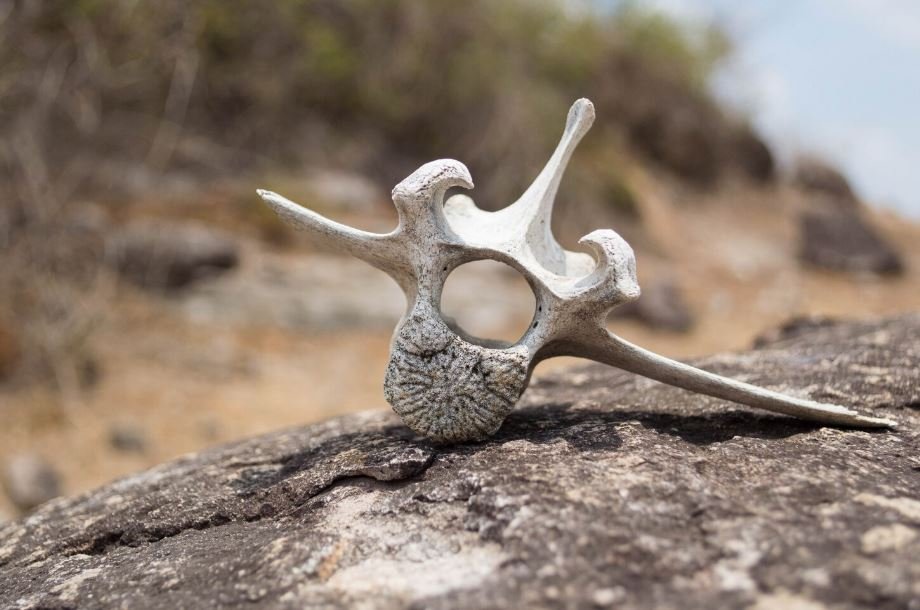
In the north of Patagonia, the wind never stops. The Kokorkom, or “desert of the bones,” as the locals refer to it, is traversed by it as it scrapes across ridges of sandstone, lifting thin sheets of dust. It’s hard to believe that this area was once teeming with life when you’re standing there, with only scrub brush and low dunes extending to the horizon. Nevertheless, it did 95 million years ago.
The delicate skeleton of Alnashetri cerropoliciensis, a dinosaur so small that it would hardly touch an adult’s knee, was discovered there by paleontologists. It is currently one of the smallest non-avian dinosaurs ever found in South America, weighing less than a chicken and measuring just over two feet from snout to tail. Its bones, preserved almost as though it had been purposefully laid down, were discovered curled in sandstone.
| Discovery | Alnashetri cerropoliciensis |
|---|---|
| Location | La Buitrera, Río Negro Province, Patagonia, Argentina |
| Geological Period | Late Cretaceous (approx. 95 million years ago) |
| Estimated Size | ~70 cm long (about 28 inches), 0.7 kg |
| Research Institution | CONICET |
| Journal Published | Nature |
| Reference | https://www.nature.com |
Patagonia has been synonymous with giants for decades. Once, a predator weighing several tons, the Giganotosaurus, stalked these plains. The Argentinosaurus lumbered across the same ground, growing to unimaginable lengths. The story has been cozy: the colossal is found in southern South America. That story is complicated by this fossil.
Alnashetri was a member of the alvarezsaurs, a strange subgroup of theropods, the larger group that includes birds and, later, carnivores. Alvarezsaurs were distinguished by their long, thin legs and stubby but strong forelimbs. In order to burrow into termite mounds, many later members developed larger claws and smaller teeth. Alnashetri, however, seem to have existed before that specialization and still had sharp teeth that were appropriate for hunting small vertebrates.
This detail might be more important than its size.
The individual was approximately four years old and almost fully grown, according to researchers who examined the histology, or microscopic growth rings in its bones. This implies that extreme miniaturization was common. It was evolutionary and purposeful. This lineage opted for diminutive size in an environment dominated by enormous predators and titanic herbivores.
A subliminal presumption ingrained in dinosaur mythology—that larger was always preferable—is called into question by that decision.
Evolutionary history is rarely this straightforward in reality. The finding brings to mind Ingentia prima, an earlier Argentine fossil that was discovered years ago and was referred to as one of the first giants. Scientists had to reevaluate how and when dinosaurs first grew so large because of that specimen. By implying that shrinkage happened repeatedly, possibly independently, within the same larger family tree, Alnashetri now tilts the pendulum in the opposite direction.
One gets the impression from seeing this that dinosaur evolution was more of a branching experiment in survival than a march toward gigantism.
The preservation is impressive in and of itself. It was suggested that the animal was swiftly buried by a sand dune because the skeleton was discovered articulated, with the bones arranged as they would have been in life. In the past, the shifting desert of Patagonia served as a sort of natural archivist, preserving delicate remains before weather or scavengers could destroy them. The specimen was meticulously removed and prepared by paleontologists over the course of more than ten years, brushing away grains that had pressed against its ribs for millions of years.
It seems almost monastic to have such patience. The giant story is further complicated by La Buitrera’s larger ecosystem. The same area has produced the fossils of small mammals like Cronopio and early snakes like Najash. These were not desolate lands dominated only by imposing animals. They were layered landscapes, with insects humming in the heat, feathered hunters darting between dunes, and predators stalking burrows.
Whether Alnashetri’s small stature provided any particular benefits in this desert environment is still unknown. Its long legs imply speed, possibly allowing it to run across open sand without larger carnivores noticing. Its arms suggest grasping behavior even though they are not designed for flight. This animal seems to have occupied a slender ecological lane, one that is easily disregarded in a society obsessed with giants.
Large skeletons attract visitors to museums. Children’s books are dominated by tall reconstructions. The sound of enormous footsteps is preferred even by Hollywood. Rarely do smaller dinosaurs take center stage at exhibitions. They don’t have any drama. However, findings like this subtly challenge the notion that size was the primary defining factor of the Mesozoic world.
Rather, it starts to appear surprisingly contemporary. After all, small theropods are the ancestors of birds. Their current success—occupying every continent and adjusting to almost any environment—may be due more to their flexibility and agility than to their physical strength. With its light body and likely feathers, Alnashetri resembles a cousin caught on the edge of a family photo rather than an evolutionary dead end.
The scale has a humble quality as well. Seeing a fossil of such small size and knowing that it coexisted with organisms 100 times heavier than it makes one reevaluate what dominance actually means in terms of evolution. It’s not always loud to survive.
The fossil beds in Argentina never cease to amaze. It seems like every new excavation calls into question long-held beliefs about the origins of giants, how predators hunted, and why some lineages grew while others shrank. Future excavations could make this story even more complicated. In paleontology, revision is essential.
But for the time being, this little skeleton lying beneath the Patagonian sky acts as a silent reminder. There were more than just giants during the dinosaur era. This was a time of experimentation with size, speed, and strategy. The biggest questions can occasionally be found in the smallest bones.
