

Outside of Lyon, the road to the research campus feels almost purposefully unremarkable, with modest office buildings and logistics warehouses hidden behind metal fencing. Yet, behind those subdued exteriors, France is putting together something much more ambitious than it first seems: the National Quantum Computing Center, a project that was conceived out of President Emmanuel Macron’s €1.8 billion wager that the nature of computing is about to change.
It seems as though Lyon was picked out of instinct rather than chance. The city, which has always been more focused, less theatrical, and industrious, has always existed in the shadow of Paris. It is evident that France is not attempting to impress anyone with its aesthetics as one strolls through its scientific districts, past glass-fronted laboratories and muted signage. It aims to create something that will be significant in the future.
Physically and figuratively, the new quantum center is connected to the National Institute of Nuclear and Particle Physics’ nearby computing infrastructure, where the VIL3 data center just went online. With servers that can scale to 2 megawatts, that facility is built to meet the demanding computational needs of contemporary science while operating quietly. However, it’s also evolving into something else entirely, a link between quantum machines and classical computing that still has a hint of experimentation.
Despite the excitement, there is still a sense of uncertainty surrounding quantum computing. Nobody knows exactly when these machines will become commercially useful, even researchers acknowledge in private. Hundreds of millions of dollars have been invested in French startups PASQAL and Alice & Bob, who are vying to create working quantum processors, as investors appear to think it is inevitable. However, reality and belief don’t always proceed at the same pace.
| Category | Details |
|---|---|
| Initiative | France National Quantum Computing Center |
| Location | Lyon, France |
| Government Investment | €1.8 Billion National Quantum Plan |
| Announced | January 2021 (Plan), Expansion continuing through 2026 |
| Supporting Institution | French National Centre for Scientific Research (CNRS) |
| Related Facility | IN2P3 VIL3 Data Center (500kW scalable to 2MW) |
| Jobs Expected | 16,000 by 2030 |
| Purpose | Quantum computing research, development, and hybrid computing |
| Industrial Partners | PASQAL, Alice & Bob, Atos, OVHcloud |
| Official Reference | https://quantique.france2030.gouv.fr |
| Additional Reference | https://www.cnrs.fr |
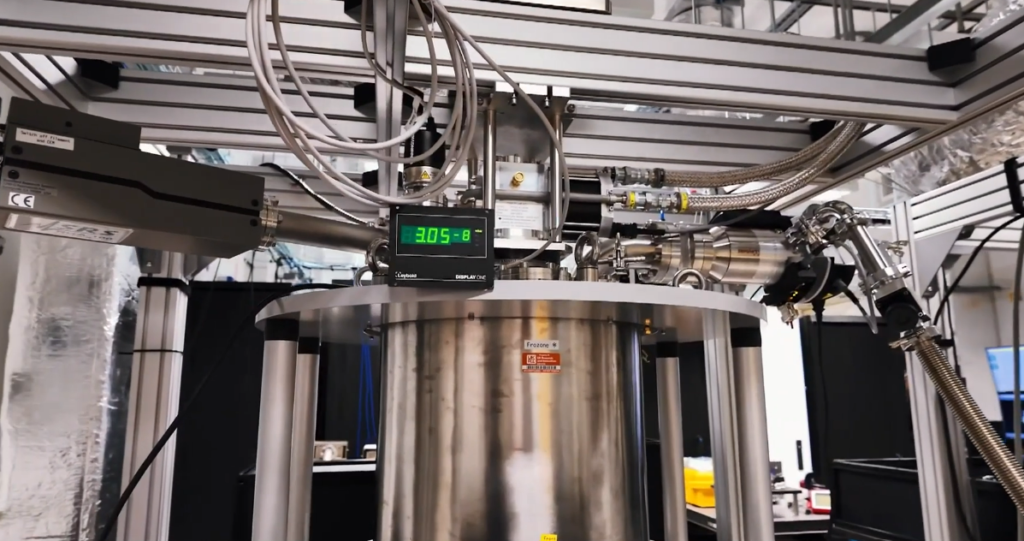
The patience of France’s approach seems unusual.
The government has chosen to create the ecosystem first, investing in research labs, assisting startups, and building infrastructure that can house future machines, rather than waiting for quantum computers to mature elsewhere. Perhaps this strategy, as costly and slow as it seems, is more about making sure France doesn’t fall behind in the event that quantum computing suddenly picks up speed than it is about making breakthroughs right away.
Scientists are already conducting experiments inside these facilities, connecting quantum prototypes to conventional supercomputers to create hybrid systems that can make up for each other’s shortcomings. As you watch this happen, you get the impression that something is still incomplete, similar to the early aviation workshops before flying became commonplace.
France’s scientific heritage contributes to its confidence. World-renowned physicists, including Nobel Prize winners whose contributions established the groundwork for quantum theory itself, have long come from the nation. But success is not assured by history alone. The United States continues to dominate the industry thanks to firms like Google and IBM, but Germany and the United Kingdom are also making significant investments.
The competition seems far away from Lyon, but it is very real.
Government representatives openly discuss the creation of 16,000 jobs by 2030, implying that the quantum center is an economic endeavor as well as a scientific one. In the same way that Silicon Valley developed around Stanford University decades ago, there is hope that startups will congregate in the area and establish a local industry. It is still unclear if policy can be used to engineer that type of organic growth.
France’s readiness to invest so much of its tax dollars in technology that might not pay off for years shows more about the country’s outlook on the future. Concerns about relying too much on foreign computing infrastructure, especially American cloud providers, are subtly present in Europe. Perhaps the final significant opportunity to establish autonomous technological leadership is provided by quantum computing.
However, risk is not eliminated by ambition.
Still, quantum hardware is brittle, operates at temperatures lower than space, is prone to mistakes, and is excruciatingly hard to scale. According to even the most optimistic predictions, practical quantum machines might not be available for years. In private, some researchers acknowledge that timelines have slipped in the past.
Nevertheless, construction is still ongoing.
There are new labs opening. They are hiring engineers. Crates of equipment are being delivered, carefully unpacked, put together, and calibrated.
The difference between the investment’s certainty and the technology’s uncertainty is difficult to ignore.
France’s decision to engage in a technological revolution before its results are known makes what is taking place in Lyon feel less like a completed accomplishment and more like a statement of intent. There is hope, but there is also realism and an awareness that innovations don’t always happen when the government wants them to.
