

The technology was not the first thing that caught people’s attention. The traffic was the cause.
Cars sat motionless outside Bharat Mandapam, their engines humming impatiently in the late winter Delhi sun, long before the opening speeches started. Formal suit-clad delegates emerged and started to move, fiddling with their conference badges as though to persuade themselves that this was the norm. It’s possible that the ambitious, impressive, and slightly unbalanced tone of the summit was established there.
The purpose of the AI Summit 2026 was to reveal something more significant than a conference. It was intended to mark a change, establishing India as a key player in the negotiations for its future rather than merely as a participant in artificial intelligence. Phrases about safety, opportunity, and teamwork flickered on LED screens inside the enormous convention halls. However, it seemed as though everyone was measuring something invisible—power—as they moved between the exhibition booths.
| Category | Details |
|---|---|
| Event Name | India AI Impact Summit 2026 |
| Location | Bharat Mandapam, New Delhi, India |
| Dates | February 2026 |
| Hosted By | Government of India |
| Key Participants | Sundar Pichai, Sam Altman, Dario Amodei, global policymakers |
| Major Outcome | Over $200 billion in AI investment pledges |
| Focus | AI governance, infrastructure, global AI cooperation |
| Official Website | https://impact.indiaai.gov.in |
| Reference | https://en.wikipedia.org/wiki/AI_Impact_Summit |
| Reference | https://blog.google/technology/ai |
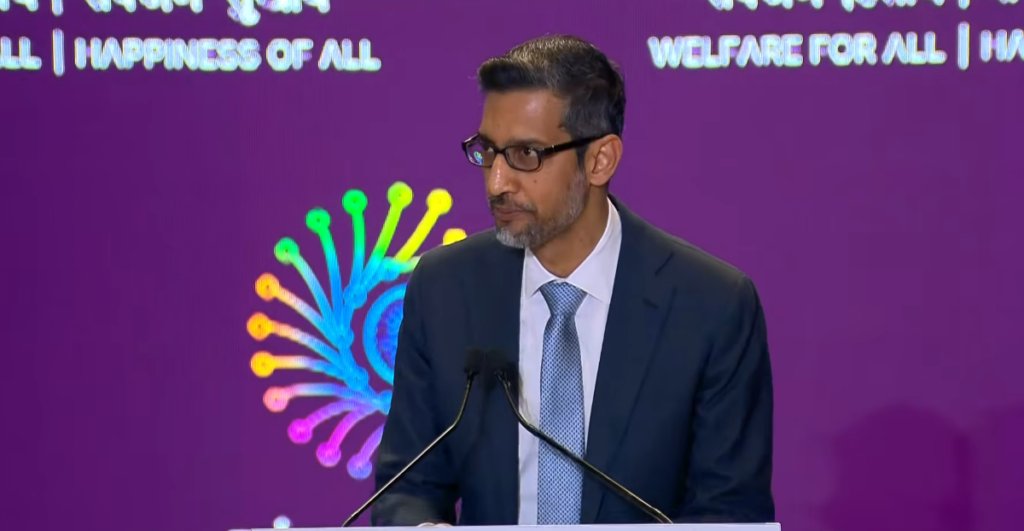
Just the guest list was significant. With composure and accuracy, Sundar Pichai discussed accountability in the development of intelligent systems. Sam Altman navigated crowds with the vigilance of someone who knew he was being watched all the time. Standing close by, Dario Amodei appeared deliberate, almost wary. The event became more than just a ceremony because of their presence. It turned into a stage.
But one moment wouldn’t remain symbolic.
Leaders were asked to demonstrate unity by raising their hands together during a widely reported group photo. Most readily complied. However, despite their fierce rivalry, Altman and Amodei refrained from holding hands. Rather, they raised their arms independently. It was short, subtle, but clear. As we watch it develop, we get the impression that competition rather than collaboration will shape AI’s future.
At the same time, the summit was overrun with announcements of investments.
Reliance Industries announced plans to invest heavily in infrastructure. Behind closed doors, in meeting rooms, partnerships were quietly forged. The use of numbers, such as billions and tens of billions, was casual, as though the concept of scale had become commonplace. It appears that investors no longer consider AI to be experimental. Now it’s infrastructure. It’s still unclear, though, if all those promises will result in actual machines, jobs, or change.
Exhaustion and optimism coexisted on the exhibition floor.
Startups showcased software that could write code, diagnose illnesses, and forecast crop yields. With a little hoarseness in their voices from repeating the same pitch dozens of times, young engineers enthusiastically described their work. It’s difficult to ignore how much hope is placed in still-imperfect systems when you watch them.
Then there were the ones that were missing.
Bill Gates abruptly withdrew from his scheduled speech. Jensen Huang of Nvidia had already canceled. In the schedule, their vacant speaking slots hung there like unsolved questions. The decisions were presented as pragmatic in official explanations. Nonetheless, it seems that the world’s tech leadership is growing more circumspect and selective about where it shows up.
The summit itself was unable to support itself.
Entrances were overrun by crowds. Temporarily, exhibition halls were shut down. Delegates voiced their displeasure with the lack of planning, first in private and later in public. It felt ironic that there were logistical flaws at an event meant to demonstrate proficiency. It might be simpler to create artificial intelligence than to manage the people who will be using it.
But there was no denying the ambition.
Speaking about protecting children in an AI-driven world, Prime Minister Narendra Modi framed the technology as something that needs direction rather than just creativity. His remarks revealed a deeper level of anxiety that pervaded the summit. While efficiency is promised by artificial intelligence, there is also uncertainty. Although it demands trust, it offers power.
Perhaps the most difficult aspect is trust.
There was a growing sense that something permanent was taking place as one walked through the venue in the late afternoon, as lights glinted off polished floors and conversations grew softer. Research labs are no longer the only places where AI exists. It is permeating everyday life, industries, and governments.
