

The ground doesn’t feel totally reliable on a gloomy afternoon in Rancho Palos Verdes. The cliffs, which were once sturdy enough to support multimillion-dollar residences and glass chapels, are now moving almost imperceptibly, inch by inch. It might go unnoticed at first by someone standing close to the edge. However, over a period of weeks, the alterations accumulate—foundations silently giving way to gravity, fences leaning, and cracks growing wider.
The coastline of California has always been unstable, sculpted by time and waves. However, it seems like the rhythm has shifted recently. What was once slow now seems hurried, almost impatient. According to scientists, erosion is accelerating due to the complex effects of human development, stronger storms, and rising sea levels. On paper, that explanation makes sense. It feels more like inevitability than theory when you’re perched on the edge of a collapsing bluff.
Chunks of earth occasionally break away with a dull, unsettling sound further north, close to Pacifica; it’s less dramatic than a landslide in a movie, but it’s still more terrifying because it’s real. In the same way that people adjust to frequent disruptions, residents have become accustomed to it. A fence vanishes. A portion of the trail has been closed. Life goes on, albeit slightly changed.
| Category | Details |
|---|---|
| Topic | Coastal Erosion in California |
| Location | California Coast, USA |
| Key Drivers | Sea-level rise, storms, urban development, land subsidence |
| Current Sea-Level Rise | ~8 inches over the past century |
| Erosion Rate | 0.75–1.24 meters/year (increasing) |
| Future Projection | Up to 3+ meters/year by 2100 |
| Beach Loss Estimate | 24% to 75% of beaches by 2100 |
| Economic Risk | $8–$10 billion property at risk by 2050 |
| Notable Impact | Highway 1 damage, landslides, Wayfarers Chapel closure |
| Reference 1 | NOAA Sea Level Rise Data |
| Reference 2 | US Geological Survey Coastal Studies |
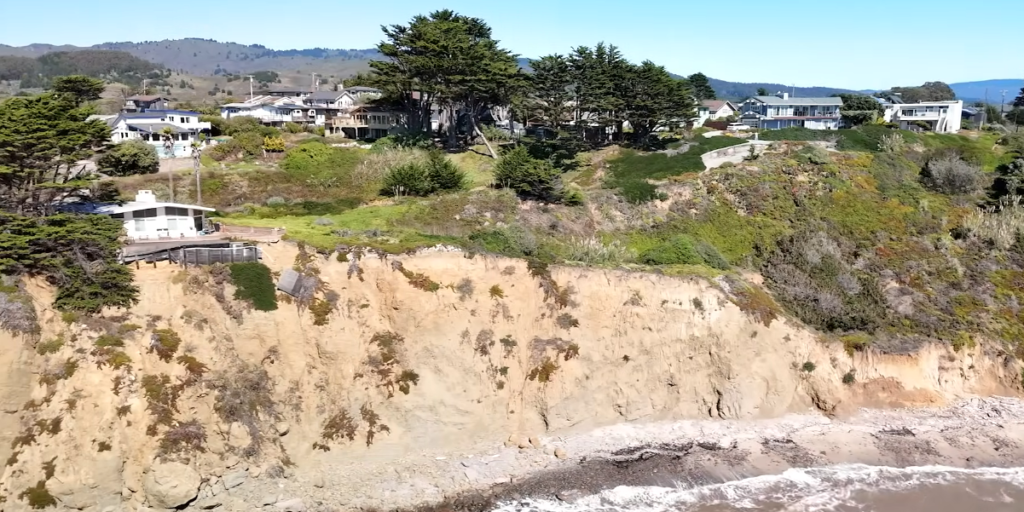
It’s difficult to ignore how inconsistent the narrative is. Over the past few decades, some beaches—especially those in Southern California—have actually gotten wider thanks to coastal engineering and artificial sand replenishment. Large portions of Huntington Beach continue to appear expansive and nearly durable. However, those areas don’t feel naturally stable; rather, they feel like exceptions that have been meticulously maintained. In other places, the shoreline is receding in ways that seem more difficult to stop, and the sand is getting thinner.
Over the past century, sea levels have increased by roughly eight inches. When compared to the geometry of a coastline, that figure seems modest, almost insignificant. Particularly when storms push waves farther inland, even a slight vertical rise results in a horizontal loss of land. The effect intensifies when you include sinking land in specific areas. We might be witnessing the beginning of a much more significant change.
The storms come next. Cliffs that were never built to withstand that kind of repeated force are being battered by waves that seem to be fueled by warmer ocean temperatures. When it rains a lot, the ground gets wet and loses its hold. It only takes a strong swell or an exceptionally high tide for a stretch of coastline to suddenly give way.
In this tale, Highway 1—that famous asphalt ribbon that stretches across the Pacific—becomes a sort of symbol. Erosion and landslides have already caused some of it to be damaged or rerouted. It’s hard not to wonder how long the road can remain in place as you watch traffic flow along those small sections. Like the land underneath it, infrastructure is beginning to appear temporary.
Additionally, there is an economic undercurrent that is getting harder to ignore. In California, coastal real estate has long been associated with wealth, with views that support exorbitant costs. However, that equation is starting to become more complicated due to erosion. According to studies, property worth billions of dollars may be vulnerable to flooding or collapse by 2050. The cost of insurance is going up. The cost of maintenance is increasing. The concept of “prime coastal real estate” is beginning to seem less enduring than it formerly did.
In certain areas, the reaction has been to retaliate by erecting barriers, fortifying cliffs, and trucking in sand. In the short run, these initiatives may be successful and even give the appearance of stability. However, they are costly and necessitate ongoing practice. Beneath these interventions, a silent question remains: how long can this be maintained?
The fact that not all erosion is entirely natural adds to the complexity of the situation. Dams and urban infrastructure have cut off rivers that once carried sediment to the coast, decreasing the amount of fresh sand available. In a way, beaches are starving. It’s a gradual process that doesn’t show up right away, but over time it makes shorelines more vulnerable.
Nevertheless, there is a certain hesitancy in the public discussion of the issue despite the data and the apparent changes. The timeline extends decades into the future, which might be the reason. or because many areas of the coastline still have a lovely appearance today. Crowds still flock to sunsets. Surfers continue to paddle out. The same perspectives that have shaped California for many generations continue to shape life.
As I watch this happen, I get the impression that the true change is psychological as well as physical. The notion that coastlines are stable, dependable, and unchanging is also beginning to fade. It’s unclear what will take its place. The term “managed retreat” is becoming more common, but it still sounds theoretical and abstract.
How soon things will change from this point on is still unknown. According to some estimates, erosion rates could double or even triple by the end of the century, resulting in the disappearance of up to 70% of Southern California’s beaches. That is an astounding amount. However, it exists in an area that is both easy to accept and easy to put off, just like many long-term forecasts.
Disclaimer
Nothing published on Creative Learning Guild — including news articles, legal news, lawsuit summaries, settlement guides, legal analysis, financial commentary, expert opinion, educational content, or any other material — constitutes legal advice, financial advice, investment advice, or professional counsel of any kind. All content on this website is provided strictly for informational, educational, and news reporting purposes only. Consult your legal or financial advisor before taking any step.
