

A small group of tourists stood outside a wooden lodge with a view of a frozen lake late one evening in northern Finland. A nearby chimney gave off a subtle scent of pine smoke. The sky initially appeared normal—clear, black, and starry. Then the horizon started to stretch with a pale green band. It changed into something almost theatrical in a matter of minutes: neon curtains floating slowly above the trees, rippling waves of light, and crimson streaks.
Quietly, one of the guides shook his head. Even those who make a living by watching the aurora appeared taken aback.
In the Northern Hemisphere, such moments have been occurring at an exceptionally high frequency. In the last two years, auroras have been seen in areas where they are uncommon, such as southern England, Germany, the American Midwest, and even some regions of the southern United States. In May 2024, people were leaning out of apartment windows with their smartphones raised toward the night as bright pink skies shimmered over New York City.
It’s difficult to ignore how weird this feels.
The explanation starts on the Sun’s turbulent surface, far from Earth. The solar cycle, which lasts about eleven years, is the natural rhythm that our star goes through. The Sun acts graciously during the quiet phases, emitting only sporadic bursts of energy. However, the star becomes restless and erupts with magnetic storms that launch massive clouds of charged particles into space when the cycle reaches its peak, which scientists refer to as the solar maximum. That restless stage is what we are going through right now.
| Category | Information |
|---|---|
| Phenomenon | Intense auroras caused by powerful solar storms and geomagnetic activity |
| Current Solar Phase | Solar Cycle 25 reaching solar maximum |
| Key Scientific Body | National Oceanic and Atmospheric Administration |
| Space Weather Forecast Center | NOAA Space Weather Prediction Center |
| Historic Comparison | Carrington Event |
| Scientific Cause | Coronal mass ejections and X-class solar flares |
| Reference Sources | BBC explanation of solar storms and auroras • NOAA space weather forecasting resources |
Since its quiet start in 2019, Solar Cycle 25 has proven to be far more intense than scientists had anticipated. The number of sunspots, those dark magnetic knots dispersed throughout the solar surface, has rapidly increased. Each one functions as a pressure valve that is about to burst, releasing massive plasma eruptions known as coronal mass ejections or abrupt bursts of radiation.
It’s oddly captivating to watch solar observatories record these eruptions. Like a cosmic tidal wave, a glowing arc emerges from the Sun’s edge and spreads outward. At times, billions of tons of electrically charged gas can travel over a million miles per hour as they blast into space. The show starts if Earth just so happens to get in the way.
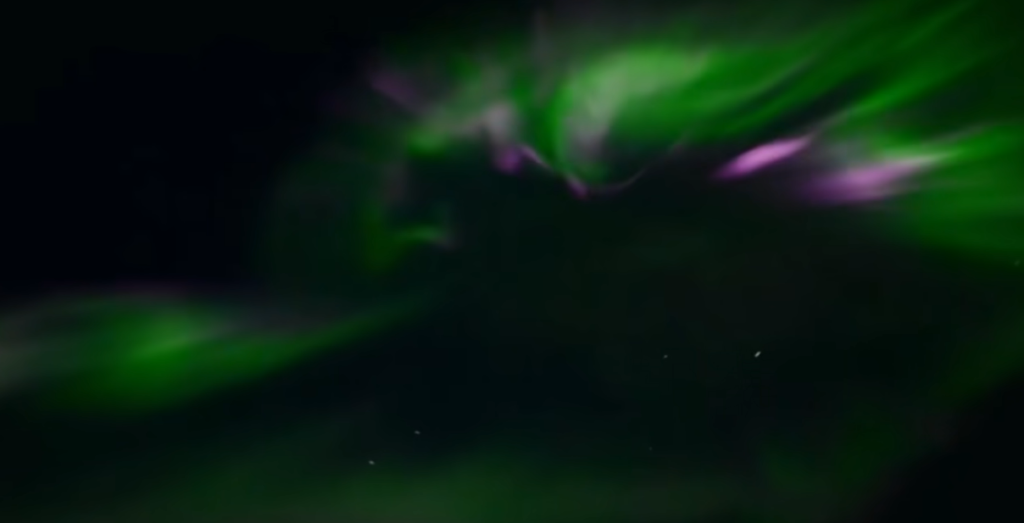
These charged particles collide with gases high in the atmosphere and funnel toward the polar regions when they strike the planet’s magnetic field. The glow of oxygen is red and green. Pink and purple hues are produced by nitrogen. Moving light starts to ripple across the sky.
For centuries, the aurora borealis was primarily a polar phenomenon that could only be seen in isolated locations like northern Scandinavia or Alaska. However, the phenomenon has moved much further south due to the intensity of recent solar storms. Residents of cities that are typically overwhelmed by light pollution have occasionally seen faint red arcs glowing above skyscrapers when they stepped outside. People suddenly realize that they can still be surprised by the sky, and there’s a quiet wonder in that moment.
However, there is a less romantic aspect to the beauty. Earth’s magnetic field is shaken by the same solar storms that create these spectacular displays. Electric currents can be produced along power lines that span continents when that field varies. These currents have the potential to overload transformers or cause blackouts in extreme circumstances.
A few disturbing reminders can be found in history. Millions of people in Quebec lost power during a chilly Canadian night in 1989 due to a geomagnetic storm. Additionally, telegraph operators reported sparks leaping from their equipment during the well-known Carrington Event in 1859, while auroras illuminated skies as far south as the Caribbean.
Far more delicate technology is used in modern society.
Strong solar storms can cause the Earth’s upper atmosphere to expand outward, increasing atmospheric drag for satellites orbiting the planet. Sometimes engineers rush to protect delicate electronics or modify orbits. There could be a weakening of radio signals. Pilots and farmers alike have learned to be cautious because GPS navigation can veer slightly off course.
Solar eruptions are now tracked by space weather experts at the NOAA Space Weather Prediction Center in a manner similar to meteorologists observing hurricanes. In order to determine whether a flare might be approaching Earth, their screens show magnetic maps of the Sun. In forecasting rooms, a sense of cautious tension can arise when storms arrive stronger than anticipated.
Predicting the Sun is still difficult, though.
There are still many unknowns in the field of solar physics. Scientists believe that this cycle may result in a “double peak,” which means that solar activity may increase once more before the decade is out. If that occurs, aurora observers might see exceptionally bright skies for a few more seasons.
Icelandic and Lapland tour operators are already aware of the potential. As tourists chase the lights in the hopes of seeing what some guides discreetly refer to as a once-in-a-generation aurora era, winter tours are selling out months in advance.
It can be oddly humble to watch this happen from the surface of the Earth. We are abruptly reminded that the planet is not alone by the night sky. It is situated within an expansive electrical environment that is shaped by a star that occasionally has tantrums.
Disclaimer
Nothing published on Creative Learning Guild — including news articles, legal news, lawsuit summaries, settlement guides, legal analysis, financial commentary, expert opinion, educational content, or any other material — constitutes legal advice, financial advice, investment advice, or professional counsel of any kind. All content on this website is provided strictly for informational, educational, and news reporting purposes only. Consult your legal or financial advisor before taking any step.
