

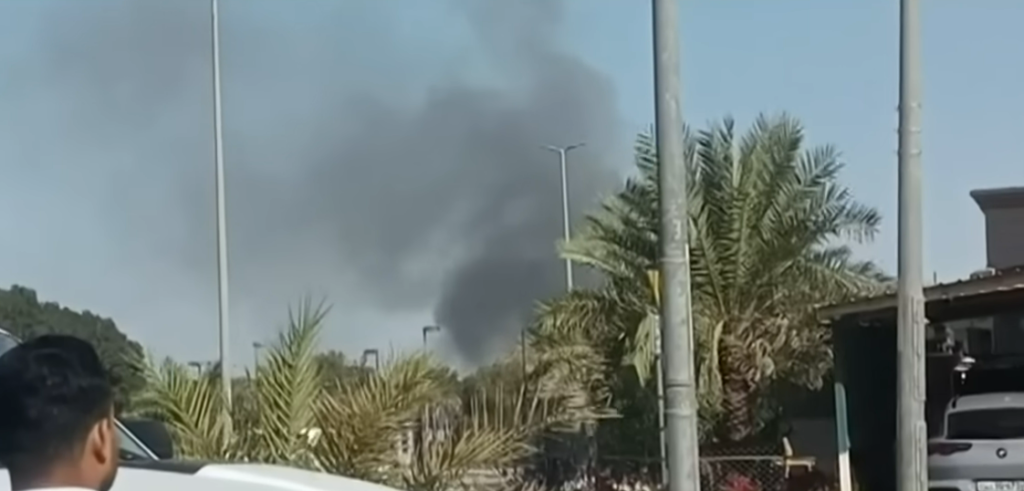
The city appeared almost surprisingly serene the morning the drones struck Riyadh. Smoke rose above the outer walls of the diplomatic quarter, which is typically characterized by mowed hedges and peaceful embassy compounds. With lights flashing against beige government buildings that seldom see public disturbance, fire engines moved swiftly. The U.S. Embassy compound was hit by two drones, Saudi officials said, resulting in what they said was a small fire and some minor damage.
The word “limited” might have been picked with care.
There is more to the alleged Iranian attack on Saudi Arabia than just one isolated incident. Retaliation on top of retaliation seems to be a never-ending cycle that is drawing Gulf states further into a conflict that was already escalating internationally. Several regional actions were attributed to the Islamic Revolutionary Guard Corps. In retaliation, Washington pointed to Iranian command facilities that had been destroyed. Proclamations became firm. The price of oil rose.
Saudi Arabia, which has always been cautious about being used as a proxy battleground, was once again directly targeted. With its glass skyscrapers and enormous LED billboards, Riyadh’s skyline has represented stability in recent years, with tourism campaigns growing, entertainment venues opening, and an ongoing economic transformation. That meticulously constructed image is upset when smoke is seen drifting close to the embassy district.
| Category | Details |
|---|---|
| Primary Incident | Drone strikes on U.S. Embassy in Riyadh |
| Date | March 3, 2026 |
| Location | Riyadh, Saudi Arabia |
| Reported Damage | Limited fire, minor structural damage |
| Injuries | None reported |
| Saudi Defense Authority | Saudi Ministry of Defense |
| Alleged Attacker | Islamic Revolutionary Guard Corps (IRGC) |
| U.S. Military Response | United States Central Command (CENTCOM) |
| Strategic Waterway Affected | Strait of Hormuz |
| Economic Impact | Oil price spike, airspace disruptions |
Official Sources:
Saudi Ministry of Defense: https://www.mod.gov.sa
U.S. Central Command: https://www.centcom.mil
The kingdom seems to be balancing on a tightrope. publicly denouncing Tehran’s actions and restating its right to self-defense while being cautious not to come across as the main aggressor. Several more drones were reportedly intercepted by Saudi air defenses close to Riyadh and Al-Kharj. These days, the workings of modern warfare take place above ground, frequently undetectable until an explosion signals its presence.
Governments did not react as quickly as markets did. With traders expecting a disruption in the Strait of Hormuz, Brent crude saw a sharp increase. Tanker prices skyrocketed. It’s difficult to ignore how rapidly price increases are a result of global anxiety. Similar to blood flowing through an artery, energy passes through this area, and any constriction instantly creates pressure elsewhere.
Cafes were still open in Riyadh’s business areas. Towers of offices buzzed. Conversations, however, changed. Replayed footage of the embassy compound was shown on screens. Families texted one another. There is always a point at which geopolitics becomes local and ceases to be abstract.
By targeting diplomatic buildings, energy infrastructure, and logistical hubs throughout Gulf states that house American forces, Iran seems to be extending the battlefield horizontally as part of a larger strategy. It’s still unclear if that strategy increases Tehran’s influence or further isolates it. Whether the goal is spectacle or deterrence is a topic of debate among analysts.
Attacks connected to Iran have previously targeted Saudi Arabia. The 2019 attack on the oil facilities in Abqaiq and Khurais is still remembered because of the miles-long smoke plumes and the momentary halving of production. Even the strongest systems had weaknesses that were revealed by that episode. The embassy strike this week may not have the same financial impact, but it has a significant symbolic impact.
Through Central Command, the US indicated that it would be conducting ongoing operations against Iranian military facilities. Donald Trump issued a warning that the campaign might go on for weeks or even longer. This open-ended framing makes allies uncomfortable. Prolonged conflicts often veer off course from their initial justification.
Meanwhile, there was a decrease in commercial aviation across the Gulf. Cancellations flickered on the flight boards. Under fluorescent lights, travelers waited in airport lounges while updating their apps. Conflict turns personal during these inconspicuous disruptions.
A more comprehensive regional calculus is developing. Gulf states have made significant investments to stabilize relations, draw in foreign investment, and diversify their economies. A protracted conflict jeopardizes those gains. At least for the time being, investors appear to think that escalation will be contained. However, the belief that conflict is still controllable has always been linked to confidence in this area.
It’s difficult not to notice a subtle resemblance to past Middle East crises as you watch this play out—moments when escalation seemed inevitable until it wasn’t. Following loud demonstrations of force, diplomacy frequently arrives subtly.
Restoring Saudi Arabia’s image of control is its top priority right now. bolstering defenses. markets that are calm. demonstrating resiliency. The delicate balance for Iran may lie in demonstrating capability without inciting severe retaliation.
By midday, the smoke over Riyadh had cleared. Shelter-in-place advisories were still in effect for embassy employees. Security guarantees were reiterated by officials. But something changed.
An embassy complex is more than just a structure. It represents geopolitical alignment, diplomatic presence, and alliance. Drones convey a message when they cross that line, even if they only cause minor harm.
It’s still unclear if this Iranian attack on Saudi Arabia will lead to a more serious conflict or a brief but dramatic escalation. There is a history of the Gulf teetering on the edge and then pulling back.
Disclaimer
Nothing published on Creative Learning Guild — including news articles, legal news, lawsuit summaries, settlement guides, legal analysis, financial commentary, expert opinion, educational content, or any other material — constitutes legal advice, financial advice, investment advice, or professional counsel of any kind. All content on this website is provided strictly for informational, educational, and news reporting purposes only. Consult your legal or financial advisor before taking any step.
