

LNG futures typically don’t make the front page. They shift, change, and traders reposition themselves. However, it felt different this week. As word spread that drone strikes had forced Qatar’s Ras Laffan complex, the largest LNG export facility in the world, to halt production, screens in London and Amsterdam glowed red, then violently green.
At one point, gas prices in Europe increased by over 40%. Asian LNG came next. In response, U.S. natural gas futures rose and settled close to $3 per MMBtu. It felt more like a system that had been startled awake than a normal commodity movement as I watched the numbers flicker across terminals.
Ras Laffan is a real name. On the northeastern coast of Qatar, this expansive industrial city is dotted with shiny liquefaction trains, tightly spaced pipelines, and tankers docking in a steady rhythm. It provides almost one-fifth of the world’s LNG supply. The market takes notice when that facility pauses, even for a moment.
It seems as though traders had become accustomed to their surroundings. Europe’s storage levels were close to 30%, which was less than last year, but winter was coming to an end. It was intended that the refill season would start out peacefully. Rather, prices exploded, exposing the true fragility of the cushion.
This spike might have a significant amount of fear in it. When low inventories and supply disruption headlines coincide, markets frequently overshoot. However, the structural fragility is difficult to overlook. Europe’s reliance on LNG imports increased in 2022 as a result of its shift away from Russian pipeline gas. Qatar became essential.
| Contract / Benchmark | Henry Hub Natural Gas Futures (NG) |
|---|---|
| Exchange | NYMEX (CME Group) |
| Current Price (approx.) | ~$3.03 per MMBtu |
| Contract Size | 10,000 MMBtu |
| Global LNG Benchmark | TTF (Netherlands), JKM (Asia) |
| 52-Week Range (US Nat Gas) | $2.62 – $7.82 |
| Major LNG Export Hub | Ras Laffan Industrial City, Qatar |
| Share of Global LNG (Qatar) | ~20% of global supply |
| EU Gas Storage (approx.) | ~30% capacity |
| Official Market Info | https://www.cmegroup.com/markets/energy/natural-gas.html |
| U.S. Energy Data | https://www.eia.gov/naturalgas |
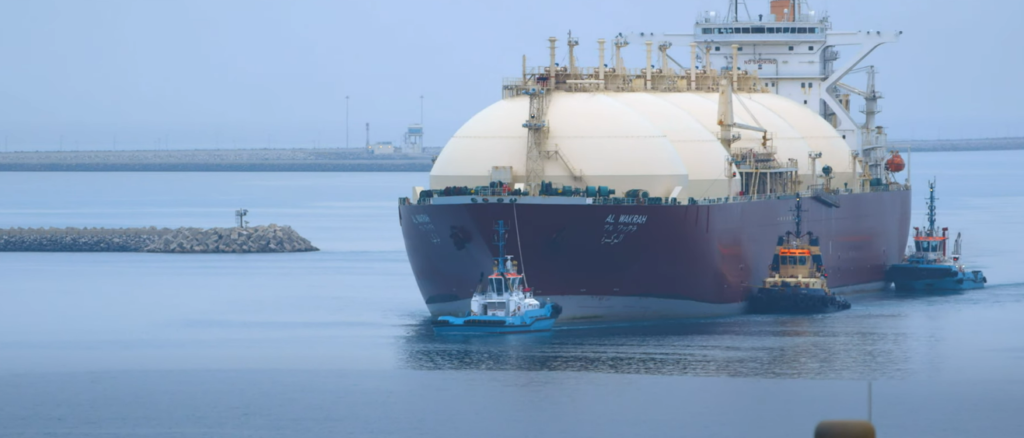
As Asian buyers started making aggressive bids for different cargoes, brokers in Rotterdam’s gas trading offices reportedly answered calls well into the evening and recalculated positions. A global chessboard is LNG. Japan, South Korea, and China compete with Europe for shipments from the United States and Australia once Qatar leaves the board. Each cargo diversion tightens the system as a whole.
An additional layer is added by the Strait of Hormuz. Approximately 20% of the world’s LNG trade passes through that confined waterway. Shipping delays and insurance premium increases are even caused by closure rumors. Idling offshore tankers are more than just aesthetically pleasing; they symbolize supply that might not arrive at regasification terminals on schedule.
In response, U.S. natural gas futures, which are traded using the Henry Hub benchmark, saw modest increases. With a daily average of more than 110 billion cubic feet, domestic production is still robust. Parts of the U.S. are expected to see warmer temperatures, which is reducing the demand for heating. However, the situation is complicated by export dynamics.
U.S. exporters are strongly encouraged to ship as much cargo as possible overseas when European TTF prices rise above €40 per megawatt-hour. In a stressed system, the Gulf Coast’s Sabine Pass, Freeport, and Cameron facilities act as pressure valves. Higher export pull pushes Henry Hub higher by tightening domestic balances.
It’s difficult to ignore how connected everything seems. The surge in LNG futures in Amsterdam causes German industrial companies to abruptly reevaluate their cost estimates. French chemical plants review their hedging tactics. Utilities in Asia balance exposure to the spot market with long-term contracts.
Additionally, a psychological memory is involved. The energy crisis of 2022, when prices skyrocketed and factories reduced production, is still remembered throughout Europe. That crisis peak is far away from the current levels. Nevertheless, it is unsettling to see prices jump 40% in a single session.
Investors appear to be split. Some claim that production will resume and tanker traffic will return to normal, indicating that this disruption is temporary. Others believe that if geopolitical tensions continue, the risk premium might endure. Whether the market is underestimating the outage’s duration is still unknown.
The stock markets responded swiftly. Energy stocks increased. Wider indices fluctuated. Assets in safe havens grew. Unlike crude oil, LNG futures are specialized, but when volatility increases, they can have a knock-on effect.
There are conflicting technical signals. Longer-term charts continue to be softer, but short-term indicators for U.S. natural gas show strength. Uncertainty is reflected in that contrast. The spike is being purchased by momentum traders. Given how swiftly gas prices fell following prior spikes, longer-term investors seem cautious.
As we watch this develop, it seems like LNG has unwittingly emerged as one of the world’s most geopolitically sensitive commodities. Although oil makes headlines, liquefied gas is now used to heat homes and power Europe’s grids. Its interruption seems instantaneous.
In some areas of the EU, storage levels below 31% are uncomfortable but not disastrous. If prices stay high, the cost of replenishing reserves during the spring and summer will probably be higher. Debates about subsidies may be revisited by governments. Already struggling with inflation, central banks will be keeping a close eye on things.
Probabilities, not certainties, are traded on energy markets. The likelihood of a protracted disruption has gone up. A portion of the price change is justified by that alone. It is debatable whether it warrants all of it.
LNG futures have increased, somewhat decreased, and are still unstable. It is recalculating among traders. Policymakers are evaluating. The effects might soon be felt by consumers. Expectations are changing, and the market is reacting in real time to events taking place thousands of miles away from its screens, but there isn’t yet a definitive solution.
Disclaimer
Nothing published on Creative Learning Guild — including news articles, legal news, lawsuit summaries, settlement guides, legal analysis, financial commentary, expert opinion, educational content, or any other material — constitutes legal advice, financial advice, investment advice, or professional counsel of any kind. All content on this website is provided strictly for informational, educational, and news reporting purposes only. Consult your legal or financial advisor before taking any step.
